

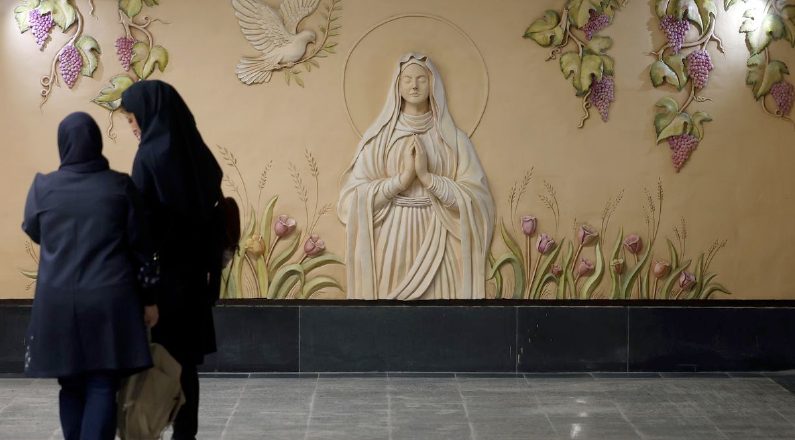
(ZENIT News / Rome, November 6, 2025) – A new metro station has been dedicated to the Holy Virgin Mary in Tehran’s sixth district, near the Cathedral of Saint Sergius, reflecting the religious diversity in Iran despite the Islamic regime and its Muslim majority.
Christians make up less than 1% of Iran’s population, a country of 92 million inhabitants. Christians are officially recognized by the Constitution and are permitted to practice their faith, although proselytizing is prohibited. They are primarily Armenian and Assyrian Christian communities that have lived in the region for thousands of years and maintain churches, schools, and cultural institutions.
The Armenian and Assyrian communities valued the official recognition of their faith with this sign at the metro station near the Cathedral, built between 1964 and 1970 by the Brotherhood of Saint Sergius, which is the heart of Armenian Christianity in Tehran. It was restored in 2006.
The Shia Muslim tradition venerates Mary (Maryam) as a Saint and the Mother of the Prophet Isa (Jesus), facilitating the presence of her name in a public space without controversy. It is noteworthy that the radical Shia government shows respect for the followers of other Abrahamic religions. Iranian media highlighted the inauguration of the station with a name of high Christian significance, as a gesture of respect for the country’s religious and cultural diversity. Beyond the symbols, Iranian Christians live in fear due to surveillance and occasional persecution in Iran. Iranian Christianity arose within the context of Persian Zoroastrianism and grew from the 2nd century onwards. According to tradition, the Church of Persia was founded by the Apostle Thomas.
The wars with Rome, the Greeks, and Byzantines with the Sassanids displaced Christian populations into the interior of Persia, where they founded communities. They were persecuted, although they affirmed their independence from Rome and aligned themselves with Nestorianism and Monophysitism. Theological differences marked loyalty to Persian power versus the Christian Empire of the Romans.
Iranian Christianity, primarily Armenian and Assyrian, possesses a strong linguistic and cultural identity. It comprises 200,000 faithful concentrated in the large cities of Tehran and Isfahan. The Armenians form the largest Christian community in Iran, having arrived in the 17th century with Shah Abbas I, contributing to the economic and cultural prosperity of the Persian kingdom. Armenian artisans and merchants in Isfahan created the first Persian printing press in 1645 and fostered the opening of Persia to the West.
Under the monarchy of Reza Pahlavi (1941-1979), Armenians experienced greater freedom. The Islamic Revolution of 1979 disrupted this balance, and 50,000 Armenians emigrated. Today, there are between 150,000 and 200,000 Armenians, although the community is aging and becoming impoverished.
The second largest Christian community is the Assyrian-Chaldean, linked to the Oriental Apostolic Church, estimated at between 15,000 and 20,000 members. Small groups of Catholics, Anglicans, and Protestants have recently joined.
The 1979 Iranian Constitution officially recognizes Christians as «people of the Book» and grants them freedom of worship within the limits of the law. They are granted seats in Parliament: two for Armenians and one for Assyrian-Chaldeans. This recognition is somewhat theoretical: as Christians are excluded from most administrative, military, and university positions.
The wearing of the hijab by women, the prohibition of alcohol, and the monitoring of religious activities applies to everyone, regardless of their faith. Since the Revolution, Christian schools have lost autonomy: their programs must be approved by the government, Persian is imposed as the language of instruction, and the presence of Muslim students is obligatory.
This context is fragile, and the situation of Christians converted to Islam is deeply alarming. According to a report published on January 20, 2025, by Open Doors, Christian Solidarity Worldwide, and Middle East Concern, 96 Christians were convicted in 2024, four times more than in 2023. These convictions are compounded by measures such as forced exile, large fines, or severe restrictions on fundamental civil rights.
Despite the repression, the churches of Tehran and Isfahan are full during liturgical feasts. The silent fervour of the faithful discreetly gathers them together, bearing witness to a living Church, wounded but not defeated. Like the station of the Blessed Virgin Mary, Iranian Christianity lives in the Persian land, discreet and persecuted, it is indestructible; its very survival in a hostile environment is a miracle of fidelity.

Publicaciones relacionadas:
 The Mexican Camino de Santiago or Camino de Guadalupe, Reaches Half the Goal in Record Time: 12 Squares and 50 Kilometers
 Miracle at Lourdes: Church gives official recognition to miracle number 71 in the history of the sanctuary
 The 7th shrine dedicated to Mary, mother of persecuted Christians, will open in Iraq
 The Tallest Image of Our Lady of Fatima Was Inaugurated in Brazil’s Most Catholic City.
