

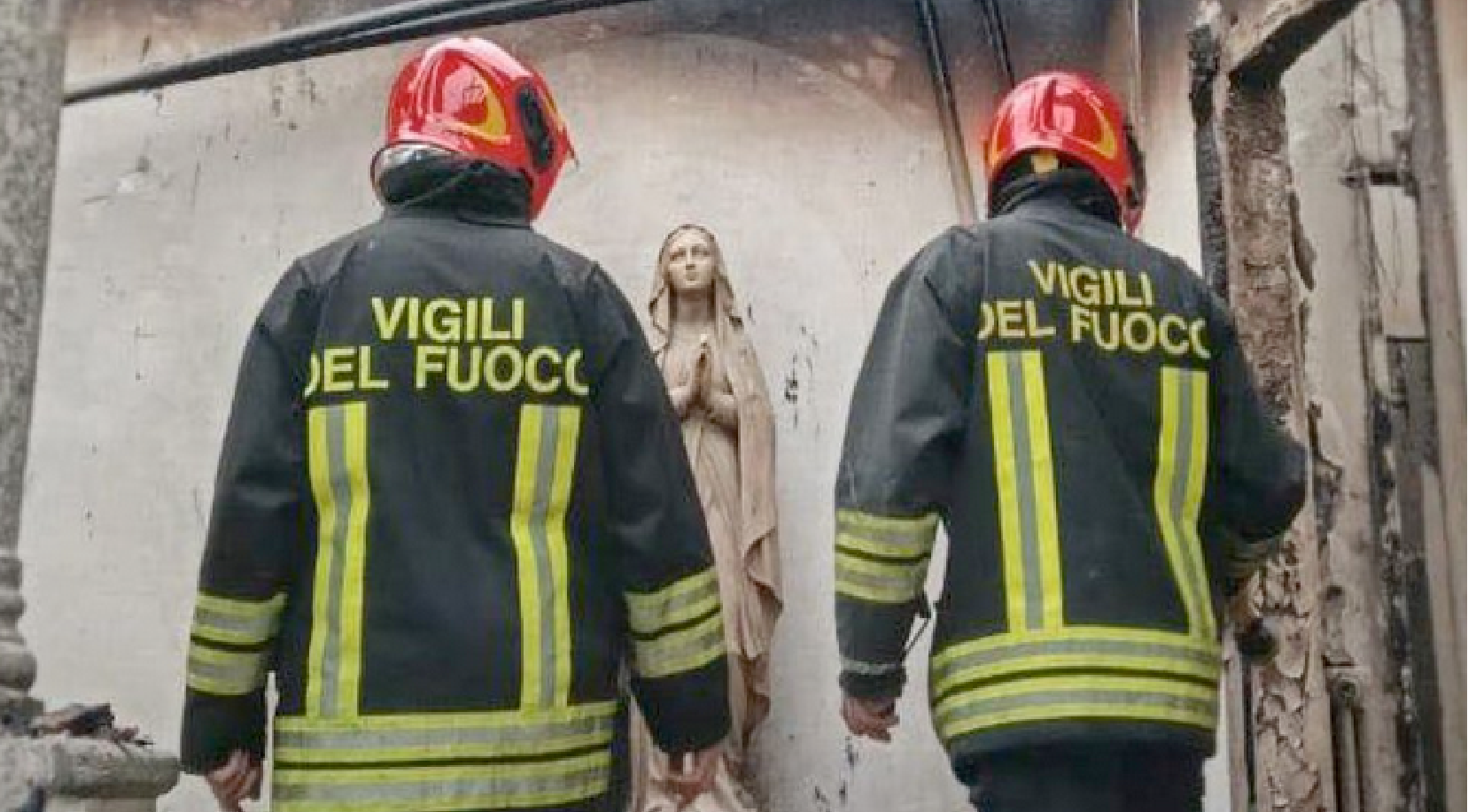
(ZENIT News / Milan, 10.14.2025).- Flames tore through the quiet hills of northern Italy on the night of October 11, consuming centuries of prayer, art, and silence. The Monastery of Bernaga, a 17th-century convent in La Valletta Brianza near Milan, was reduced to charred stone and ashes in just a few hours. Twenty-two cloistered nuns fled into the night, guided only by emergency lights and the instinct to protect the life of prayer that had defined their existence.
Founded in 1628, Bernaga was more than an architectural landmark. For generations it had been a living fragment of Catholic heritage, a space where time seemed to slow to the rhythm of the bell. It also carried a special resonance for the faithful worldwide: it was there that Carlo Acutis—the young computer-savvy saint canonized in September by Pope Leo XIV—received his First Communion. The small chapel where the boy once knelt beside his mother is now a blackened ruin, the candles melted into the floor.
The Italian fire responded to a blaze at a hillside village in Lombardy that broke out on the roof of the Monastery of Bernaga in La Valletta Brianza pic.twitter.com/RnX8LLnmlm
— Reuters (@Reuters) October 12, 2025
According to preliminary investigations, the blaze may have been caused by an electrical short circuit in one of the sisters’ rooms. At the moment the alarm sounded, the community was gathered in the common hall listening to the Pope’s prayer for peace. Their evacuation was swift and orderly, thanks to the intervention of nine fire brigades from Lecco, Monza Brianza, and Como. No one was injured, though the damage to the monastery’s heritage is described as “irreparable.”
Mayor Marco Panzeri called it “a catastrophe beyond measure—a wound to our memory and our soul.” Firefighters battled the flames through the night, using ladder trucks and water tankers, but the ancient wing that held religious icons, manuscripts, and paintings could not be saved.
Ver esta publicación en Instagram
As daylight revealed the extent of the destruction, the local church bells tolled—not in mourning, but in prayer. The Diocese of Milan has already pledged to help rebuild the monastery, which the nuns insist will rise again. “Where fire brought destruction, faith will bring renewal,” said the parish priest during Sunday Mass, echoing the resilience of a community unwilling to let the sacred site fade into history.
For the faithful who see in Carlo Acutis a symbol of youthful holiness and digital evangelization, Bernaga’s tragedy carries a deeper meaning. The place that nurtured a saint’s first encounter with the Eucharist now calls for a new beginning—one shaped by the same trust in divine providence that Acutis once embodied.
Thank you for reading our content. If you would like to receive ZENIT’s daily e-mail news, you can subscribe for free through this link.

Publicaciones relacionadas:
 Almost Half a Million Catholics of India Are Putting Themselves in Imminent Schism for
 This Is the Vocational Decline in Europe in 2023
 Gays in Seminaries? In Regard to Homosexuals and the Priesthood, the Norms Have Not Changed at All
 Pope Francis yes, Church no: survey reveals that the Pope is the most trusted person in Italy
