

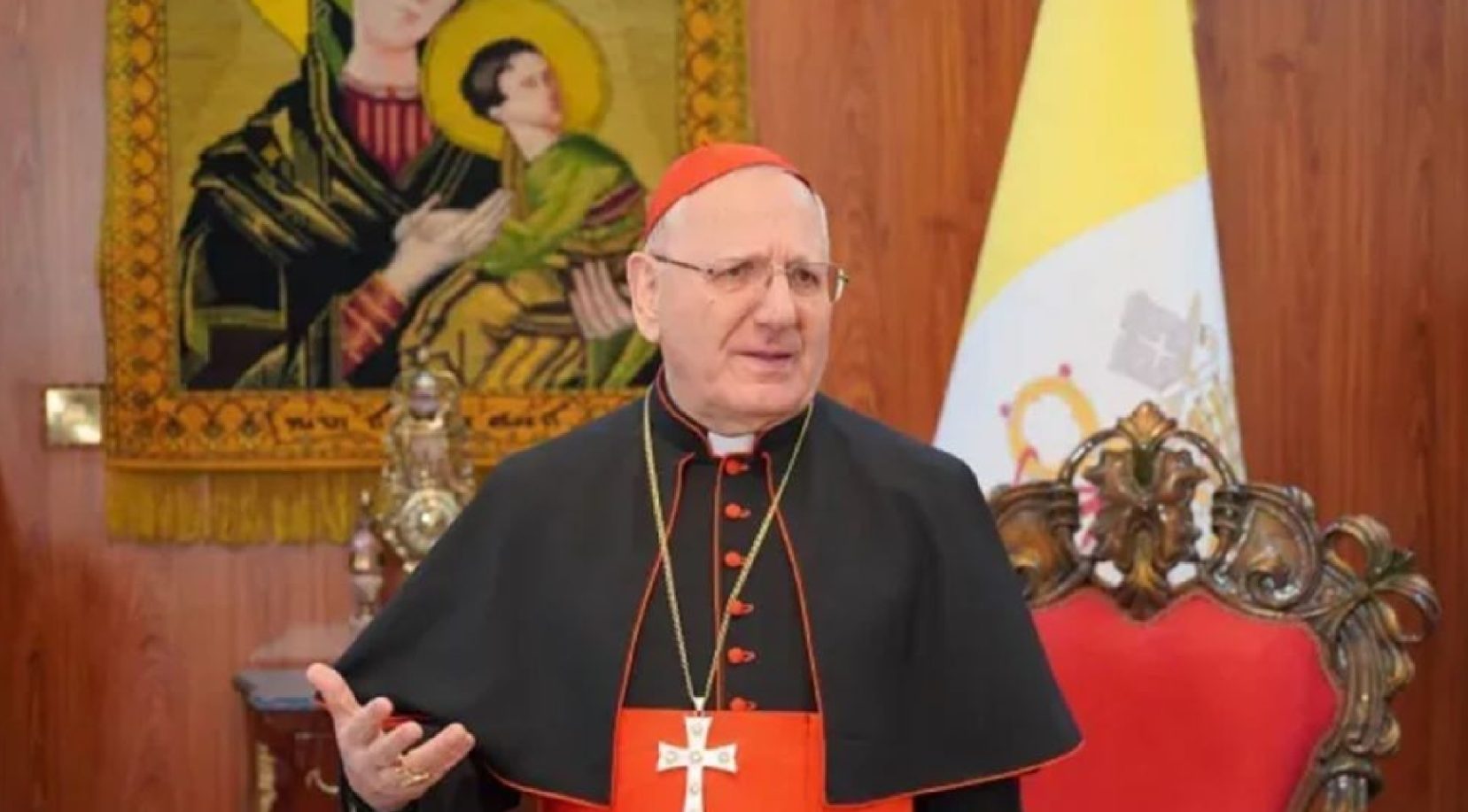
(ZENIT News / Rome, 01.28.2026).- Cardinal Louis Raphaël Sako is a leading figure in the Eastern Catholic Church. He has been the Chaldean Patriarch of Babylon since 2013 and resides in Baghdad, Iraq. Having participated on January 7-8, 2016, in the first Extraordinary Consistory of Pope Leo XIV in Rome, he shares his reactions with ZENIT and speaks about his Chaldean Church in Iraq: a resilient Church, strong in faith despite the suffering, lack of freedom, and exile of many Christians.
* * *
ZENIT: How did you experience the Extraordinary Consistory in which you participated at the beginning of January?
Cardinal Louis Raphaël Sako: I had already attended seven Ordinary Consistories, which were quite formal, as we participate in the promotion of Cardinals. This time, however, it was an Extraordinary Consistory, a true Synod. We addressed four themes proposed by the Pope: the joy of the Gospel, synodality, preaching and liturgy.
These four themes are interconnected, as they focus on evangelization or the mission of the Church. In a world that has changed so much, how do we preach the Gospel and celebrate the presence of Christ? How and with what language do we express our faith to those who await a true witness? This Consistory was a wonderful experience of collegiality for me. I spoke to emphasize that the Church is always synodal, since it is composed of the assembly, the clergy, but also all the faithful, that is, the People of God. However, only the clergy attended the Consistory. I believe this is a deficiency, since today many lay people have studied theology, liturgy, or pastoral care. Why not take advantage of their experience?
ZENIT: What conclusions do you draw from this meeting of Cardinals for your own Church in Iraq?
Cardinal Sako: No decisions were made among the Cardinals, only discussions took place, as there will be another Consistory in June. The Cardinals come from both East and West. Our exchanges were very fruitful, despite the significant differences in cultures, mentalities, and languages. We cannot adopt a single model for everyone; we must take into account diversity, our different origins, our cultures, and our sensibilities. We shared together in small groups.
Personally, I emphasized solidarity and the importance of Christians maintaining their inner freedom. I said that we must support our Eastern European countries because, despite the difficulties we face, we have a vocation there: to bear witness to our faith. We are the roots of Christianity; we must not be forgotten. And I also gave a small testimony. While I was delivering truckloads of food and blankets to a Muslim camp, the Imam came to greet me and said, «I know that your God is love.» So, what more can I say? I consider the Western Church to be rather timid. It is very relational, but afraid to confront the secular regime. In Iraq, on the other hand, the Muslim majority constantly challenges us. We don’t have much freedom at home; however, we have a lot of dynamism and solid relationships with Muslims.
ZENIT: Isn’t this «little bit of freedom» precisely what is also a driving force and what strengthens the faith in your country, where Christians are a minority?
Cardinal Sako: That’s right. Among Christians, we are very dynamic and very free. A minority is always dynamic. We carry out many activities and also engage in dialogue with other religions. Thanks to our presence in this country, I can say that there is no longer as much hate speech against Christians. Muslims often tell us: «You are the salt of the earth!» We must be aware of this. I gave a sermon on Christmas Eve and spoke briefly about the situation, but some Muslim leaders and politicians misunderstood me and criticized me. Afterward, I explained myself, and the entire population defended me. Even an Imam told me: «I offer you my home. My children and I are ready to protect you.» An Imam! [said this]
ZENIT: You had to spend nine months in Iraqi Kurdistan, where you were temporarily separated from your people. How did you experience this time of exile?
Cardinal Sako: I refused to give in to the pressure from the Iraqi President, who wanted me to resign. In response, I went to Kurdistan. From there, I continued to lead the Chaldean Church in my country. It was very painful. But in pain, there is hope, faith. There is also strength. And when I returned to Iraq, there was a great celebration in Baghdad. Even the Prime Minister’s representative came to the airport to welcome me. So no, we must not give in to evil; that is the strength of Christianity.
But this time was also a period of maturation for me: I was able to reflect, pray, and write. I wrote many articles, and even a small book about Islam that introduces this religion to Christians and Muslims: 1,500 copies were given away to Muslims!
ZENIT: Many Iraqis have fled to try to build a better life in the West. What do you say to the Christians in your country to encourage them to stay?
Cardinal Sako: I speak to them first of hope and tell them that the future will be better. So we must prepare for that future. Then I tell them that we Christians have a vocation in Iraq. It is not by chance that we are here; there is a divine plan for us. We were sent to the Muslim world to bear witness to our faith; we are all missionaries. Our future is in Iraq, not in the diaspora. We must strengthen this Christian community, support it, and encourage it. We must also help it, in its suffering, to give true witness to its faith. Our presence has immense power!
As a Patriarchate, we have become a point of reference, a religious authority alongside the Shiite and Sunni authorities. Yes, we Iraqi Christians are not a foreign community in Iraq. This is our land. We were the vast majority in this land before the arrival of the Muslim fighters in the 7th century. We welcomed them and contributed enormously to their development. Today we insist on full citizenship in Iraq: we want to be equal before the law and justice, and no longer have to declare our religion on official documents. This will give us much more freedom, because faith is a free relationship with God, but also with others.
ZENIT: Finally, what is the greatest challenge for Christians in Iraq today?
Cardinal Sako: I would say it stems from the lack of stability in our country. Security is fundamental for everyone, and it is difficult to live in anarchy, violence, and fear. That is why in Iraq we always strive to live in peace, given the persecution we have suffered throughout history, we are deeply influenced by the desire for peace and we pray for it frequently. We often say to each other, «Salam aleikum,» which means, «Peace be with you.» There are people who want to leave because their family is divided. We respect them and always tell them, «It is your decision, not the Church’s.» But we must protect those who stay. They come to us even for small things because the Church is part of their lives. And we are servants, not princes! That is why I am always rooted in my home. That is where I love to be.
As Eastern Christians, we can contribute much to the Western Church, but we can also learn from its methodology, its theology, and all its advancements. There is a complementarity. Let us think, then, of solidarity: we are one body, we are in communion. Wherever members suffer, we must encourage and help them.

Publicaciones relacionadas:
 Bishop Who Visited the Pope in Hospital Talks About the Pope and the Church’s Prayer of Intercession for Him
 How Did Cardinal Prevost React To Being Elected and What Did He Feel About Being a «Papabili»? Cardinal Tagle Responds
 How Is the Jubilee Going and What Impressions Do Those Who Organized It Have? ZENIT’s Interview with Monsignor Rino Fisichella
 ZENIT’s Interview with Cardinal François Bustillo: «Being A Cardinal Is Above All A Responsibility of Communion»
