


(ZENIT News / Washington, 07.22.2026).- For J. D. Vance, the central question is not whether Christianity belongs in public life, but what happens when a society tries to live as though it does not need a faith capable of judging its ambitions.
That conviction ran through a wide-ranging conversation between the vice president of the United States and Bishop Robert Barron, touching on Saint Augustine, René Girard, the economy, immigration, artificial intelligence, the legacy of Pope Francis, the expectations surrounding Pope Leo XIV and Vance’s own conversion to Catholicism. Beneath the many subjects, however, lay one consistent argument: if Jesus Christ is truly the Son of God, then Christianity cannot be confined to private worship or personal morality.
Vance’s political career has made him one of the most prominent Catholic voices in American public life. His interpretation of the faith, however, is not simply a collection of political positions borrowed from Catholic language. He presents Catholicism as an intellectual framework through which he examines economics, culture, technology and the exercise of political power.
His intellectual journey began, in part, with Saint Augustine. As a young man, Vance said, he had absorbed the assumption that religion belonged to the realm of irrationality and that serious intellectual answers were to be found elsewhere. Augustine’s City of God challenged that assumption. The book convinced him that he was confronting a mind of extraordinary power and forced him to reconsider the supposed opposition between reason and faith.
The Augustinian insight that every society ultimately worships something became one of the central themes of the conversation. Even societies that describe themselves as entirely secular, Vance argued, possess an implicit theology. Money, status, power and success can become idols when they are treated as ultimate realities.
He acknowledged that he had once been caught in precisely that logic. During his years at Yale, he said, he became increasingly preoccupied with the markers of achievement: academic credentials, professional prestige and social recognition. He described himself bluntly as having «worshiped success.» The problem, he suggested, is not ambition itself, but the moment when the desire for recognition becomes the measure of a person’s worth.
That theme led naturally to René Girard and his theory of mimetic desire, which Vance discovered through Peter Thiel. People often desire what they see others desiring, creating rivalry that can eventually become hostility. Social media, Vance and Barron argued, has accelerated this mechanism on an unprecedented scale, turning digital platforms into environments where imitation quickly becomes competition, accusation and public humiliation.
For Vance, this is more than a theory of social behavior. It is a way of understanding a culture increasingly organized around comparison and resentment.
The same theological framework informs his view of economics. Vance cited the Catholic social tradition, particularly Pope Leo XIII’s Rerum Novarum, as an important influence on his political thinking. He described the encyclical as offering an alternative to both Marxist class conflict and an individualism that treats economic life as a realm without obligations beyond personal gain.
The Catholic approach, as presented in the conversation, is more demanding precisely because it refuses to fit comfortably into conventional political categories. It defends property while insisting that the goods of creation possess a universal purpose. It recognizes legitimate differences between workers and owners while rejecting the idea that permanent conflict is the only possible relationship between them.
The principle also challenges the tendency to treat economic growth as the supreme measure of public policy.
Vance offered abortion as an example of what happens when economic calculations become detached from human dignity. If abortion is defended primarily because it allows more women to participate in the labor market, he argued, then the economy has become an idol. Economic activity exists to serve the human person, not the reverse.
That argument reflects a broader pro-life principle: human beings must never be reduced to their usefulness to production, consumption or national economic performance.
Immigration provided a more immediate test of the relationship between Catholic moral teaching and political decision-making. Vance acknowledged that Catholic teaching requires migrants to be treated with dignity while also arguing that nations have legitimate responsibilities to protect their borders and maintain public order. The difficult question, he suggested, is not whether moral principles matter, but how they should be applied amid complex political circumstances.
That distinction also shaped his comments about Pope Leo XIV.
Vance rejected the assumption that every criticism of the Trump administration by the Pope represented hostility toward the administration itself. A Pope, he argued, may simply be carrying out his responsibility to offer moral teaching. Political leaders, in turn, must take that teaching seriously and determine how it should inform concrete policy.
The position is significant because Leo XIV has been critical of aspects of American immigration policy, including arguments previously advanced by Vance himself concerning the ordering of obligations toward citizens and migrants.
Rather than presenting disagreement as evidence of political animosity, Vance suggested that the proper response is reflection.
His comments about Pope Francis followed a similar pattern, although his praise may be interpreted differently by Catholics who believed that some of Francis’s provocative formulations created unnecessary confusion. Vance said he valued the former Pope’s ability to provoke discussion, even when particular statements made him stop and ask whether they were coherent or correct.
For Vance, Francis was exceptionally effective at forcing conversations that might otherwise never have occurred.
The question now is whether Leo XIV will provide a different kind of Catholic public voice. Vance described the new Pope as exceptionally intelligent, deeply holy and uniquely familiar with American culture, expressing hope that his pontificate will help the Church engage contemporary society with greater clarity.
Barron and Vance also shared concern that parts of the Western Church have become hesitant to speak confidently in public. Their argument was not for a Church that becomes an instrument of partisan politics, but for one willing to articulate moral truths without allowing fear of controversy to silence it.
That distinction is essential. Catholic engagement in public life cannot mean reducing the Gospel to a political platform. Nor can religious freedom mean that believers are permitted to worship privately while being expected to abandon their convictions when they enter the public square.
The conversation reached into the future through a discussion of artificial intelligence. Vance warned that the technology raises questions extending far beyond employment and economic productivity. Artificial intelligence may reshape human relationships, particularly among young people, and could deepen isolation if digital interaction increasingly replaces genuine human community.
Here, he argued, the Church has a contribution to make. Its accumulated reflection on the human person, human dignity and the nature of community can offer criteria for judging a technological revolution that risks advancing faster than society’s moral vocabulary.
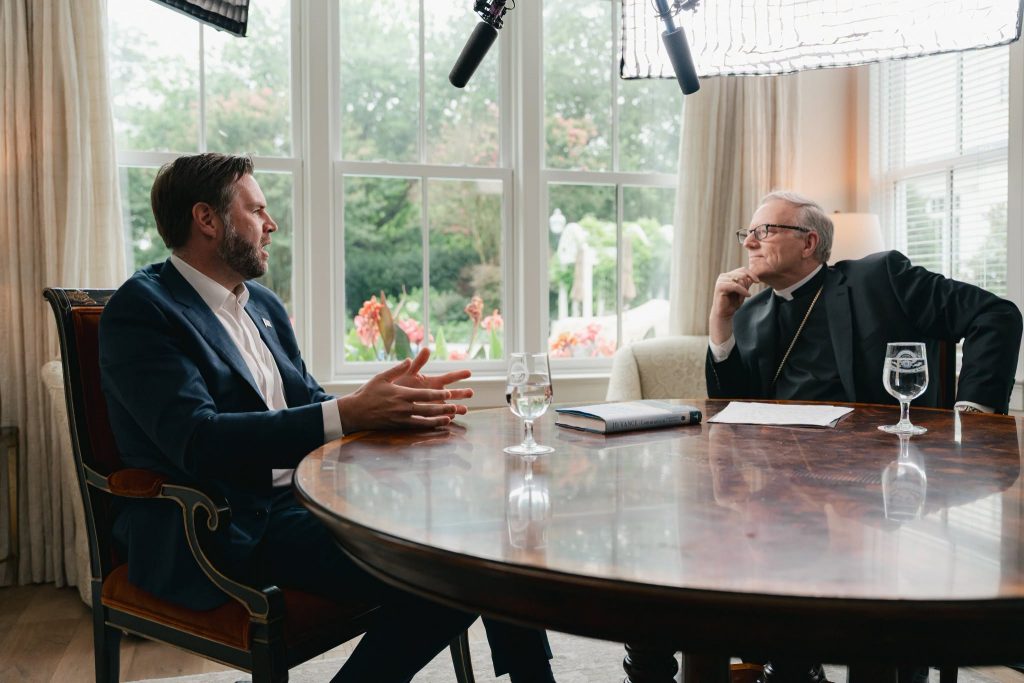
The interview ended with a more intimate subject: prayer. Vance acknowledged that returning to faith after years of atheism meant learning how to pray again. He described trying to pray a decade of the Rosary in the morning and another at night, while also praying with his children when family and professional responsibilities permit.
His advice to those returning to faith was uncomplicated: perfection is not a prerequisite for beginning.
That personal note perhaps offered the clearest key to the entire conversation. Vance’s Catholicism is presented not merely as a political identity or intellectual influence, but as a discipline that demands conversion, self-examination and perseverance.
His growing prominence has nevertheless generated tensions among pro-life Catholics, particularly because of his support for the Trump administration’s comparatively permissive position on abortion medication. That tension illustrates the broader challenge facing any politician who claims that Catholic faith should illuminate every area of public life: the Church’s teaching does not always fit neatly into partisan alliances, and no political figure can simply claim the Catholic tradition without also being judged by its demands.
For Vance, the ultimate challenge may therefore be the same one he attributes to modern society: refusing to turn politics, success, economics or national power into idols.
A Catholic presence in public life will be meaningful only if it retains the freedom to challenge its own allies as well as its opponents. The Church can serve democracy not by becoming another political faction, but by reminding political power that it is never ultimate.
That may be the deepest point shared by Vance and Barron: a society does not become truly secular simply by removing religious language. It merely risks replacing one object of worship with another.
Thank you for reading our content. If you would like to receive ZENIT’s daily e-mail news, you can subscribe for free through this link.

Publicaciones relacionadas:
 Cardinal Dolan takes insurer to court for non-compliance in sexual abuse cases
 Applauded by some, criticized by others: this is Cardinal Schönborn’s new successor at the helm of the prestigious episcopal see of Vienna
 Five years in El Salvador and disciple of Cardinal Cupich: this is the new archbishop of New York
 At 76 Years Old, This Is Cardinal Dolan’s New “Job”: New York Police Chaplain
