

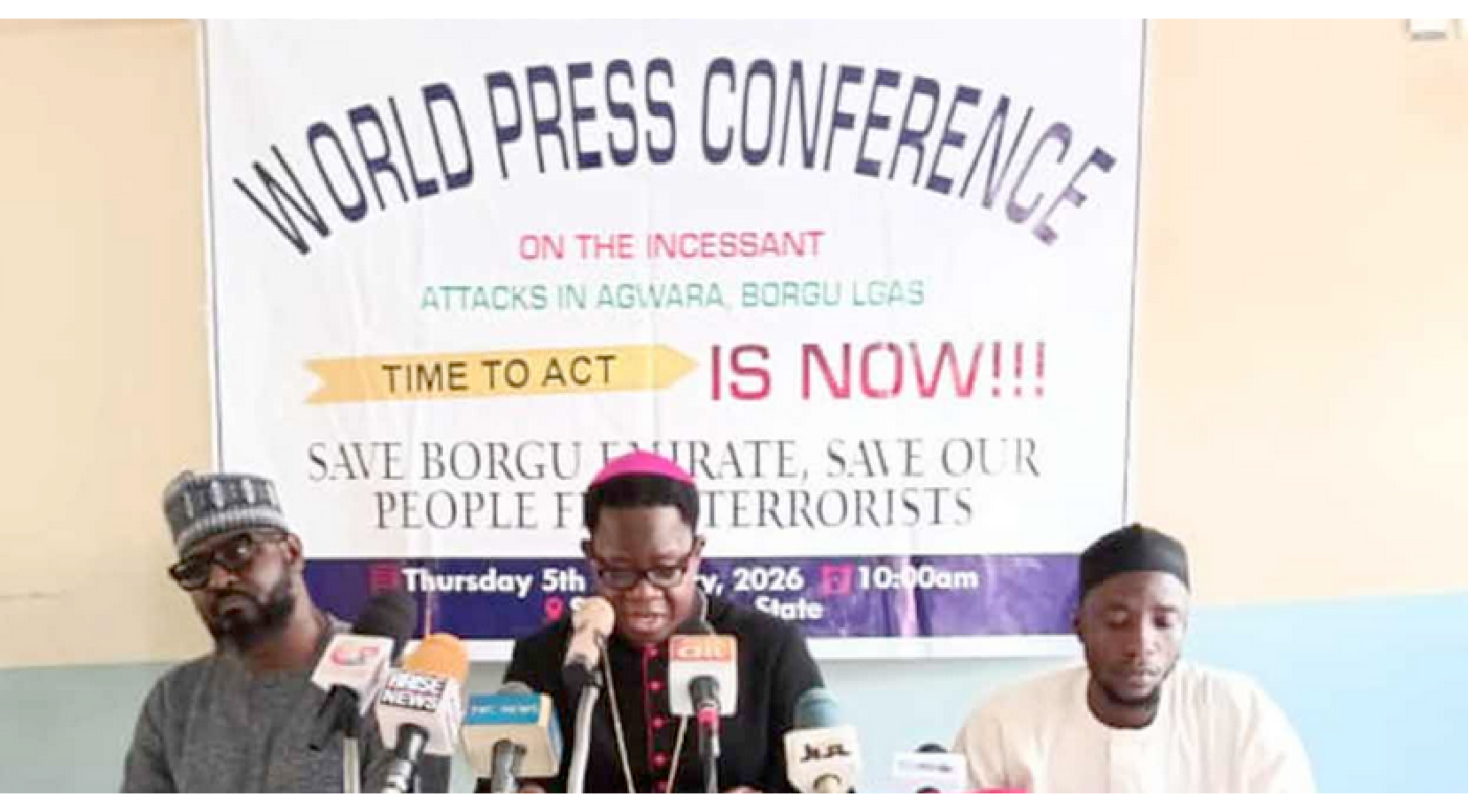
(ZENIT News / Rome, 02.12.2026).- In just three days at the start of the month’s first fortnight, at least 51 people were abducted and six killed in coordinated assaults on four villages in Kaduna State, Nigeria. The violence, concentrated in the predominantly Christian southern districts of the state, comes barely weeks after more than 180 people were kidnapped there in January—many of whom were only recently released.
The attacks have not spared religious leaders. In Kajuru Local Government Area, gunmen stormed the residence of Father Nathaniel Asuwaye, parish priest of Holy Trinity Church in Karku, during the night between Friday and Saturday, February 6. According to the Archdiocese of Kafanchan, which confirmed the incident, the raid left three people dead and ended with the priest taken captive alongside 10 others. In a nearby assault, three additional victims were killed and 38 people abducted, including a local imam and four members of his congregation.
Two more individuals were seized on the road to Maro, and homes were destroyed in further attacks in the same area, though the total toll there remains unclear. No group has claimed responsibility for the Kaduna operations.
These episodes are part of a broader surge of bloodshed that has swept across several northern and central states. Earlier in the week, at least 47 people were killed in violence spanning Katsina, Kwara and Benue states. Many of those victims died at the market in Abande, in the Mbaikyor district, where militias opened fire on traders and residents. Even more devastating was the massacre in Woro, in Kwara State, where more than 160 people—some reports place the number at 175—were slaughtered in what the Nigerian Red Cross described as the deadliest attack recorded this year in that border district with Niger State.
Press accounts indicate that the majority of those killed in Woro were Muslims targeted by jihadist militants after refusing to adopt an extremist interpretation of Islam. During the raid, armed groups burned homes and shops, leaving the village in ruins and compounding the humanitarian toll. Nigerian President Bola Tinubu condemned the assault as “brutal,” deployed an army battalion to Kwara, and attributed responsibility to Boko Haram. State authorities have spoken more broadly of “terrorist elements” and cells operating in the region.
The pattern is familiar yet increasingly complex. While Boko Haram remains active, particularly in the northeast, other armed actors—often labeled “bandits” by authorities—carry out kidnappings for ransom, cattle rustling and village raids across vast swaths of the northwest and Middle Belt. In many areas, criminality, jihadist ideology and local conflicts over land and resources intersect, blurring lines of attribution. The absence of immediate claims of responsibility in Kaduna underscores this ambiguity.
For the Catholic Church in Nigeria, the latest wave has triggered an unusually coordinated public response. On February 7, the Catholic Secretariat of Nigeria, the administrative arm of the bishops’ conference, issued a stark denunciation of what it called a “relentless wave of killings and kidnappings.” Citing the massacre of more than 160 civilians in Woro, the statement asked how such slaughter could occur outside the context of declared war and warned that recurring atrocities amount to a betrayal of Nigerians’ right to live in peace.
The Secretariat demanded that the federal government redeploy security forces to areas where communities are effectively under siege, identify and prosecute sponsors and facilitators of terrorism regardless of status, and ensure that perpetrators are arrested and punished. It also called for urgent relief, psychosocial care and compensation for victims, alongside reconstruction of devastated communities.
Northern ecclesiastical provinces—including Kaduna, Abuja and Jos, encompassing more than 20 dioceses—have echoed those demands. In a joint appeal, they described farmland—once the backbone of rural subsistence—as increasingly perilous terrain. Persistent abductions, targeted killings and the occupation of agricultural communities, they said, have driven farmers from their land, intensifying hunger and poverty in a region already strained by displacement.
Individual bishops have added their voices. Bishop Bulus Yohanna of Kontagora, whose diocese covers part of Niger State, has urged the establishment of a fully equipped military base capable of pursuing and neutralizing armed groups. His plea follows the November 2025 kidnapping of 320 people from a Catholic school in Papiri. All the children and staff were eventually released, a development for which the bishop publicly thanked the authorities, but the episode remains emblematic of the scale of insecurity. In Kaduna State, the governor recently announced that 183 Christians abducted in three separate incidents over recent weeks had also been freed or rescued.
Clerical kidnappings continue to compound the sense of vulnerability. The joint statement from northern provinces referenced the ongoing captivity of Father Emanuel Ezema of Zaria Diocese, who was abducted with eight laypeople in an attack that killed at least three others. His case predates Father Asuwaye’s abduction and illustrates how priests have become both symbolic and practical targets in regions where religious identity and community leadership are tightly interwoven.
The crisis has reached Rome. During his weekly Angelus address, Pope Leo XIV expressed sorrow and concern over the recent attacks, offering prayers for victims and urging Nigerian authorities to act decisively to safeguard life. His intervention signals that the violence is not viewed as an isolated national problem but as a matter of international ecclesial and humanitarian significance.
Aid to the Church in Need, which has long designated Nigeria as a priority country, continues to support local dioceses, particularly in the north. The charity has appealed for sustained prayer and solidarity, emphasizing that beyond statistics—51 abducted here, 160 or more killed there—lies a society fraying under the cumulative weight of trauma.
Nigeria’s security challenge is often described as instability. Yet the scale and frequency of recent attacks suggest something more corrosive: a normalization of mass casualty events and routine abductions that erode public trust and communal coexistence. That priests and imams now appear side by side on lists of the kidnapped underscores a sobering reality. The violence is not confined to one creed or community. It is consuming the social fabric itself.
Whether the deployment of additional battalions and promises of renewed operations will reverse the tide remains uncertain. For now, in villages from Kajuru to Woro, the immediate concerns are more elemental: the safe return of the abducted, the burial of the dead, and the hope that fields once meant to sustain life might cease to be battlegrounds.
Thank you for reading our content. If you would like to receive ZENIT’s daily e-mail news, you can subscribe for free through this link.

Publicaciones relacionadas:
 Nicaraguan Dictatorship Expels More Nuns: This Time the Religious of the Cross
 Seven Legionaries of Christ and one consecrated woman charged: Chilean justice responds by closing investigation due to lack of evidence
 Muslim groups commit massacre of Christians in Congo: nearly 30 dead
 Syria: in 14 years, the Christian presence has fallen by 84%: these are the numbers
