

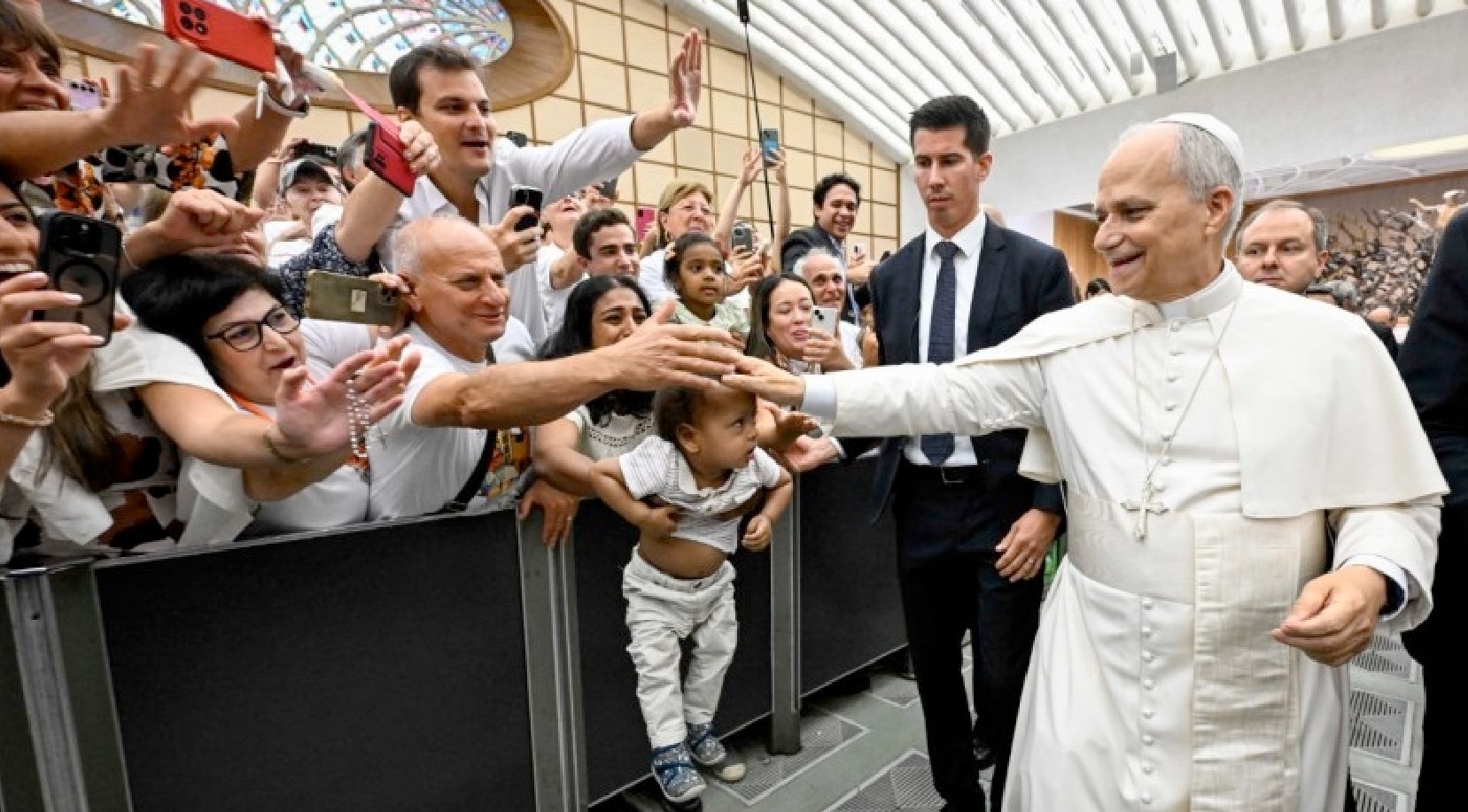
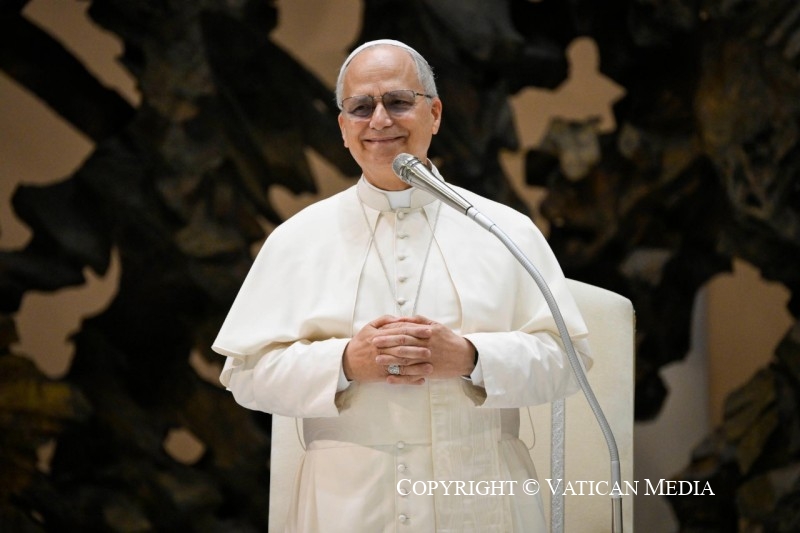
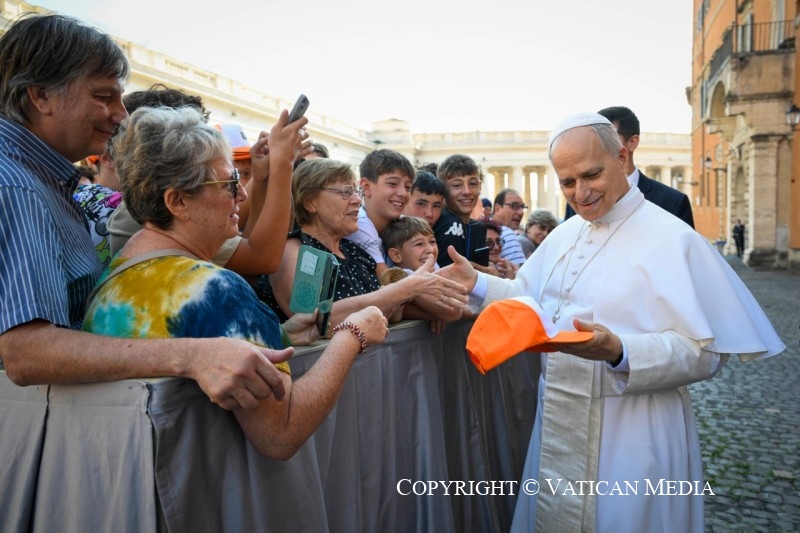
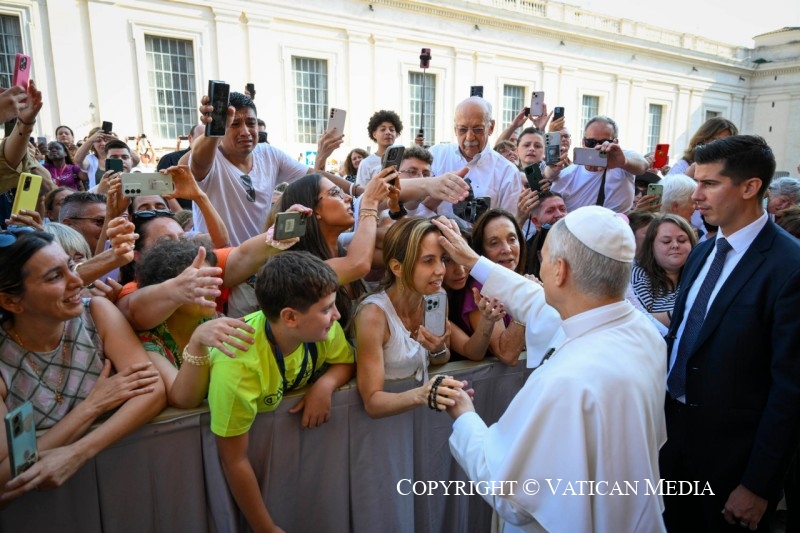
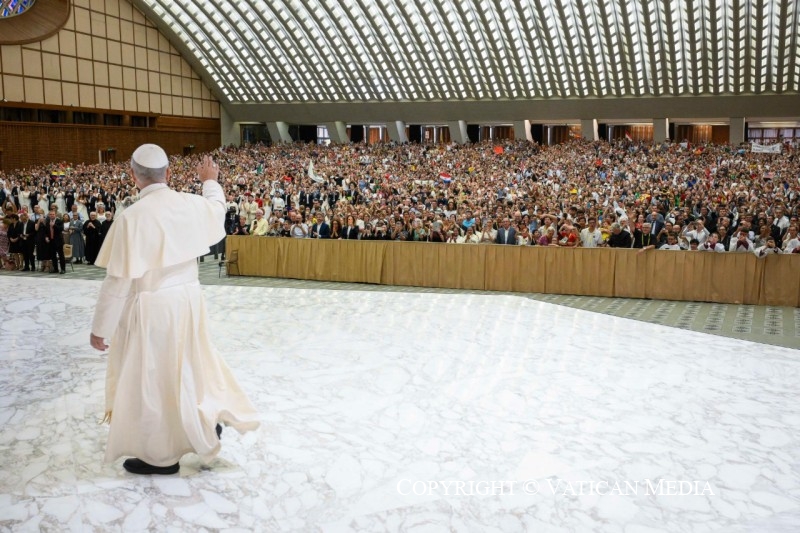
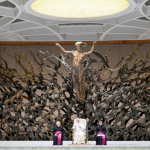
(ZENIT News / Vatican City, 27.08.2025) – The General Audience on Wednesday, August 27, presided over by the Holy Father Leo XIV, was held in Paul VI Hall in Vatican City, due to the high temperatures in Rome. However, many people who were unable to find a place in the hall gathered in the adjacent courtyard and in the Vatican Basilica, where the Pope went at the end of the audience to greet them. Below is the English translation of the Supreme Pontiff’s catechesis. For several weeks now, the Pope has been reflecting on the final hours of Jesus’ life.
* * *
Dear Brothers and Sisters,
Today we pause at a scene that marks the beginning of Jesus’ Passion: the moment of His arrest in the Garden of Olives. The evangelist John, with his usual depth, does not present us with a frightened Jesus, fleeing or hiding. On the contrary, he shows us a free man, who steps forward and speaks, courageously facing the hour in which the light of the greatest love can be revealed.
“Then Jesus, knowing all that was to befall Him, came forward and said to them: ‘Whom do you seek?’”(John 18:4), Jesus knows this. Yet He decides not to back down. He surrenders. Not out of weakness, but out of love. A love so full, so mature, that it does not fear rejection. Jesus is not captured: He allows Himself to be captured. He is not the victim of an arrest, but the author of a gift. This gesture embodies a hope of salvation for our humanity: knowing that, even in the darkest hour, we can remain free to love until the end.
When Jesus answers, «It is I,» the soldiers fall to the ground. This is a mysterious passage, since this expression, in biblical revelation, evokes the very name of God: «I am.» Jesus reveals that God’s presence is manifested precisely where humanity experiences injustice, fear, and loneliness. Precisely there, the true light is ready to shine without fear of being overwhelmed by the advance of darkness.
In the middle of the night, when everything seems to be crumbling, Jesus shows that Christian hope is not escape, but decision. This attitude is the fruit of a profound prayer in which He does not ask God to free us from suffering, but to give us the strength to persevere in love, aware that the life freely offered out of love cannot be taken away from us.
«If you seek me, let these men go» (John 18:8). At the moment of His arrest, Jesus is not concerned with saving Himself: He only wants His friends to go free. This shows that His sacrifice is a true act of love. Jesus allows Himself to be captured and imprisoned by the guards just so He can free His disciples.
Jesus lived every day of his life in preparation for this dramatic and sublime moment. Therefore, when it arrives, He has the strength not to seek an escape route. His heart knows well that losing one’s life for love is not a failure, but rather possesses a mysterious fruitfulness. Like the grain of wheat that, when it falls to the ground, does not remain alone, but dies and bears fruit.
Jesus, too, is troubled by a path that seems to lead only to death and the end. But He is equally convinced that only a life lost for love is ultimately found again. This is true hope: not in trying to avoid pain, but in believing that, even in the heart of the most unjust suffering, the seed of new life is hidden.
And us? How many times do we defend our lives, our projects, our certainties, without realizing that, in doing so, we leave ourselves alone. The logic of the Gospel is different: only what is given flourishes, only love that becomes free can restore confidence even when all seems lost.
The Gospel of Mark also speaks of a young man who, when Jesus is arrested, flees naked (Mark 14:51). It is an enigmatic but deeply evocative image. We too, in our attempt to follow Jesus, experience moments in which we are surprised and stripped of our certainties. These are the most difficult moments, when we are tempted to abandon the path of the Gospel because love seems an impossible journey. However, it will be a young man, at the end of the Gospel, who will announce the Resurrection to the women, no longer naked, but dressed in a white tunic.
This is the hope of our faith: our sins and our hesitations do not prevent God from forgiving us and restoring our desire to resume our following, to enable us to give our lives for others.
Dear brothers and sisters, let us also learn to surrender ourselves to the Father’s Will, allowing our lives to be a response to the good received. In life, it is not necessary to have everything under control. It is enough to choose each day to love freely. This is true hope: knowing that, even in the darkness of trial, God’s love sustains us and matures within us the fruit of eternal life.

Publicaciones relacionadas:
 The difference between illusions and preparations: a catechesis by Pope Leo XIV applied to the Eucharist
 The invisible saving action of Jesus: catechesis by Pope Leo XIV
 How does Jesus quench our thirst for fulfillment? The beautiful catechesis of Pope Leo XIV that you will identify with
 In what sense is the Bible the Word of God in human words? Pope Leo XIV responds
