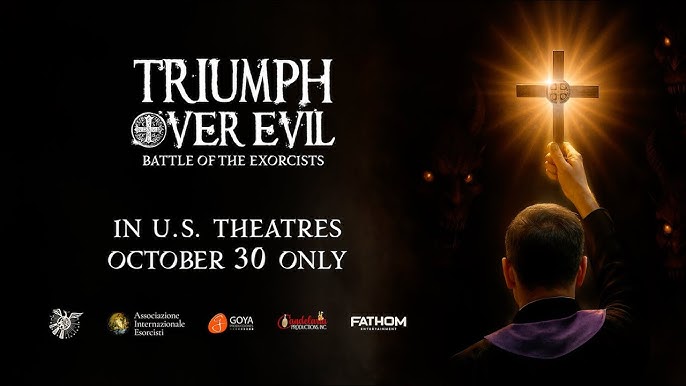
(ZENIT News / Washington, 11.08.2025).- When the documentary «Triumph Over Evil: Battle of the Exorcists» premiered in American theaters on October 31, 2025, many expected yet another Halloween spectacle—dark corridors, spinning heads, and sensational horror. What they found instead was something altogether different: a careful, almost contemplative exploration of one of the Church’s most misunderstood ministries.
Directed by Giovanni Ziberna, a former atheist who found faith in the Catholic Church, and produced by Valeria Baldan, the film stands apart in tone and intention from the legion of “exorcism movies” that have haunted popular culture for decades. Approved and officially supported by the Vatican-recognized International Association of Exorcists (IAE), it marks the first time that an inside look at the Catholic rite of exorcism has received the Church’s direct endorsement.
Its Italian version, «Libera Nos. Il trionfo sul male», released in 2022, had already attracted attention for its sober tone and spiritual insight. Now, the English-language adaptation introduces Western audiences to a world that is neither theatrical nor superstitious, but profoundly human and deeply spiritual.
Ziberna’s own conversion story serves as a quiet thread running through the film. He recalls that his first exposure to an exorcism came not as a believer but as a technical assistant. Expecting something eerie, he instead encountered what he calls “a great light.” That moment, he says, taught him that exorcism is not about fear—it is about freedom, not spectacle but salvation.
Rather than amplifying the drama of demonic possession, «Triumph Over Evil» focuses on the discernment that precedes every authentic exorcism. Viewers are guided through the meticulous process by which priests, doctors, and psychologists distinguish between psychological suffering, spiritual oppression, and genuine possession. Several psychiatrists appear in the film to underscore how the Church insists on clinical evaluation before the rite can even be considered.
Among those interviewed is the late Father Gabriele Amorth, the legendary Roman exorcist whose wisdom continues to shape the ministry he embodied. His voice, recorded before his death, resonates with simplicity: liberation begins with prayer, fasting, the sacraments, and a life rooted in grace. Monsignor Francesco Bamonte, current president of the IAE, expands on that theme, describing Mary’s maternal role in the defeat of evil. American exorcists, including Father Stephen Rossetti and Father Chris Alar, offer perspectives that bridge continents but share a common conviction—the battle is real, and it is spiritual.
One of the most revealing moments in the documentary comes from Father Benigno Palilla, who dismantles the Hollywood mythos that has defined the public imagination since «The Exorcist» (1973). “That horror atmosphere they try to create,” he says, “is not what we experience during an exorcism. There is suffering, yes, but it is a moment of joy because liberation is at hand.”
Father Paolo Morocutti, a psychologist and theologian at the Catholic University of Rome, brings further clarity. He reminds viewers that true exorcisms are never public. Cameras are not permitted, recordings are banned, and what unfolds in that sacred space is not a performance but an act of mercy—one soul’s struggle for peace.
Even as it contains cinematic elements, the film resists sensationalism. Its pacing is deliberate, its tone reverent. Rather than provoking fear, it invites reflection on a mystery that modern society too often ignores or ridicules: the reality of spiritual evil and the quiet heroism of those who confront it.
Ziberna and Baldan have made it clear that «Triumph Over Evil» is not intended for shock value but for truth-telling. They are open to bringing the film to any theater that requests it, including parish halls and diocesan centers—a decision that aligns perfectly with the spirit of the work itself.
In the end, the documentary’s power lies not in what it reveals about demons, but in what it says about the divine. It portrays the exorcist not as a warrior against darkness for his own glory, but as a servant standing in the light of a greater power—one who, in silence and prayer, participates in what Ziberna calls “the most mysterious and hopeful of human battles: the victory of grace over fear.”
Through its quiet realism, «Triumph Over Evil» accomplishes something rare in cinema about faith—it replaces fascination with reverence, and fear with the glimmer of redemption.
Thank you for reading our content. If you would like to receive ZENIT’s daily e-mail news, you can subscribe for free through this link.