

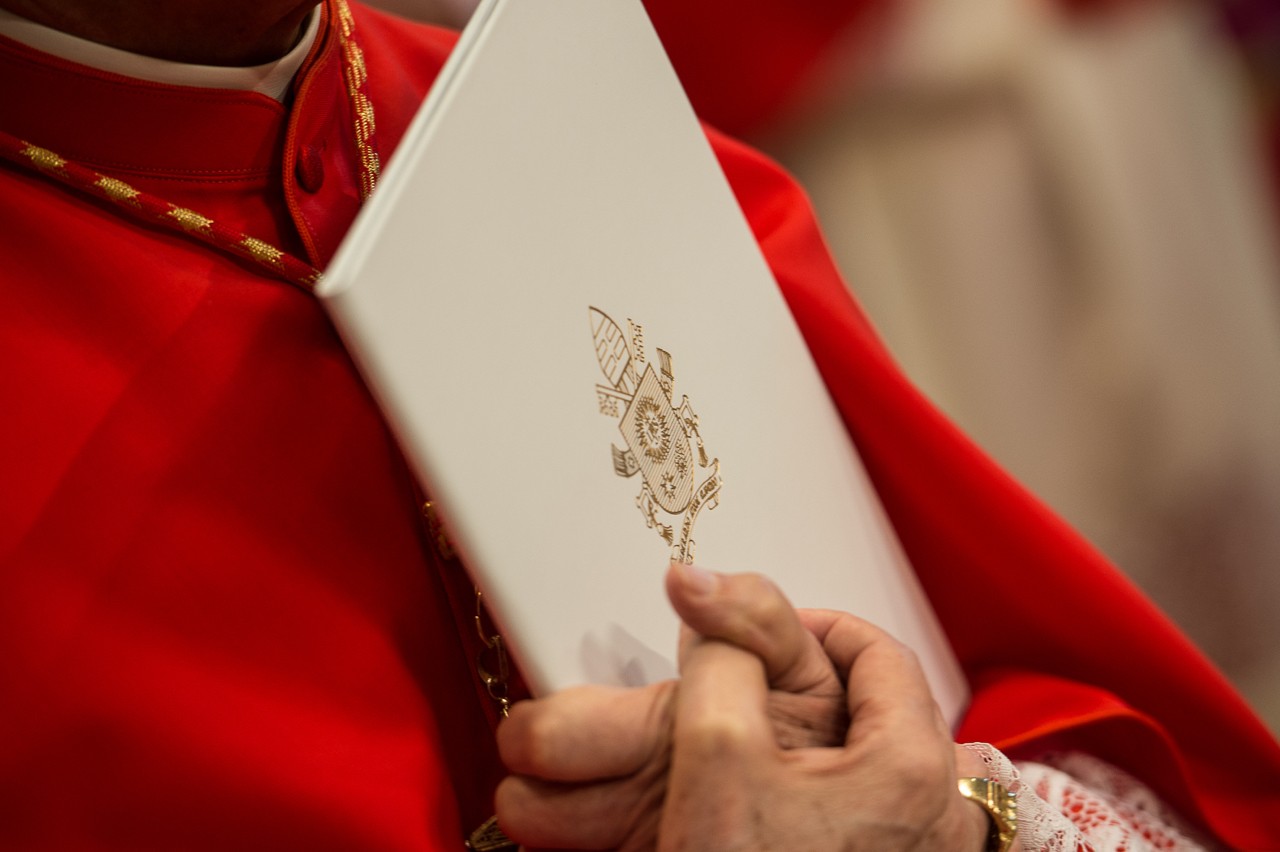
(ZENIT News / Rome, 10.20.2026).- A proposal to reshape the Catholic Church’s legal framework has opened a serious debate over the relationship between lay participation, episcopal authority and the sacramental nature of Church government. Published on September 30, 2026, the final report of the Synod’s Canonical Commission suggests amendments to 34 canons and calls for a longer-term review of both the Latin and Eastern codes of canon law. While its authors seek to translate the Synod on Synodality’s conclusions into practical rules, several canon lawyers warn that some recommendations could blur distinctions the Church has traditionally made between the responsibilities of baptized Catholics and the authority entrusted to ordained ministers.
The controversy is not simply about administrative efficiency. At its heart lies a question with consequences for the Church’s identity: how far can participation in decision-making be expanded without altering the theological foundations of ecclesiastical authority?
The report remains consultative and non-binding. None of its proposals has become law, and any legislative change would require papal approval and formal promulgation. Nevertheless, the document has prompted an unusually pointed debate among experts over what synodality should mean in practice.
The limits of lay participation
Among the most outspoken critics is Dominican priest Pius Pietrzyk, a canon lawyer who argues that the report risks separating the Church’s power of governance from the sacrament of Holy Orders. He described its recommendations as ranging from minor cosmetic changes to what he considers a betrayal of the Second Vatican Council and the Church’s historical understanding of ecclesiology.
Gerald Murray, a canon lawyer and priest of the Archdiocese of New York, similarly sees a substantial doctrinal problem. In his assessment, the proposals would extend governing authority to baptized Catholics who have not received ordination, challenging the traditional relationship between the Church’s governing, teaching and sanctifying missions.
The commission’s recommendations include broadening the roles that qualified laypeople can exercise in ecclesiastical offices and ministries, increasing lay participation in particular Church councils, and changing the rules governing diocesan tribunals. It also proposes allowing diocesan bishops to appoint lay judges without the approval currently required from the episcopal conference, according to the report’s critics.
For Pietrzyk, the prospect of judicial bodies composed entirely of people without Holy Orders raises fundamental questions about the nature of Church authority. Murray argues more broadly that baptism gives every Christian equal dignity, but does not make every baptized person a pastor. In his view, the Church must distinguish the common vocation of all the faithful from the particular responsibilities conferred through ordination.
These objections represent a significant strand of Catholic canonical opinion, but they are not the only interpretation offered by specialists.
David Long, an adjunct professor at the Catholic University of America’s School of Canon Law, considers the questions more nuanced. He accepts that the report seeks to give greater legal recognition to the Second Vatican Council’s teaching on the supernatural sense of faith shared by the whole People of God. However, he questions the proposal to place that teaching at the beginning of Canon 749, which deals with infallibility. He believes it would fit more appropriately within Canon 750, alongside the Church’s shared profession of faith under the guidance of the Magisterium.
Long also cautions that the sensus fidelium—the faithful’s collective sense of the faith—must not be confused with a simple majority opinion. Its exercise, he argues, belongs within the Church’s communion and under the guidance of its teaching authority.
His position illustrates an important distinction in the debate: recognizing the contribution of the faithful does not necessarily mean transferring ecclesiastical authority away from bishops and priests.
Consultation, consent and episcopal responsibility
Some of the report’s proposals concern mechanisms intended to make Church governance more participatory and accountable. These include making diocesan pastoral councils compulsory and requiring the consent of the presbyteral council for certain significant episcopal decisions.
Long welcomes the prospect of stronger pastoral consultation and greater accountability, but warns that requiring consent goes further than seeking advice. The legislation, he argues, would need to clarify what happens when a bishop and his presbyteral council cannot reach agreement.
This is more than a procedural detail. Bishops remain responsible for governing their dioceses, and any system of shared decision-making must explain how that responsibility operates when consensus proves impossible. Participation can improve decisions, but unclear lines of authority may instead create conflict and uncertainty.
Another disputed proposal concerns the delegation of laypeople to assist at marriages. Current canon law already permits such delegation in particular circumstances, especially where priests and deacons are unavailable, subject to the required authorizations. The commission’s proposal would remove the Holy See’s role in this process.
Murray stresses that the layperson assisting at a Catholic marriage does not confer the sacrament or give the priestly blessing. In the Latin Church, the spouses confer the sacrament upon each other through their consent, while the authorized assistant receives that consent in the name of the Church. The debate, therefore, concerns not whether laypeople can perform useful functions, but how exceptional provisions should be regulated and whether their scope should be expanded.
The same distinction lies behind the wider disagreement over lay judges. Long notes that existing canon law already permits lay judges, so their participation is not inherently a departure from Catholic doctrine. His principal concern is whether the report defines the proposed expansion of lay authority with sufficient precision.
Is synodality becoming a new constitutional principle?
The commission’s longer-term ambition raises questions beyond individual canons. It identifies a need for a comprehensive revision of the Latin and Eastern codes to incorporate the theological and ecclesiological insights associated with the 2021–2024 Synod on Synodality.
Italian theologian Nicola Bux warns against turning synodality into a universal principle that effectively becomes obligatory for the whole Church. The Synod of Bishops, established in its modern form by Pope Paul VI, has a consultative character; the pope retains the authority to decide which recommendations to adopt. Bux argues that synodality can be a valuable method of participation, but should not be treated as a substitute for the Church’s sacramental and hierarchical structure.
He also questions whether the proliferation of documents, commissions and organizational reforms is addressing the Church’s most pressing needs. In his view, renewed faith, priestly vocations and the transmission of Christianity to younger generations deserve greater attention than institutional redesign. Laypeople, he argues, serve the Church not only through councils and committees but also through family life, education, professional work and Christian witness in society.
This criticism touches on a broader pastoral concern. The credibility of the Church cannot be measured solely by the number of people involved in formal decision-making. Nor, however, should the importance of evangelization be used to dismiss legitimate questions about consultation, transparency or the contribution of lay expertise.
The challenge is to ensure that participation strengthens the Church’s mission rather than becoming an end in itself.
The decision now belongs to the Church’s highest authority
The report was coordinated by Archbishop Filippo Iannone, who headed the Dicastery for Legislative Texts when the commission was established and now leads the Dicastery for Bishops. Its ten members included Cardinal Gianfranco Ghirlanda, canon lawyer Myriam Wijlens and Spanish canonist José San José Prisco.
The debate has also coincided with a warning from Anthony Randazzo, the new prefect of the Dicastery for Legislative Texts, against treating synodality as an opportunity to abandon elements of the Church’s tradition.
Ultimately, the commission’s report does not settle the questions it raises. Its recommendations will have to withstand further canonical and theological scrutiny before any can become binding law. The pope will determine what, if anything, proceeds to legislation.
That distinction matters. A working document is neither a doctrinal definition nor a change in canon law. Yet the dispute exposes a genuine tension within the synodal process: how to make the voices and experience of the faithful count more visibly while preserving the particular responsibilities that Catholic doctrine attaches to ordained ministry.
Thank you for reading our content. If you would like to receive ZENIT’s daily e-mail news, you can subscribe for free through this link.

Publicaciones relacionadas:
 Orthodox Copts Will Celebrate Mass in Pope’s Cathedral: Vatican Explains Why
 [From Rome] Pope Francis in Asia: A Trip to Mongolia to Evangelize with Messages for Russia and, Especially, for China
 In What Capacity Does Archbishop Charles Scicluna Speak about Discussing Celibacy for a Second Time?
 This is what the latest criticisms of synodality from prominent episcopal voices are saying: fatigue, ambiguity, and the risk of losing sight of the Church’s mission
