

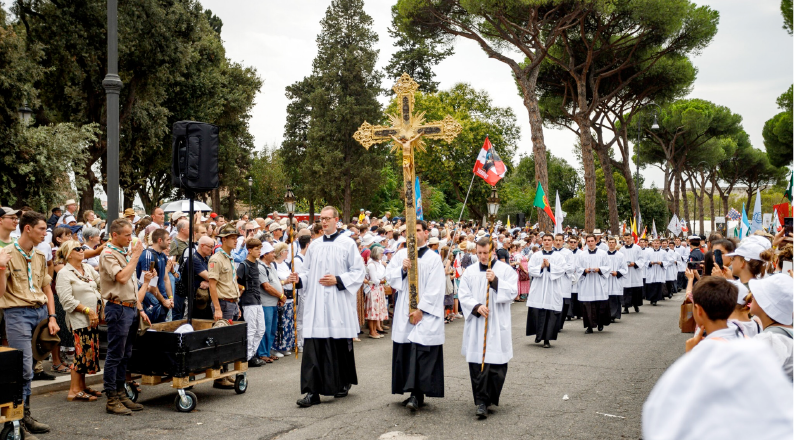
(ZENIT News / Rome, 08.22.2025).- In the heat of an Italian August, the streets of Rome once again became the stage for a chapter in the long and often fraught history between the Catholic Church and one of its most controversial offshoots. Nearly 7,200 members of the Society of Saint Pius X (SSPX) undertook a pilgrimage to the Eternal City from August 19 to 21, marking the Holy Year declared by Pope Francis.
The group, which included some 680 priests and religious, arrived from 44 countries. They processed through Rome’s ancient basilicas, culminating in a visit to St. Peter’s Basilica on August 21. Yet, despite the grandeur of their numbers and the devotion of their prayers, their presence unfolded under a cloud of unresolved tension.
Founded by Archbishop Marcel Lefebvre in the 1970s, the SSPX has lived in a complex relationship with Rome for nearly five decades. Lefebvre’s rejection of the reforms of the Second Vatican Council led to a rupture that culminated in his excommunication in 1988, when he consecrated four bishops without papal approval. Those wounds, while partially treated in 2009 when Benedict XVI lifted the excommunications, have never fully healed.
Their Jubilee pilgrimage was itself a symbol of this ambiguity. Initially announced on the official Holy Year website, their participation was later removed from the calendar. They crossed the Holy Door of St. John Lateran—the Pope’s cathedral and the original site of the Jubilee tradition—before moving on to the Vatican basilica.
Father Davide Pagliarani, the Society’s Superior General, led the faithful, accompanied by Bishops Bernard Fellay and Alfonso de Galarreta. Their presence evoked memories of Lefebvre himself, who had joined the Jubilee of 1975, only to be cast further into the margins of ecclesial life in the years that followed.
The pilgrimage comes at a delicate time. Relations between Rome and the SSPX, once at a near stalemate, saw cautious openings under Pope Francis. The Pontiff granted faculties for SSPX priests to validly hear confessions and, under certain conditions, witness marriages—temporary gestures that signaled goodwill without resolving deeper doctrinal disputes.
Yet time presses forward. With only two bishops currently within the Society, the issue of episcopal succession looms large. Canon law requires papal approval for new consecrations, and proceeding without it would risk reopening old wounds at a moment when dialogue has already slowed since Fellay’s departure from leadership in 2018.
For observers of Catholic life, the August gathering was more than a simple act of devotion. It underscored both the vitality and the precariousness of a community suspended between attachment to Catholic tradition and estrangement from ecclesial authority. Their presence in Rome was, paradoxically, both a gesture of communion and a reminder of division.
As the Holy Year progresses, the unanswered question remains whether the Society’s steps through Rome’s basilicas will one day lead back to full unity—or whether the path will once again diverge, as it has so many times since Archbishop Lefebvre first defied Rome nearly half a century ago.


Thank you for reading our content. If you would like to receive ZENIT’s daily e-mail news, you can subscribe for free through this link.

Publicaciones relacionadas:
 This Will Be the Rome of the 2025 Jubilee: 5G in the Entire City and New Streets and Parking Lots Around the Vatican
 Pope and Priests From a Sector of Rome Talk About Prisoners, Women in the Formation of Priests and the Forthcoming Jubilee
 “Julia”, Rome Capital’s new virtual assistant for Jubilee pilgrims
 The Ten Countries That Contributed the Most Pilgrims to the Jubilee and Other Surprising Interesting Data
