

(ZENIT News / Rome, 01.27.2026).- At a time when religious life in the United States is often described in terms of aging communities and shrinking numbers, a new national study offers a more nuanced portrait—one that combines demographic realism with signs of enduring vocational vitality.
The Center for Applied Research in the Apostolate (CARA), Georgetown University’s research arm for Catholic life, has released its annual survey of women and men who professed perpetual vows in 2025 within religious institutes, provinces, or monasteries based in the United States. Perpetual profession marks a definitive commitment to consecrated life, following years of formation and temporary vows. It is, in effect, the moment when a vocation becomes irrevocable.
To assemble the Profession Class of 2025, CARA contacted major superiors across the country, working through networks identified by the U.S. bishops’ Secretariat of Clergy, Consecrated Life and Vocations. Of 723 superiors approached, 520 responded—a solid 72% response rate. These leaders reported a total of 179 religious who made perpetual vows in 2025: 74 women and 105 men. From that group, 130 sisters, brothers, and priests completed CARA’s detailed questionnaire, yielding a participation rate of 73%.
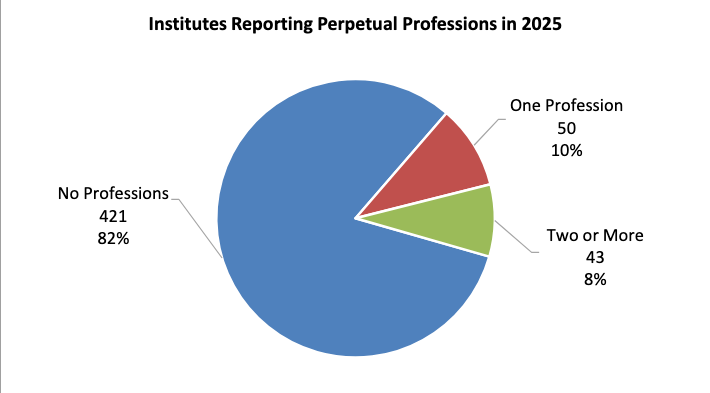
The overall institutional picture remains sobering. More than four in five responding superiors (82%) said their communities had no perpetual professions at all last year. Only 10% reported a single new member making final vows, while just 8% recorded between two and nine. Still, behind these aggregate figures stand 179 individuals who freely chose lifelong consecration.
Who are they?
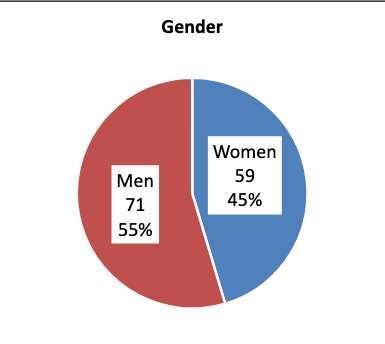
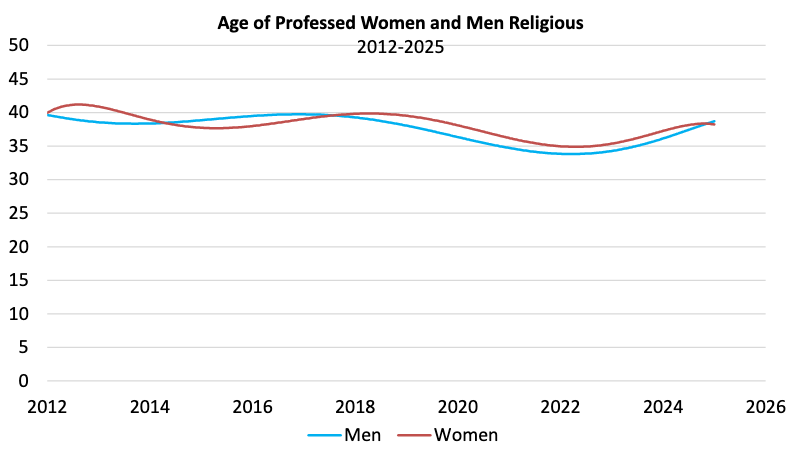
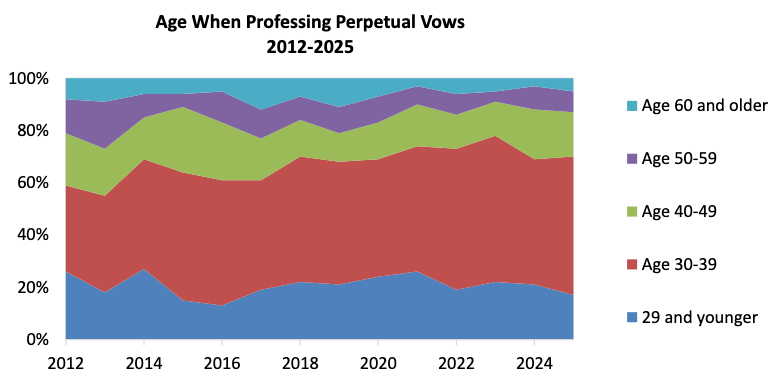
The average age of the 2025 profession class is 38, though half are 35 or younger. The youngest respondent was 22; the oldest, 74—an unusually wide age range that reflects the increasingly diverse pathways into religious life. Men make up 55% of respondents, women 45%.
While religious life in the U.S. is gradually becoming more international, most of this cohort remains homegrown: 69% were born in the United States. Yet nearly a third come from abroad—12% from Asia, 9% from Latin America, and 7% from Africa—underscoring the growing global character of American Catholic communities.
Ethnically, 57% identify as Caucasian or European American. Sixteen percent describe themselves as Asian or Pacific Islander, another 16% as Hispanic or Latino(a), 9% as African or African American, and 3% as mixed race or other.
Continuity of faith within families remains striking. Ninety-two percent have been Catholic since birth, and among converts, the average age of conversion was just 20. Almost all respondents (95%) had at least one Catholic parent, and 85% were raised in households where both parents were Catholic. More than a third report having a priest or religious among their relatives—a reminder of how vocations often emerge within already faith-saturated environments.
Their family profiles are also notable. Nearly everyone grew up with siblings; close to four in ten come from families with four or more children. About a third are the eldest child, while a quarter are the youngest. During their formative years, 85% were raised by married couples living together, and 95% by their biological parents.
Education and professional experience feature prominently in these vocations. Nearly half attended Catholic elementary schools, 35% Catholic high schools, and 39% Catholic colleges or universities. Seven in ten earned a college or graduate degree before entering religious life. Eight percent delayed applying because of student debt, taking an average of two years to pay down roughly $55,500—often with help from friends and family.
Most did not come directly from classrooms into convents or seminaries. Four in five had work experience beforehand, typically in business or education, and nearly all had served in parish or diocesan ministries. Altar serving (60%), lectoring (57%), youth or campus ministry (56%), and RCIA or faith formation (56%) were among the most common forms of engagement.
Their spiritual journeys also follow a recognizable pattern. Almost every respondent practiced regular prayer before entering religious life, and on average they first sensed a vocation around age 18. For half, that awareness came even earlier.
Encouragement proved decisive: 86% say someone actively urged them to consider religious life—most often a sister or brother (52%), a friend (48%), or a parish priest (46%). Yet vocation discernment was not without resistance. More than half experienced discouragement from at least one person, with women reporting this more frequently than men.
Before taking the leap, most spent years getting to know their future communities—on average six years—and 92% participated in formal discernment programs. The most popular was the now-familiar “Come and See” experience, which introduces potential candidates to daily life in a religious institute.
Taken together, the data challenge simplistic narratives of inevitable decline. Yes, most U.S. religious communities welcomed no new perpetually professed members in 2025. But those who did arrive are often well-educated, spiritually intentional, and deeply formed by parish life and ministry long before they take vows.
Thank you for reading our content. If you would like to receive ZENIT’s daily e-mail news, you can subscribe for free through this link.

Publicaciones relacionadas:
 Ireland starts new 2024 – 2025 school year with 21 new seminarians
 How Many Legionaries of Christ Are There in 2025? Most Recent Statistics Are Published
 1 in 20 new priests by 2025 in the U.S. come from the military. Research reveals surprising facts
 One-third of Catholic clergy in the United Kingdom are Anglican converts: the surprising revelations of an investigation
