

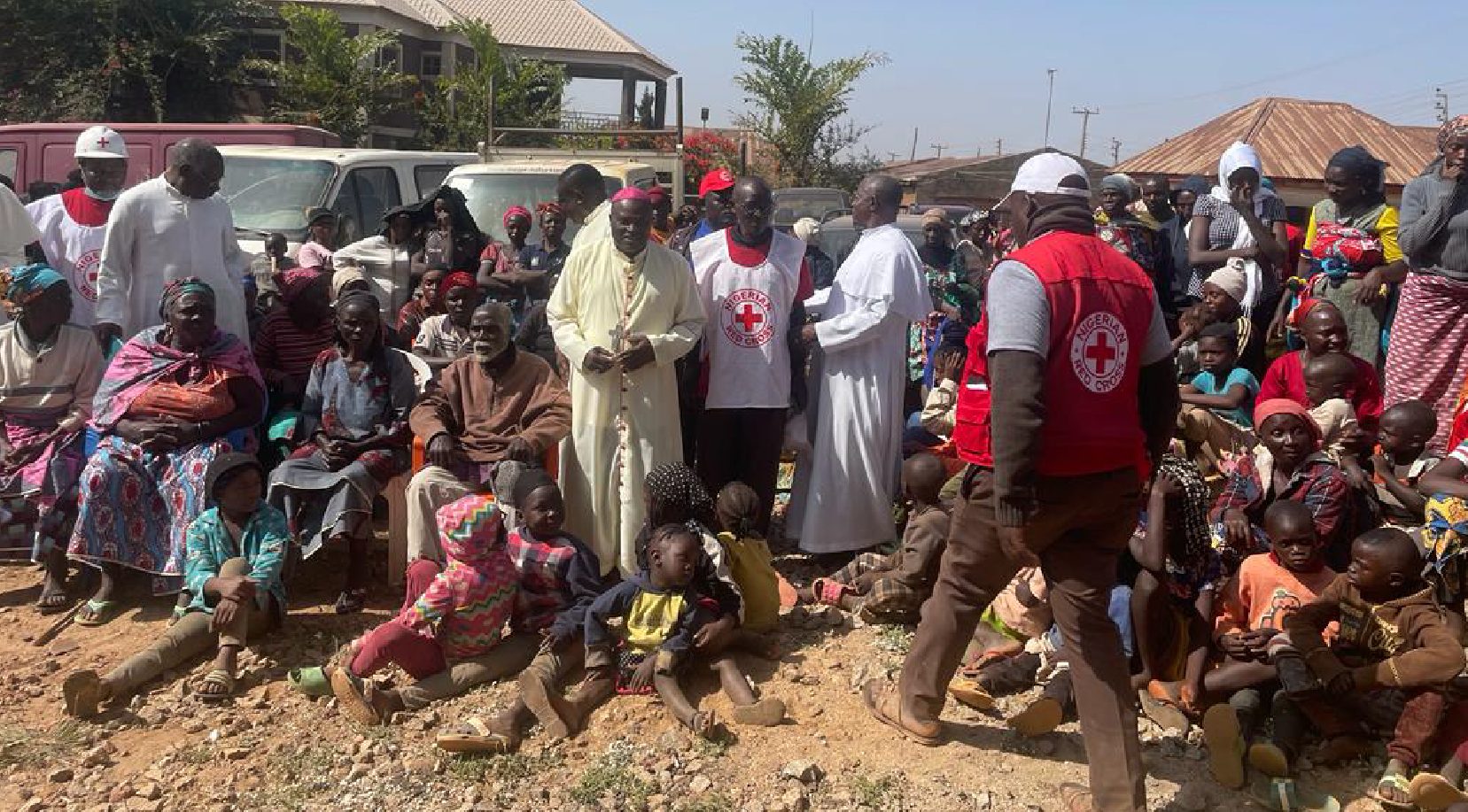
(ZENIT News / Rome, 09.18.2025).- A new report from Nigeria has cast a stark light on the relentless wave of anti-Christian violence sweeping across the country, revealing that roughly one hundred churches are destroyed every month. The figures, compiled by the International Society for Civil Liberties and Rule of Law (Intersociety), suggest that the world’s most populous African nation has witnessed nearly 19,100 churches attacked, looted, or shuttered since 2009.
That year marked the rise of Boko Haram, the Islamist insurgency whose campaign for a caliphate in the Sahel ignited one of the most brutal chapters in Nigeria’s modern history. Since then, extremist factions — including Boko Haram, ISIS-West Africa, and armed Fulani herders — have left a devastating trail of burned sanctuaries, massacred congregants, and shattered communities.
For Emeka Umeagbalasi, the Catholic-inspired human rights advocate who leads Intersociety, the statistics are not abstract but a portrait of survival. “A church does not simply close itself,” he told reporters. “It takes violence, intimidation, or bloodshed to empty a parish. When we counted every church that had been abandoned or destroyed, the figure reached 19,100. That is one hundred every month, three every single day, for sixteen years.”
The destruction is not the only marker of persecution. According to Intersociety’s August report, more than 7,000 Christians were killed across Nigeria in the first 220 days of 2025 alone — an average of thirty-two a day. Since the violence erupted in 2009, the death toll has climbed to 185,000, including some 125,000 Christians and 60,000 Muslims accused of being “liberal” or insufficiently radical. Nearly 8,000 Christians have also been kidnapped during that period, many by the more than twenty jihadist groups that now operate with impunity.
The scale of the crisis, Umeagbalasi argues, puts Nigeria on the trajectory of regions once defined by Christianity and later emptied of it. He draws parallels with Anatolia, once the heartland of Byzantine Christianity before its transformation under Ottoman rule, and with parts of Egypt where Christian communities dwindled under centuries of Islamist pressure. “What happened in Constantinople or Asiut is unfolding in Nigeria today,” he warned. “Unless urgent action is taken, there will be little left of Christianity here within fifty to one hundred years.”
Nigeria’s religious mosaic underscores the gravity of this trend. The north is home to an estimated 40 million Christians — alongside 76 million Muslims — while the south counts 70 million Christians and 24 million Muslims. Yet despite this balance, Umeagbalasi contends that the Nigerian state has been complicit, if not actively facilitating the advance of radical Islamism. “The project is no longer to govern or reform Nigeria,” he said starkly, “but to force the nation into submission to radical ideology.”
International voices are beginning to take note. In Washington, Senator Ted Cruz introduced the «Nigeria Religious Freedom Accountability Act» on September 11, urging the State Department to designate Nigeria as a “Country of Particular Concern” and to maintain sanctions on Boko Haram and ISIS-West Africa. “Christians are being executed for their faith, forced under Sharia, and subjected to blasphemy laws,” Cruz argued. “There must be real costs for Nigerian officials who enable these atrocities.”
Umeagbalasi welcomed the proposal, calling it a “moral encouragement” to those striving to safeguard Christian communities. Still, advocates caution that legislation alone will not stem the tide unless matched by sustained diplomatic, humanitarian, and security interventions.
Thank you for reading our content. If you would like to receive ZENIT’s daily e-mail news, you can subscribe for free through this link.

Publicaciones relacionadas:
 Nigeria: 15 Days Later, A New Massacre in Two Churches of the Country
 Revealing Report Highlights Growing Marginalization of Christians in the United Kingdom
 Image of Christ scourged, destroyed by Jewish extremist, reinstalled in Jerusalem
 Pope Leo XIV receives documented report on religious persecution in Nicaragua
