

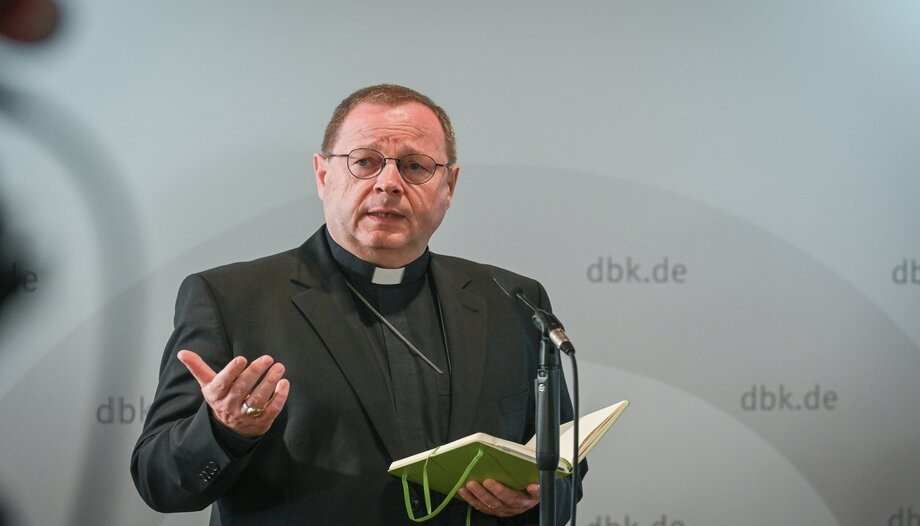
(ZENIT News / Limburg, 11.03.2026).- Pope Leo XIV is facing an increasingly consequential debate over how the Catholic Church should understand and respond to the sexual abuse crisis, after former German bishops’ conference president Georg Bätzing publicly challenged the Pontiff’s reluctance to describe the phenomenon as systemic. The exchange has exposed a deeper question that could become significant for the new pontificate: whether confronting abuse requires not only holding individual perpetrators accountable but also reconsidering the structures through which authority is exercised in the Church.
The controversy stems from Leo XIV’s return flight from France on September 28, following a visit that included a meeting in Lourdes with seven survivors of sexual abuse. Asked by journalists whether he had acknowledged the systemic nature of the crisis, as some of the victims had subsequently reported, the Pope explained that he preferred a different formulation. He acknowledged that certain ecclesiastical organizations had operated as abusive systems, but maintained that sexual abuse was, first and foremost, a human problem.
The distinction prompted a public response from Bätzing, Bishop of Limburg and president of the German Bishops’ Conference until February 2026. In a statement published on November 3, he described the Pope’s formulation as insufficient and called for an equally explicit acknowledgment that institutional conditions within the Church had facilitated abuse and, in some cases, its concealment.
Bätzing’s argument rests principally on the findings of the MHG study, commissioned by the German bishops and published in 2018. The investigation concluded that clerical sexual abuse could not be explained exclusively through the misconduct of individual offenders. It identified institutional risk factors, including clericalism, unequal power relationships, the excessive sacralization of priestly authority and weaknesses in accountability. It also pointed to problems surrounding the treatment of sexuality and sexual orientation within ecclesiastical environments.
For Bätzing, these findings make it impossible to separate individual wrongdoing from the institutional circumstances in which it occurred. He argues that the taboo surrounding sexuality and homosexuality among clergy can contribute to dependency, secrecy and a culture of silence. He specifically maintains that homosexual orientation itself should not be treated as a risk factor, distinguishing it from the institutional attitudes that, in his view, have prevented open discussion and effective oversight.
The question of the disproportionate number of male victims, particularly among children and adolescents, nevertheless remains an important element of the debate. It demands careful examination of the circumstances surrounding abuse, including the profiles of offenders, the vulnerabilities of victims and the environments in which crimes were committed. Such evidence should neither be dismissed nor turned into an automatic judgment about individuals on the basis of their sexual orientation. Establishing the actual causes requires rigorous research rather than assumptions, ideological positions or selective interpretations of statistics.
The disagreement also touches on the future of the German Synodal Way, which Bätzing has consistently defended. The process emerged in the aftermath of the abuse crisis and sought to address questions of power, responsibility, transparency and participation in Church governance. Its advocates argue that the concentration of authority and the absence of sufficiently effective oversight helped create conditions in which abuse could flourish and remain hidden.
Bätzing considers the process an essential contribution to reform and has called for greater participation and shared responsibility among bishops, clergy and laypeople. He also criticized the Roman Curia, saying that he had so far seen little evidence of the profound cultural transformation needed within its structures.
His intervention, however, cannot be separated from the broader controversy surrounding the German Synodal Way. Several of its proposals have generated serious disagreements with Rome, particularly those concerning the blessing of same-sex unions, changes to the Church’s teaching on homosexuality and the possibility of ordaining women to the diaconate. The Vatican has repeatedly expressed reservations about initiatives that risk introducing changes incompatible with Catholic doctrine or the universal nature of ecclesiastical governance. Bätzing’s defense of institutional reform therefore comes from a figure whose wider ecclesiological agenda remains contested within the Church.
For Leo XIV, the challenge will be to establish how far the lessons of the abuse crisis should translate into changes in ecclesiastical governance. Greater transparency, effective supervision and clear accountability are not necessarily incompatible with the Church’s hierarchical constitution. On the contrary, legitimate authority cannot be a shield against scrutiny, and spiritual responsibility must never become an excuse for institutional impunity.
The Pope has not yet fully explained how he understands the structural causes identified by investigations such as the German MHG study. It would therefore be premature to interpret his remarks as a rejection of the evidence or as a definitive position on the reforms needed. But Bätzing’s intervention has made one question particularly difficult to avoid: can the Church adequately confront the abuse crisis without examining how power has been exercised, protected and, at times, abused within its own institutions?
Ultimately, the issue extends well beyond the future of the German Synodal Way or the relationship between Limburg and Rome. It concerns the Church’s capacity to learn from one of the gravest crises in its modern history.
Thank you for reading our content. If you would like to receive ZENIT’s daily e-mail news, you can subscribe for free through this link.

Publicaciones relacionadas:
 Israeli Company Installs Water Generation Machine at Office of Papal Charities in Vatican City
 Cardinal Gerhard Mũller Rejects and Contests Accusations of Poor Financial Management and Denounces Defamatory Attacks
 “Be a sign of hope with words and gestures,” Pope asks Arab Catholic bishops
 Five years in El Salvador and disciple of Cardinal Cupich: this is the new archbishop of New York
