

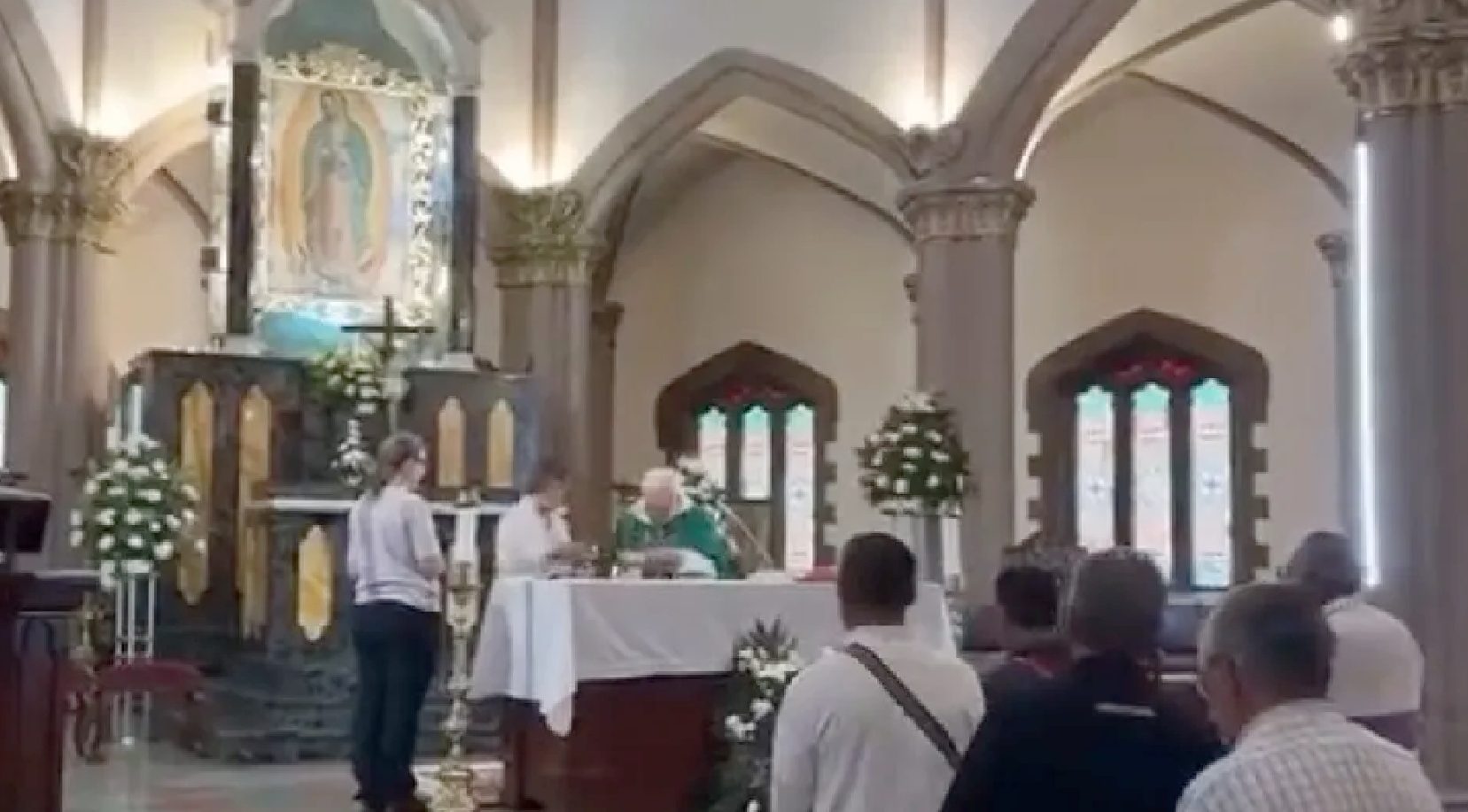
(ZENIT News / Saltillo, México, 09.01.2025).- The city of Saltillo has become the center of an ecclesial storm after a public liturgy blurred the boundaries of Catholic discipline and ecumenical hospitality. On August 26, the retired Dominican bishop Raúl Vera López invited Emilie Teresa Smith, a Canadian Anglican minister and LGBT activist, to participate prominently in a Mass celebrated at the Sanctuary of Our Lady of Guadalupe.
Footage of the event, still accessible online, shows Smith not only standing beside the bishop throughout the liturgy but also reading the Gospel, delivering a homily, and even lifting the chalice containing the consecrated Blood of Christ — gestures strictly reserved by Catholic tradition and canon law to ordained Catholic clergy.
The incident has ignited widespread debate within Mexico and beyond, touching on questions of sacramental theology, the limits of ecumenism, and the delicate balance between pastoral inclusion and doctrinal fidelity.
Bishop Vera, well known for his outspoken advocacy on social and environmental issues, dismissed criticism as exaggerated, insisting that what took place was no more than a disciplinary irregularity. He praised Smith’s theological formation and pastoral work, even describing her homily as “excellent.” Critics, however, argue that his interpretation minimizes what canon law defines as a serious breach. The Church explicitly prohibits non-Catholic ministers from performing priestly actions during the Eucharist, and likewise forbids Catholic priests from concelebrating with ministers outside full communion.
What makes the case particularly sensitive is the symbolic weight of the Eucharist. For Catholics, the consecrated species are not merely symbols but the real presence of Christ. Allowing someone who does not share Catholic faith in the sacrament to perform priestly functions raises not just questions of liturgical order but of sacrilege.
Observers see in Vera’s actions a reflection of broader tensions in the global Church: between a pastoral approach that emphasizes inclusion and gestures of fraternity, and a doctrinal framework that insists on clear sacramental boundaries. To many of the faithful, this was not simply an imprudence but a direct wound to Eucharistic faith.
The Diocese of Saltillo has reportedly sought clarification, with the current bishop requesting explanations from his predecessor. Vera, for his part, defended his decision in the language of “common sense” and even invoked Pope Francis’ encyclical Laudato si’ to justify Smith’s presence, pointing to her work in defense of the poor and the environment.
The controversy, however, reveals a deeper question confronting Catholic leadership worldwide: Can ecumenical gestures be made without compromising the very identity of the Church’s central act of worship? Or does such experimentation risk eroding what Catholics hold as sacred?
In Saltillo, those questions are no longer theoretical. They played out before cameras, on an altar, in a liturgy that has left the faithful divided — some applauding an act of inclusion, others decrying what they see as a grave profanation.
Thank you for reading our content. If you would like to receive ZENIT’s daily e-mail news, you can subscribe for free through this link.

Publicaciones relacionadas:
 USA: Health Care that Truly Heals Must be Grounded in Truth, says Bishop Rhoades
 Germany: bishop responsible for queer ministry calls for changes in Church doctrine
 Can a transgender person enter religious life? U.S. bishops to respond in new document
 U.S. Bishops Enter Supreme Court Clash Over Transgender Athletes and Women’s Sports
