

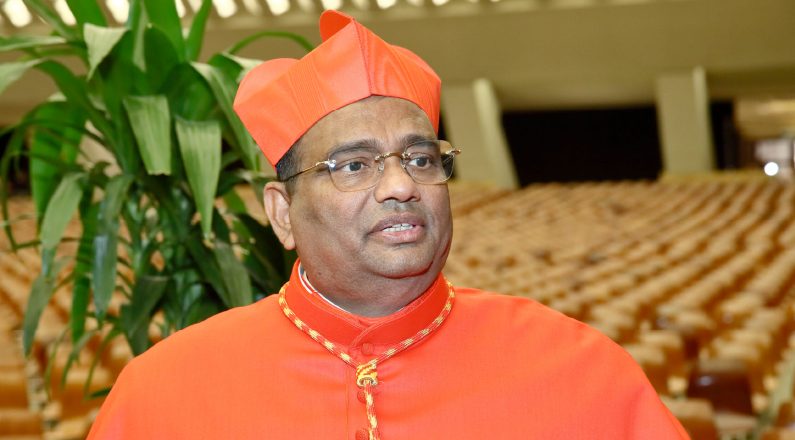
(ZENIT News / Bengaluru, 02.09.2026).- The election of Cardinal Anthony Poola as president of the Catholic Bishops’ Conference of India marks a moment of far-reaching significance, both for the Church and for a country still grappling with the social aftershocks of the caste system. For the first time, the leadership of India’s Catholic episcopate has been entrusted to a cardinal who comes from the dalit community, historically relegated to the lowest rungs of society and long excluded from power, recognition, and dignity.
Poola, the archbishop of Hyderabad, was chosen by secret ballot during the 37th General Assembly of the Bishops’ Conference, held at St John’s Medical College in Bengaluru in early February. The gathering brought together bishops from all three Catholic ritual traditions present in India — Latin, Syro-Malabar, and Syro-Malankara — representing the Church’s 174 dioceses across the country. He succeeds Archbishop Andrews Thazhath of Thrissur, who led the conference for four turbulent years marked by internal ecclesial tensions and an increasingly polarized national climate.
At 64, Poola embodies several layers of historical firsts. Created cardinal by Pope Francis in 2022, he became the first dalit ever to receive the red hat, a decision widely interpreted as a deliberate challenge to lingering caste mentalities, including those that persist within Christian communities. He is also the first Telugu-speaking cardinal, giving voice at the highest ecclesial levels to a linguistic community of nearly 100 million people in the states of Telangana and Andhra Pradesh.
The term “dalit,” derived from a Sanskrit root meaning “broken” or “crushed,” refers to communities traditionally placed outside the four-tier Hindu caste hierarchy. Although India’s Constitution formally abolished caste discrimination in 1948 and introduced affirmative-action policies, social exclusion and violence against dalits have by no means disappeared. Poola himself, born in Poluru to a mixed family with a Catholic father and a Hindu mother, has spoken openly about experiencing marginalization from an early age — an experience that has shaped his pastoral priorities.
Church leaders have been quick to underline the symbolic and pastoral weight of his election. Bishop Sarat Chandra Nayak of Berhampur, who heads the bishops’ commission for scheduled castes and tribes, described the vote as a “clear and prophetic message” to both perpetrators and victims of caste discrimination. The implication, he said, is unmistakable: dalits and tribal peoples are not merely recipients of pastoral care but can exercise leadership at every level of the Church. In theological terms, the message is rooted in baptismal equality — “in God there is no partiality.”
Poola himself struck a deliberately humble tone in his first public remarks. Thanking God and his fellow bishops for their trust, he framed leadership not as authority but as service shaped by listening, prayer, and shared discernment. He also emphasized unity: unity among India’s diverse Catholic rites, unity among Christians, and a deeper communion with the broader Indian nation. In a context marked by social fragmentation, religious polarization, and sporadic violence, he said, the Church must act as a sign of reconciliation, dialogue, and hope.
The theme of the bishops’ assembly at which Poola was elected — “Faith and the Nation: the Church’s Witness to India’s Constitutional Vision” — provides an important interpretive key. It signals a renewed insistence that the Church’s public role is inseparable from the constitutional values of equality, pluralism, and human dignity, especially at a time when those principles are increasingly contested in public discourse.
The Bengaluru meeting was also notable for another development that carries pastoral consequences: the official presentation of a new edition of the Roman Missal in Konkani, the mother tongue of Goa and a recognized official language of India. Spoken by more than two million people across Goa and coastal regions of Karnataka, Maharashtra, and Kerala, Konkani has a complex linguistic history shaped by centuries of migration and interreligious coexistence.
The new Missal, approved by the Vatican’s Dicastery for Divine Worship, is the fruit of sixteen years of sustained scholarly and pastoral work coordinated by the Conference of Catholic Bishops of India for the Latin rite. It is published in both Roman (Latin) script and Kannada script, a choice intended to ensure accessibility while preserving Konkani’s cultural heritage within the Church. The project involved close collaboration between liturgical scholars and linguists and reached completion in January 2026, aligning the text with the official Latin edition of the Roman Missal.
Presented by the apostolic nuncio to India, Archbishop Leopoldo Girelli, the Missal was described as an expression of the Church’s universal liturgy taking root in local cultures — a principle long affirmed since the Second Vatican Council, but one that requires patience and precision to implement.
Together, these two developments — the election of a dalit cardinal to national leadership and the culmination of a long process of liturgical inculturation — point in the same direction. They suggest a Catholic Church in India that is, at least in intention, seeking to confront inherited social hierarchies, broaden participation, and give concrete form to the dignity it proclaims.
Thank you for reading our content. If you would like to receive ZENIT’s daily e-mail news, you can subscribe for free through this link.

Publicaciones relacionadas:
 Lebanon: nuns who took in Muslims and Christians fleeing bombings
 Nigerian Priest Freed After Offering Himself as Captive, While Abductions of Clergy Surge in the Region
 Brazil Against Christianophobia: Proposal to Ban Costumes Mocking Christianity at Carnival
 Secularized Netherlands joins list of countries showing percentage growth in conversions to Catholicism
