

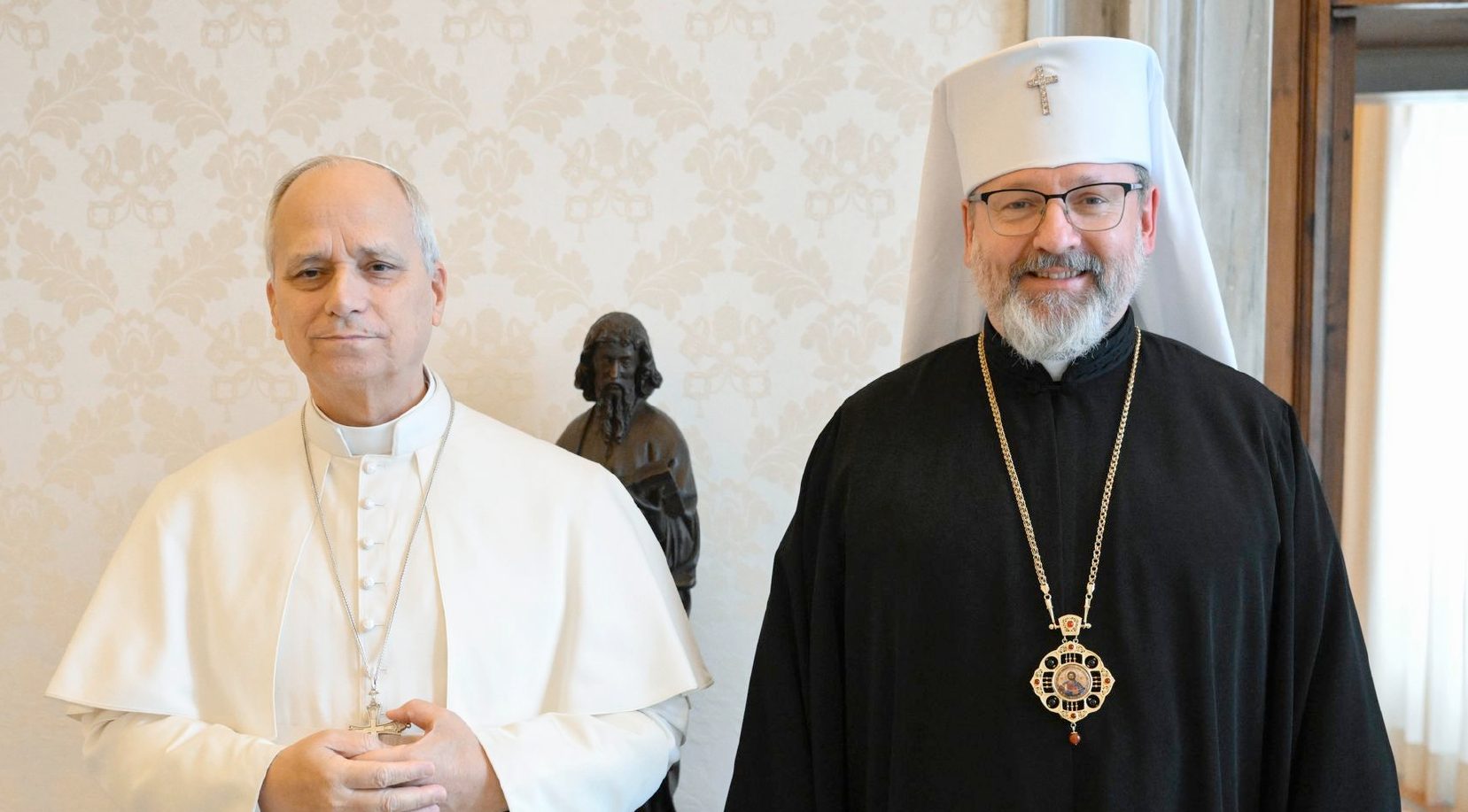
(ZENIT News / Vatican City, 02.13.2026).- In the frescoed halls of the Apostolic Palace on February 12, diplomacy and pastoral concern converged in a gesture as simple as it was symbolic: the traditional baciamano that opened the private audience between Pope Leo XIV and Major Archbishop Sviatoslav Shevchuk, head of the Ukrainian Greek Catholic Church. The exchange of greetings was brief. The substance of the meeting was anything but.
For Ukraine’s largest Eastern Catholic Church—often abbreviated as UGCC—the encounter marked the second private audience with Leo XIV since his election. The first had taken place on May 15, 2025, during the opening week of his pontificate. A further meeting followed on June 28 in St. Peter’s Basilica, when the Pope addressed Ukrainian pilgrims gathered in Rome for the Jubilee. The February 12 conversation now adds another chapter to what is becoming a steady channel of communication between Kyiv and the Vatican.
Shevchuk began by thanking the Pope for his solidarity with Ukraine and for the Holy See’s diplomatic efforts aimed at securing what he described as a “just and lasting peace.” Since the escalation of the war, the Vatican has pursued a discreet but persistent humanitarian role—facilitating prisoner exchanges, advocating for civilians, and seeking openings for negotiation even when formal diplomatic avenues have narrowed.
One of the most concrete moments of the audience came when the archbishop presented updated lists of prisoners of war and missing persons. These names, he explained, were gathered directly from families—an act that transforms abstract geopolitics into a ledger of human anguish. It was not the first time he had done so. In May 2025, he handed the Pope a list containing 500 names of Ukrainians detained or unaccounted for. The repetition underscores both the scale of the crisis and the Church’s determination to keep individual stories from disappearing into statistics.
Beyond the urgency of war, the discussion turned to ecclesial identity. Shevchuk emphasized a point that often escapes outside observers: the Ukrainian Greek Catholic Church is at once local and global. Rooted in the ancient Christianity of Kyiv, it is nevertheless present on every continent. Its communion with the Bishop of Rome—visible and explicit—anchors it within the universal Catholic Church while preserving its Byzantine liturgical and spiritual patrimony. For readers unfamiliar with Eastern Catholic Churches, they are communities that share the same faith and sacraments as the Latin Church but maintain distinct rites, disciplines and historical trajectories. The UGCC, shaped by centuries of persecution and underground existence during the Soviet era, carries a particularly strong sense of resilience.
Leo XIV reportedly expressed appreciation for the Church’s pastoral steadfastness during wartime, especially its capacity to keep diocesan and charitable structures functioning amid bombardment and displacement. He was said to have taken note of the UGCC’s pastoral strategy titled “Healing the Wounds of War,” a program designed to address not only material destruction but also psychological trauma and social fragmentation. In a country where millions have been internally displaced and entire communities uprooted, the Church has become a network of solidarity linking parishes in Ukraine with a far-flung diaspora.
The symbolism of the meeting crystallized in the gift Shevchuk placed in the Pope’s hands at its conclusion. The sculpture, created by Italian artist and cardiologist Luciano Capriotti and titled “The Dove of Peace in Times of War,” depicts a fragile ceramic bird pierced by a shard of metal from a Russian missile fired at Kharkiv. The wound is visible; the dove remains alive. Shevchuk described it as an image of contemporary Ukraine: injured, in pain, yet not extinguished.
The choice of Kharkiv is not incidental. The eastern city has endured repeated strikes since the beginning of the full-scale invasion, becoming emblematic of civilian vulnerability. By embedding a fragment of weaponry into the artwork, the piece collapses the distance between battlefield and sanctuary, between artillery and altar.
Before departing, the archbishop renewed an invitation for Leo XIV to visit Ukraine—an invitation that carries pastoral weight and geopolitical implications. Papal visits to war zones are rare and fraught with risk, yet they can serve as powerful signals of moral accompaniment. For now, the Pope has assured constant prayer and support, a commitment he has reiterated publicly, including during Angelus addresses in which he has lamented the toll of violence.
The February 12 audience did not produce a diplomatic breakthrough; such outcomes are seldom born in a single meeting. What it did reaffirm was a pattern: the Vatican’s sustained engagement with Ukraine and the UGCC’s effort to act as both national Church and global interlocutor. Between the presentation of prisoner lists and the offering of a wounded dove, the message was clear. The war is measured not only in territory gained or lost, but in lives interrupted—and in a faith community determined to remain, like the sculpture it offered, wounded yet alive.
Thank you for reading our content. If you would like to receive ZENIT’s daily e-mail news, you can subscribe for free through this link.

Publicaciones relacionadas:
 New York Skyscraper Lights Up in Honor of New Pope Leo XIV: Here Is the Photo
 Monaco will be the second destination for a trip by Pope Leo XIV at the end of March 2026: here is what is known
 Listening and Fasting: Lent as a Time of Conversion. This is what Pope Leo XIV’s first message for Lent 2026 says
 The devil’s work: one of the topics discussed with Pope Leo XIV by leaders of exorcists from around the world. Here’s how the meeting went
