

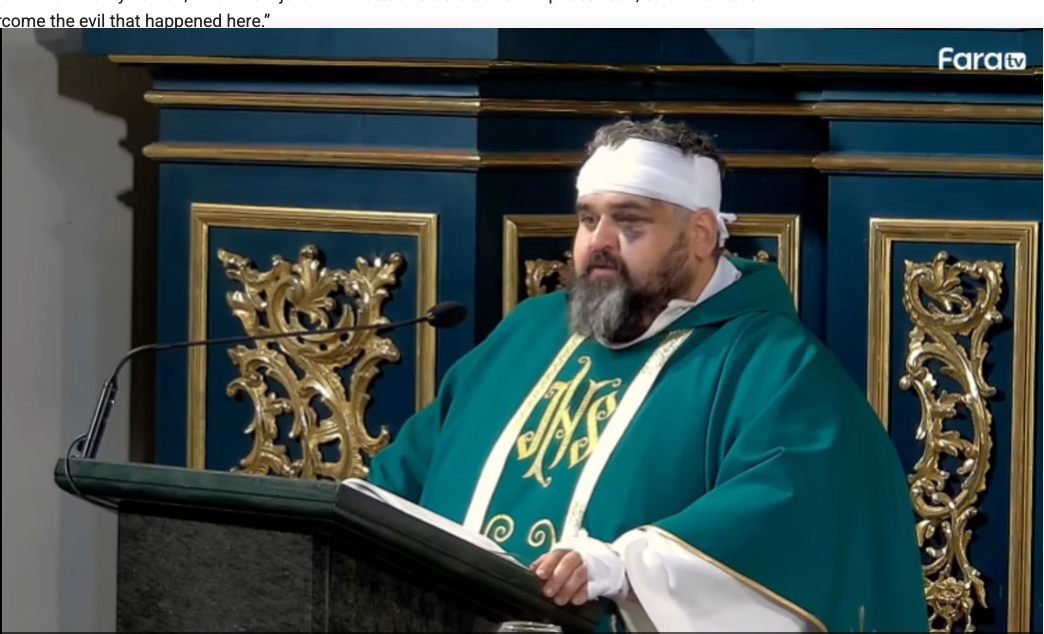
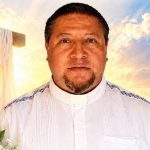
(ZENIT News / Jaroslaw, 09.29.2026).- Two days after a knife attack at a Benedictine abbey in southeastern Poland left one priest dead and four other people injured, Father Adrian Mantykiewicz returned to the altar with a message that went far beyond the tragedy: “We forgive.” His words, delivered during the first Mass celebrated at the Benedictine convent in Jaroslaw after the September 24 attack, quickly resonated across Poland.
The attack occurred at about 9:30 a.m. on Thursday, September 24, when a 31-year-old Ukrainian man attacked five people inside the abbey. Police arrested the suspect at the scene, while the injured were taken to hospital. Father Stanislaw Zbojniewicz, 67, later died from his wounds. Father Marek Pienkowski remained hospitalized in serious but stable condition, while Mantykiewicz was treated and discharged from hospital the same day. The investigation was continuing, and prosecutors charged the suspect with murder, attempted murder and causing serious injuries.
Jaroslaw, a town close to Poland’s border with Ukraine, gives the attack an additional and particularly sensitive dimension. The abbey had been among the places where Ukrainians fleeing Russia’s full-scale invasion found assistance after February 2022. Members of the community worked through the night to receive people seeking food, shelter, care and simple human kindness.
That history was on Mantykiewicz’s mind when he addressed the congregation on September 26. The attacker was Ukrainian, but the priest explicitly rejected any attempt to turn an individual crime into collective blame.
“Do not blame the nation from which the attacker came,” he told those gathered. The evil, he insisted, had been committed by one particular person, who was responsible for his own actions. Others had not committed the crime.
His intervention came at a moment when emotions could easily have moved in the opposite direction. Relations between Poles and Ukrainians have become more complicated since the initial wave of Polish solidarity with refugees in 2022, amid political tensions and longstanding historical disputes. Some people were already reacting to the attack by directing hostility toward Ukrainians as a group. Mantykiewicz instead appealed to the experience of the abbey itself: the people it had welcomed during the war were not an abstraction, but families and individuals who had needed help.
His response was explicitly Christian. “I am a disciple of Jesus Christ,” he said, explaining that Christ teaches him to love. He invoked the love of Christ who was willing to give his life even for his enemies, and asked the congregation not to answer evil with evil, but with love, support, understanding and care.
He went further, asking the faithful to pray for the alleged attacker and specifically for his conversion. “He needs this prayer more than anyone,” Mantykiewicz said. He also asked for prayers for Zbojniewicz, for Pienkowski’s recovery and for his own return to ministry.
The priest’s words did not mean that justice should be abandoned. Polish prosecutors continue to investigate the circumstances of the attack, and the suspect has been placed in pretrial detention under enhanced security in a hospital. Prosecutors have said that psychiatric experts found acute psychotic symptoms that currently prevent him from participating in judicial proceedings. The public authorities have not established a motive for the attack.
Church authorities likewise urged both prayer and restraint. Archbishop Adam Szal of Przemysl, whose archdiocese includes Jaroslaw, expressed solidarity with the wounded, their families and witnesses, while asking parishes to organize prayer on September 26. He also urged journalists to report with caution and precision while the state investigation continued.
Zbojniewicz’s death was marked by funeral rites beginning on September 28, followed by his burial the next day in his native Grzeska. He had been born there in 1958 and ordained a priest in 1986, and had served as a confessor at the Jaroslaw abbey and at St. Nicholas Bishop Church.
In the aftermath, Mantykiewicz reduced his message to something deliberately simple: “Let us take care of one another,” he told the congregation, “and love all those we meet along the way.”
Thank you for reading our content. If you would like to receive ZENIT’s daily e-mail news, you can subscribe for free through this link.

Publicaciones relacionadas:
 Success Story: This Is the Residence Where 8 Out of 10 Priests with Psychological Issues Find Success
 U.S.: Sexual abuse of individuals under the pastoral care of a clergy member is classified as a specific crime in the Civil Penal Code
 The Vatican Rejects German Bishops’ Request to Allow Laypeople to Deliver Homilies: Here’s Why
 Catholic Priest Murdered in Mexico: The 13th Such Killing During the MORENA Administration
