

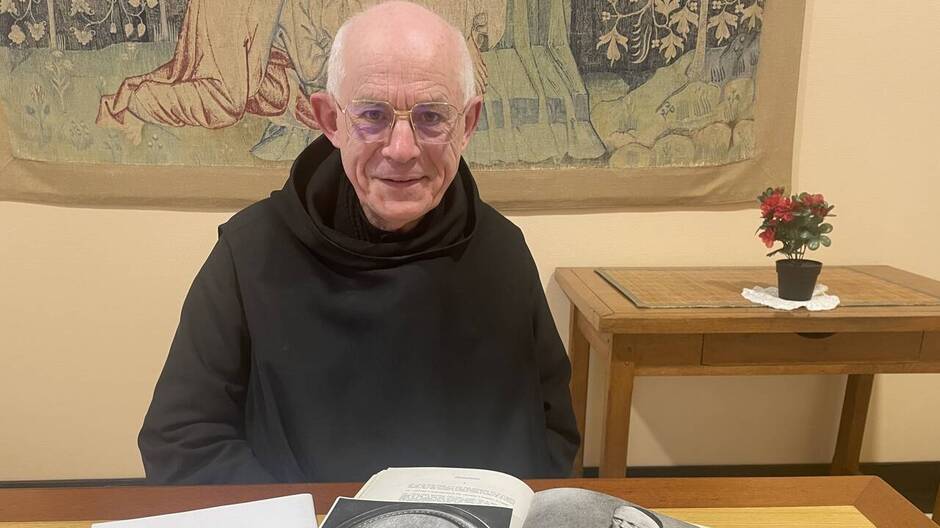
Maxime Francois Marsal
(ZENIT News / Metz, 09.29.2026).- On the occasion of Pope Leo XIV’s visit to Metz to celebrate Mass, Father Jacques-Marie Guilmard reflects on the founding and often overlooked role of the Lorraine city in the history of our continent. From the Carolingian liturgical renewal of Saint Chrodegang to the restorative epic of Dom Guéranger in the 19th century, a plunge into the heart of what made Metz the spiritual cradle of Europe.
***
Pope Leo XIV celebrated Mass in Metz Cathedral, surrounded by Benedictine abbots. Why does this event go far beyond a simple pastoral visit?
Father Jacques-Marie Guilmard: Because it revives a fundamental event: at the end of the 8th century, Metz Cathedral was the true spiritual cradle of Europe. When the Holy Father entered this sanctuary on September 28, he re-established a link with a founding history that closely unites the papacy, the liturgy, and the identity of our continent. It was in Metz that a unique synthesis between faith, prayer, and culture was forged, leaving an indelible mark on all of Western Christendom.
How did this spiritual and political adventure begin in the 8th century?
Fr. J.-M. G.: It all began with the meeting of three extraordinary personalities: a pope, Stephen II; a sovereign, Pepin the Short; and a bishop with a singular name, Saint Chrodegang. Having come to Francie—to Saint-Denis, to be precise—for political reasons, namely the coronation of Pepin the Short, Charlemagne, and his brother Carloman, the pope realized the urgent need for a profound ecclesial reform. He then entrusted this vital mission to the Bishop of Metz and, to give him the necessary authority, elevated him to the dignity of archbishop. Fully supported by Pepin the Short, Chrodegang set to work immediately. His method was simple yet revolutionary: to reform his clergy by faithfully modeling their liturgical practices on those of the pope.
Did Metz already maintain special ties with Rome at that time?
Fr. J.-M. G.: Absolutely. Devotion to the Apostolic See had been vibrant there since the city’s Christian origins, attributed to Saint Clement in the 1st century. Chrodegang drew upon this fertile ground to make Metz a true “holy city” (hagiopolis), a mirror of Rome at the heart of the Frankish world. He provided his clergy with a rule for community life—the Regula canonicorum, inspired by the practice of Saint Augustine. This rule served as an example for cathedral chapters for centuries. It placed the celebration of the Roman liturgy at the center of the daily existence of priests and all the faithful.
You say that Metz gave Europe “its soul and its face.” What do you mean by that?
Fr. J.-M. G.: The impetus from Metz quickly spread through the emerging Carolingian Empire. Its soul is that unity in prayer shaped by the Roman liturgy and filial attachment to the “Apostolic Lord,” as the Pope was then called. The Benedictine monks, who had been spreading the love of Rome for generations in England and then in the West, undoubtedly inspired the desire of Frankish princes to establish “unanimity with the Apostolic See and the peaceful concord of the Holy Church of God.” Through treaties, reigns, and wars, this common prayer kept Europe intimately united. Its face is the visible incarnation of this faith in our landscapes and customs. In the Middle Ages, churches—often dedicated to Saint Peter—rose from the ground to house the holy liturgy. The faithful, from the most humble to the most powerful, flocked to them. Later, princes and scholars would have their Books of Hours to follow the offices. It was the advent of what has been called the “civilization of the liturgy.” And at the center of this edifice resounded Gregorian chant: it was in Metz that the melodies brought from Rome were reshaped to give birth to this universal art, which, starting in 765, conquered the entire West. This crucial role of the sons of Saint Benedict as vectors of liturgy and Roman tradition was solemnly recognized in 1964, when Saint Paul VI proclaimed Saint Benedict the patron saint of all Europe; in doing so, he echoed what Dom Guéranger had written in The Liturgical Year for March 21.
So is Metz the spiritual capital of Europe?
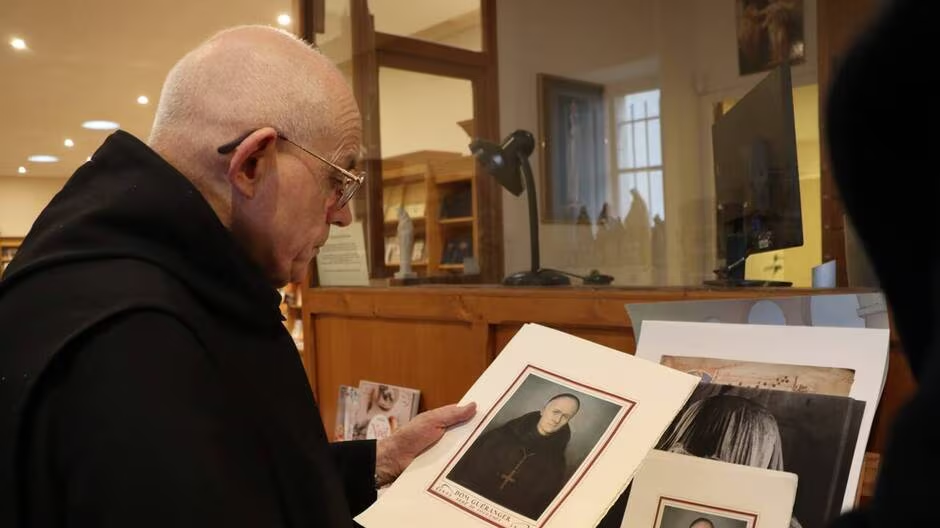
Fr. J.-M. G.: Without a doubt, and it is the work of Saint Chrodegang, whose relics rest in the cathedral where the pope celebrates Mass on September 28. Like Chrodegang, Dom Guéranger was also convinced of the necessary “unanimity with the Apostolic See”; he campaigned for the return of French dioceses to the Roman liturgy and undertook the effort to revive Gregorian chant, which, born in Metz in the 8th century, had fallen into decay in modern times. The liturgy then became, following his lead, what the Second Vatican Council emphasized as “the source and summit of the Church’s life,” and Gregorian chant, “the chant proper to the Roman liturgy.” Cardinal Aveline, President of the Bishops’ Conference of France, recently highlighted this. It is this life of the Church that the pope’s visit comes to renew and enliven within us.
What connection do you make between the Carolingian work of Saint Chrodegang and that of Dom Guéranger in modern times?
Fr. J.-M. G.: Dom Guéranger is the direct continuation of Saint Chrodegang! Starting in January 1830, after the turmoil of the Revolution, many French dioceses had strayed from the millennial Roman liturgy. Gallicanism had instituted disparate neo-Gallican liturgies. The young abbot and refounder of Solesmes set to work with tireless energy to rebuild unity with Rome. We owe to him the now widely used term “Liturgical Year”—as recalled by Holy Father Leo XIV during his general audience on August 12, 2026. Chrodegang and Dom Guéranger shared the exact same charism: a passionate love for the Vicar of Christ and zeal for the Church of Rome at prayer. This is why Dom Guéranger launched the Benedictine renewal in France and worked to ensure that the faithful participated in a conscious and habitual manner in the celebrated mysteries. It is striking to note, as a providential sign, that Dom Guéranger’s coat of arms as abbot was adopted almost identical on the flag of the Council of Europe: the same twelve gold stars arranged in a circle, the same azure background; the only difference is the absence, at the center of the circle of stars, of the rose symbolizing Christ.
The Metz visit represents spiritual Europe, but what about the pope’s presence in Saint-Denis? How do you interpret that?
Fr. J.-M. G.: I believe that what Holy Father Leo XIV taught us during his visit to France is profoundly “Guérangerian,” even if it might not seem obvious right away. The Pope went to Saint-Denis, exactly as Stephen II did in the 8th century, in order to awaken the Christian spirit and the universal dimension of faith by commissioning Saint Chrodegang. Dom Guéranger was himself a promoter of this unity around the Roman Pontiff: he was one of the key theologians referenced for the proclamation of the dogma of papal infallibility and the universal jurisdiction of the Roman Pontiff. Let us remember that Saint-Denis is a Benedictine church, and it was there that the monastic office according to the Rule of Saint Benedict was first established in 863, in what would later become the Carolingian Empire. It was even in this church that the end of the jubilee year celebrating the 150th anniversary of the death of the Servant of God Dom Guéranger was celebrated at the end of 2025.
And in Lourdes?
Fr. J.-M. G.: The pope went to Lourdes, the very place of the great apparition of Our Lady, who presented herself as the “Immaculate Conception.” Even before the dogma was proclaimed, Dom Guéranger related in his Autobiography his particular inner grace regarding this article of faith, which was not universally recognized at the time. Dom Guéranger was subsequently one of the principal architects, at the request of Pope Pius IX, of the definition of this dogma.
Do you think these ancient considerations still resonate with young people?
Fr. J.-M. G.: I am struck to see that among the younger generations, and particularly among those present at the vigil with Leo XIV at the Stade de France, the Gregorian chant repertoire is part of their Christian life, as evidenced by the final Salve Regina sung at full voice by the 80,000 people present.
Do you think Pope Leo XIV has a particular affection or attachment to Dom Guéranger?
Fr. J.-M. G.: I have no idea; however, what interested me was seeing his attachment to a French religious, a Carmelite, Brother Lawrence of the Resurrection, who gives us a message: “Place yourself in the presence of God, even in ordinary things.” It feels like reading Dom Guéranger! For Dom Guéranger, the true school of prayer is the liturgy, where it is Christ and the Church who pray first through the Divine Office. Personal prayer must spring forth spontaneously through contact with the celebrated Christian mysteries. For this reason, I want to encourage everyone to deepen their understanding of the mysteries that the Church teaches us as a mother in the liturgy, which is not reserved solely for the clergy. The Divine Office, the Liturgy of the Hours, as Holy Pope Paul VI taught (Laudis canticum), is the privilege and duty of every baptized person.
In your view, what is the prophetic message that the Pope’s visit to Metz sends to our 21st century?
Fr. J.-M. G.: It reminds us that liturgical prayer and communion with the Successor of Peter are not mere museum pieces, but living sources of unity, peace, and reconciliation for both the Church and the world. For us Christians today, this is in no way about nostalgia: what Dom Guéranger sought in modern times, following Saint Chrodegang, who was his precursor at the beginning of the Carolingian era, is something that Europe awaits, that today’s world awaits: that the Church once again becomes a “society of praise,” in Dom Guéranger’s beautiful phrase. This is the essence of the program set out by the Church at the Second Vatican Council in its very first constitution. The 20th-century Council began its work with the liturgy because the liturgy—the prayer of the Church, which is always heard—is that of the bride to the bridegroom, Christ: it is the lifeblood of our existence (cf. General Preface to The Liturgical Year by Dom Guéranger). By renewing its vitality in Metz, Europe remembers what forged its spiritual nobility. The “civilization of the liturgy” implemented by Saint Chrodegang and perpetuated by the Benedictine tradition has only one horizon: to prepare and build the “civilization of love.”
Interview conducted with Father Jacques-Marie Guilmard, monk of Solesmes. To go further: Dom J.-M. Guilmard, «L’origine du chant grégorien» (2020) and «Au cœur du chant grégorien» (2024), Éditions de Solesmes. Association for the Canonization of Dom Guéranger (ACDG – www.domgueranger.net) – Honorary President: Cardinal Aveline.
Thank you for reading our content. If you would like to receive ZENIT’s daily e-mail news, you can subscribe for free through this link.

Publicaciones relacionadas:
 FEATURE: Cardinal Parolin to ZENIT: Belarus, A Visit the Pope Will Consider; Appeal: Let Archbishop of Minsk Back into Country
 EXCLUSIVE INTERVIEW: As Pope to Participate Amid Pandemic in Sant’Egidio Encounter, Community’s President Marco Impagliazzo Says ‘Prayer Is at Root of Peace’
 Walking in synodal style: Vatican accelerates “synodal” applications (in resistant dioceses?)
 What Is the Difference Between the Holy See, Vatican City, and the Roman Curia? Cardinal Ghirlanda Explains
