


(ZENIT News / Rome, 02.04.2026).- For years, conventional wisdom in the entertainment industry has held that religion is a risky subject—polarizing, niche, and best avoided in mainstream storytelling. New research from the United States, however, suggests the opposite: faith, when portrayed with emotional honesty and narrative intelligence, can significantly enhance audience engagement, even among viewers with no religious affiliation at all.
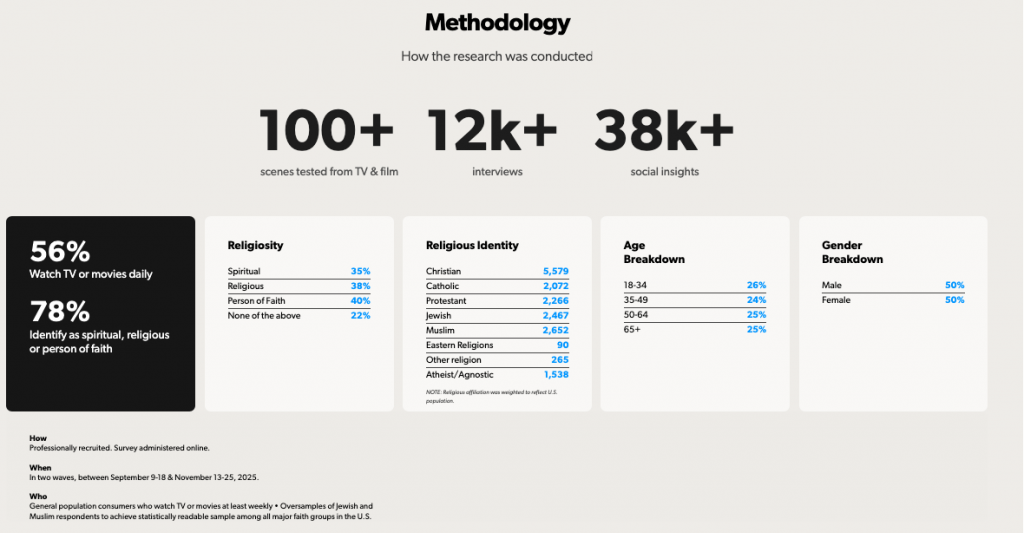
A national survey conducted by HarrisX in partnership with the Faith & Media Initiative, released in late January 2026, examined how American audiences respond to religious themes embedded in mainstream films and television series. The findings challenge long-standing assumptions in Hollywood and point to a cultural moment in which faith is no longer a liability on screen, but often an asset.
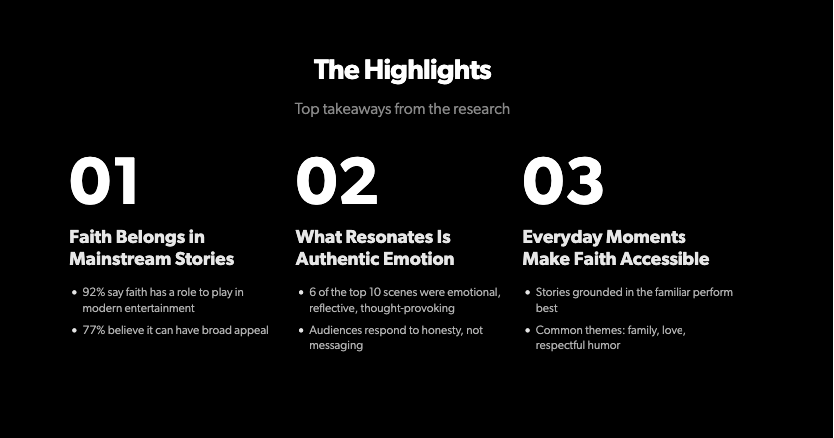
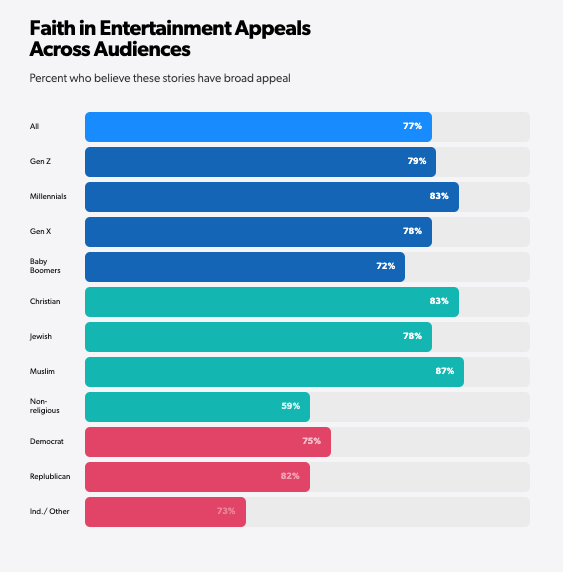
According to the survey, 77 percent of entertainment consumers agreed that the presence of faith in television and movies is broadly appealing. This sentiment was remarkably consistent across generational lines: 79 percent of Generation Z respondents, 83 percent of millennials, 78 percent of Generation X, and 72 percent of baby boomers shared this view. Political affiliation made little difference. Support remained strong among Republicans (82 percent), Democrats (75 percent), and independents (73 percent), suggesting that the appeal of religious storytelling cuts across ideological divides.
Even more striking was the level of openness. Fully 92 percent of respondents said they were receptive to religious representation in entertainment. Brooke Zaugg, executive director of the Faith & Media Initiative since 2021, admitted she expected a high number—but not one approaching universality. In her words, the figure was “almost 100 percent,” an outcome that upends the assumption that audiences instinctively recoil from religious content.
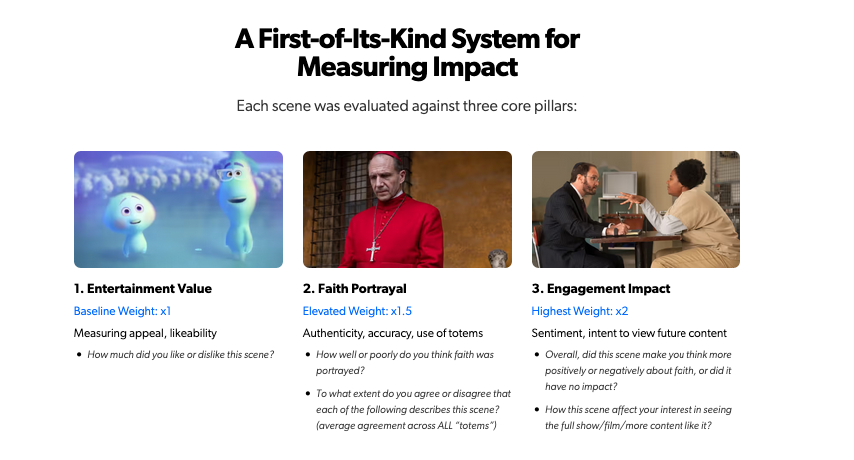
The research combined qualitative and quantitative methods. First, 32 avid entertainment consumers were interviewed in depth to identify the themes that matter most to viewers. These insights then informed a large-scale national study carried out between September and November 2025. More than 12,000 participants of varying ages, religious backgrounds, and political leanings watched over 100 curated scenes drawn from 50 television series and films. Each clip was evaluated on three criteria: entertainment value, authenticity in depicting faith, and whether it increased interest in watching the full program or similar content.
The scenes spanned multiple religious traditions, including Christianity, Judaism, and Islam, and were taken from widely known productions such as Young Sheldon, The West Wing, Ramy, Hacksaw Ridge, and newer titles like The Pitt. The diversity of material allowed researchers to identify not only whether faith resonates, but how and why it does so.
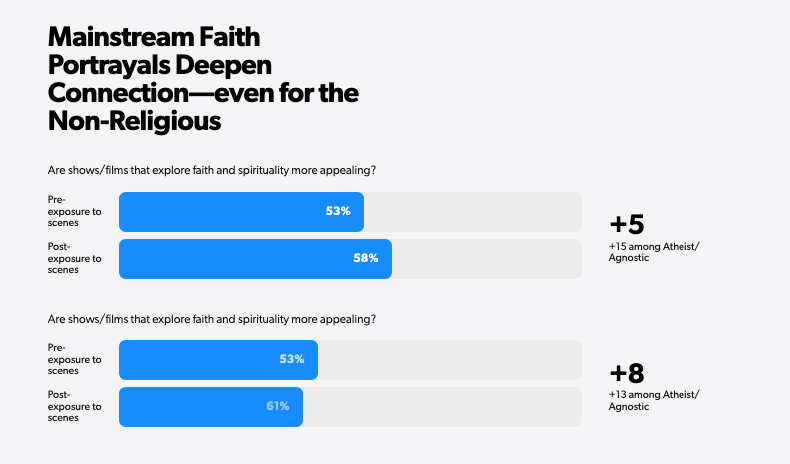
One of the most unexpected findings concerned atheists and agnostics. Rather than responding negatively to religious themes, these viewers often reported a deeper emotional connection after watching faith-related scenes. Among atheists and agnostics, 53 percent initially said that programs exploring faith and spirituality were more appealing than others. After viewing the selected scenes, that figure rose to 58 percent. Similarly, the proportion who found such programs relatable increased from 53 percent to 61 percent. Zaugg described this group as the most receptive in the entire survey, registering the largest positive shift after exposure.
What distinguishes effective portrayals of faith from ineffective ones? The data point clearly to emotional sincerity. Scenes described as emotive, reflective, or thought-provoking consistently scored higher than those marked by sarcasm, irony, or awkward humor. While more than nine out of ten viewers said they were open to humor in entertainment, reactions shifted sharply when humor intersected with religion. Respect mattered. When faith-based humor relied on clichés or caricature, audience engagement dropped noticeably.
A telling example came from the comedy series Broad City, which featured a storyline centered on Yom Kippur. Only 48 percent of viewers felt the humor was respectful. In open-ended responses, participants criticized the scene for leaning too heavily on familiar stereotypes, failing to move beyond surface-level portrayals of religious identity.
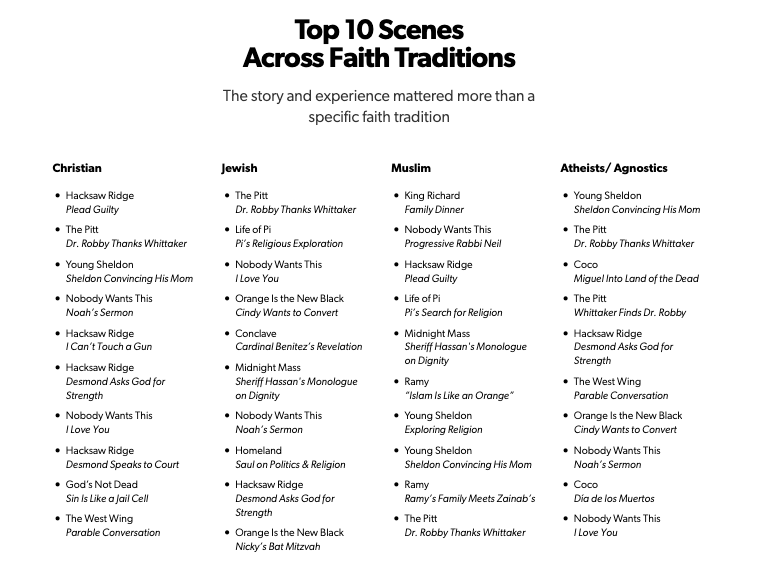
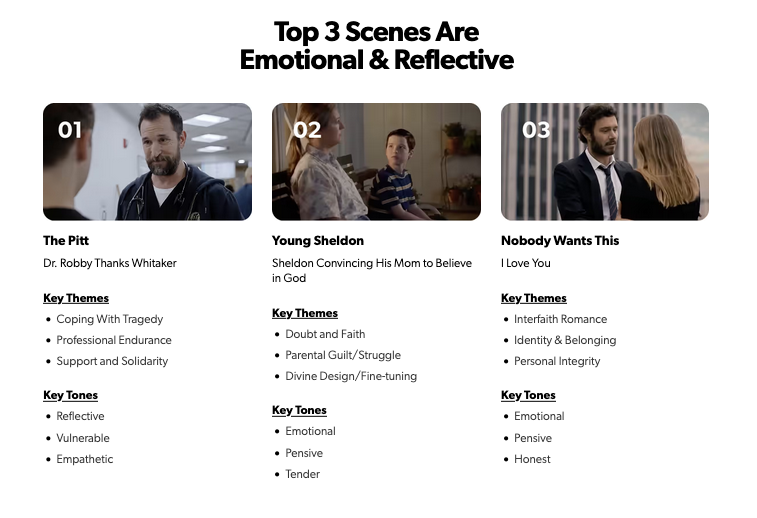
By contrast, the highest-rated scene in the entire study came from HBO’s medical drama The Pitt, set in a fictional trauma hospital in Pittsburgh. The scene follows Dr. Michael “Robby” Robinavitch during an emotionally punishing shift. Overwhelmed, he pauses for a moment of silent prayer. When a medical student asks what he was reciting, Robby explains that it was the Shema, a foundational Jewish prayer he learned from his grandmother. The student responds by quoting the Book of Isaiah, recalling his own background in theological studies. The exchange ends not with certainty, but with vulnerability: Robby admits that on days like this, he is unsure whether he believes in God at all.
Seventy-two percent of viewers described the scene as emotionally moving, and 69 percent said it invited reflection. Many respondents praised its realism and emotional honesty. Rather than presenting faith as either triumphant or absurd, the scene allowed belief, doubt, memory, and exhaustion to coexist—mirroring the complexity of real human experience.
For Dritan Nesho, founder and CEO of HarrisX, this complexity is the key takeaway for content creators. The research, he argues, offers a practical roadmap: faith resonates when it is treated with respect, avoids simplification, and engages the deeper questions of meaning that cut across belief systems. Stories do not need to preach; they need to be truthful.
Zaugg believes the findings also reflect a broader cultural shift. Since Donald Trump began his second term as president, she observes, Americans have become more willing to speak openly about belief and identity, regardless of their stance toward the administration. Religion, once considered a conversational taboo akin to politics, is re-emerging as a legitimate subject for public exploration.
Perhaps the most enduring lesson of the study is this: faith-based storytelling does not appeal to a marginal audience. It speaks to a wide and diverse public that recognizes itself in narratives of doubt, hope, memory, and transcendence. When filmmakers acknowledge that complexity, religion no longer drives viewers away from the screen—it draws them in.
Thank you for reading our content. If you would like to receive ZENIT’s daily e-mail news, you can subscribe for free through this link.

Publicaciones relacionadas:
 USA: Students With A Religious Vocation Are Unable to Enter the Seminary or Convent Because of University Debt
 Transgender Identification Surges Among Young Adults: A Generational Shift or a Social Phenomenon?
 Australia: data suggest that more and more people are seeking God
 How do young Catholics stay informed? Here’s how the digital generation consumes (and how often) news
