

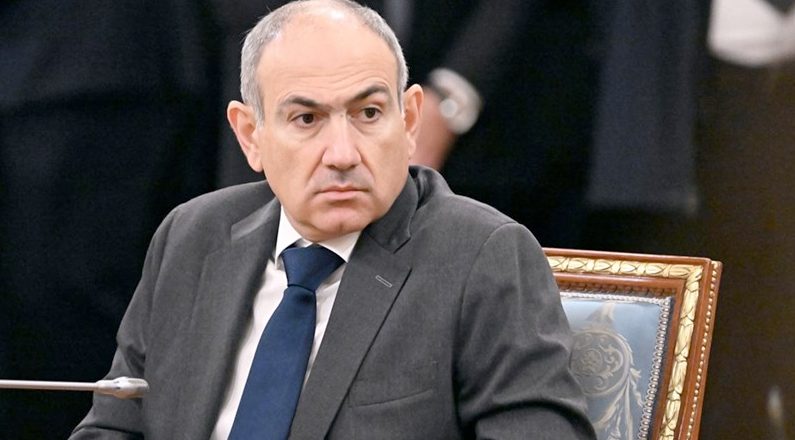
(ZENIT News / Cologne, 01.29.2026).- As Armenian Christians prepared to celebrate Christmas on January 6 — a date unique to several Eastern Churches that mark both Christ’s Nativity and Baptism on the same day — Prime Minister Nikol Pashinyan chose the moment to unveil a dramatic political intervention into one of the world’s oldest Christian institutions.
Just days before the feast, Pashinyan announced a sweeping “roadmap of reforms” for the Armenian Apostolic Church, who is not in communion with Rome, including the creation of a separate state-backed Coordination Council charged with overseeing their implementation. At the heart of the proposal lies an extraordinary demand: the removal of Catholicos Karekin II, the Church’s supreme patriarch, followed by new elections and the drafting of a revised ecclesiastical charter.
The initiative, reportedly supported by ten Armenian bishops, represents an unprecedented escalation in a conflict that has been simmering for months between Armenia’s government and the Mother See of Holy Etchmiadzin, the spiritual center of the Armenian Apostolic Church.
For readers less familiar with Armenia’s religious landscape, the stakes are immense. The Armenian Apostolic Church is not merely a denomination; it is a foundational pillar of national identity. Armenia became the first state in history to adopt Christianity as its official religion, in AD 301, and the Catholicos is traditionally regarded as both spiritual father and guardian of Armenian continuity through centuries of persecution and diaspora.
Pashinyan’s confrontation with Catholicos Karekin II has been intensely personal as well as political. The prime minister has repeatedly accused the patriarch of deceiving the faithful and violating his vow of celibacy. In July 2025, Pashinyan publicly called for Karekin’s resignation, urging believers to protest and declaring that he himself would lead a movement to “liberate” the Church.
Since then, tensions have hardened into open hostilities. Several Armenian clerics have been detained, accusations have flown in both directions, and trust between Church and state has visibly eroded.
On January 6, Pashinyan attempted to turn liturgy into leverage. After attending services at Yerevan’s Cathedral of St. Gregory the Illuminator, he launched a march toward the Katoghike Church of the Holy Mother of God, calling on Armenians to back his reform agenda. At the same time, the Patriarchal Divine Liturgy was being celebrated at Holy Etchmiadzin, underscoring the parallel realities unfolding within the country.
Local reports suggest that the march drew several hundred participants, including prominent political figures — a modest turnout, yet symbolically charged. In statements carried by OC Media, Pashinyan accused Karekin II and his inner circle of operating in what he described as a “sectarian logic.”
“Today, in essence, we must recognize that the de facto leader of the Church and the narrow elite he has formed are in a state of schism,” Pashinyan said. “This means we must free our Church from schism; we must return the Church to the people.”
Holy Etchmiadzin responded with an unusually forceful rebuttal. In an official statement, the Armenian Apostolic Church condemned the government-led initiative as unconstitutional and in violation of both international norms and Armenia’s own legal protections for religious bodies.
The Mother See insisted that ecclesiastical reform is not a matter for political councils or state-appointed structures.
“Questions of canonical order and church reform do not fall under the authority of any self-proclaimed assembly,” the statement read, emphasizing that such decisions belong exclusively to the Church’s hierarchy and highest governing bodies.
Both sides have since accused each other of provoking schism — a grave charge in a tradition that prizes unity as essential to apostolic continuity.
The standoff intensified further on January 8, when Pashinyan addressed reports that Karekin II had no intention of stepping down. Speaking at a press conference, the prime minister dismissed the idea of resistance.
“You say that Ktrich Nersisyan [Karekin II’s secular name] does not intend to leave,” Pashinyan said, according to News.am. “We will make him change his mind.”
The remark signaled that the government has little appetite for compromise.
What makes this confrontation particularly striking is its timing and symbolism. By anchoring his campaign to January 6 — Armenia’s most sacred Christian feast — Pashinyan blurred the line between civic authority and spiritual life, transforming a day traditionally devoted to worship into a platform for political mobilization.
Whether this gambit will succeed remains unclear. While ten bishops are said to support the reform roadmap, the institutional weight of Holy Etchmiadzin and the deep emotional attachment of many Armenians to their Church suggest that any attempt to unseat a Catholicos by political pressure risks lasting damage.
Beyond Armenia’s borders, observers in Rome and across the Christian world are watching closely. The crisis raises fundamental questions about religious autonomy, state power, and the vulnerability of ancient churches in modern political storms.
Thank you for reading our content. If you would like to receive ZENIT’s daily e-mail news, you can subscribe for free through this link.

Publicaciones relacionadas:
 Chinese Government Poses Problems for the Catholic Church in Hong Kong Over the Secret of Confession
 Canadian archbishop fights for church’s right to reject euthanasia
 Polish Constitutional Tribunal temporarily halts reform of religion classes in schools
 Amid Tight Restrictions, Nicaragua Allows Rare Clergy Ordinations in Managua
