

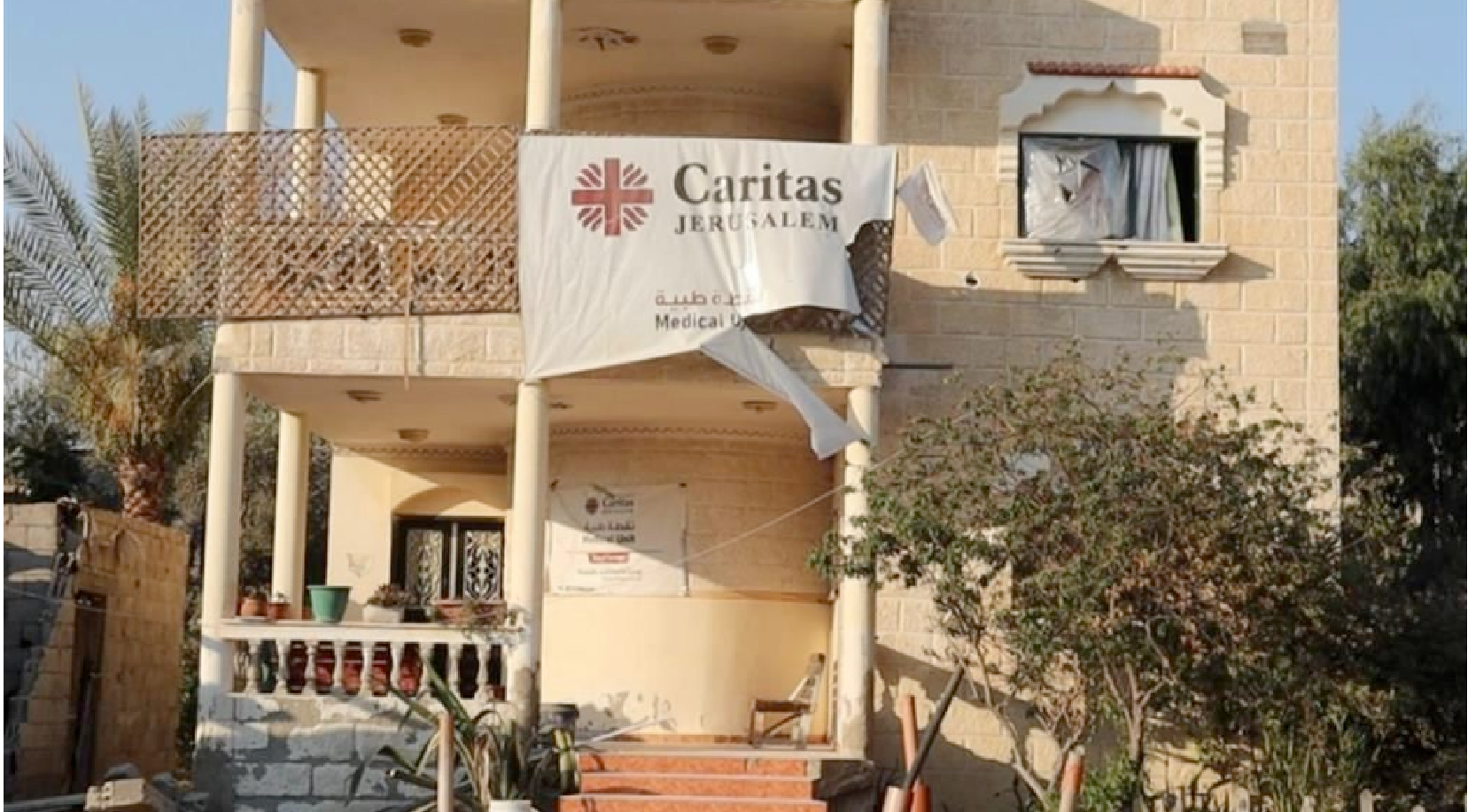
(ZENIT News / Jerusalem, 07.30.2025).- In the dusty ruins of what once was a modest but vital medical hub in Deir al-Balah, the echoes of war drown out even the cries of children. Yet one child’s sobs broke through the chaos—not for fear or wounds, but from hunger. This haunting image, shared by a doctor from Caritas Jerusalem, encapsulates the daily suffering in Gaza, where survival has become an act of endurance rather than resilience.
Caritas Jerusalem, the Catholic Church’s charitable arm in the Holy Land, is witnessing the unraveling of an already fragile reality. Its Secretary General, Anton Asfar, speaks of teams now surviving on tea, salt, and water, unable to spare even a scrap of food for the wounded. «We are overwhelmed,» he confesses, amid a landscape where aid work is repeatedly undone by military assaults.

The latest blow came to the Al-Bourqa Health Center, long a cornerstone for medical care in southern Gaza. Once deemed a safe zone, the area saw mass evacuations on July 20, displacing more than 50,000 people. Caritas staff scrambled to transfer medical equipment to a nearby outpost in Nuseirat, a desperate bid to salvage the mission. Days later, the center was caught in Israeli military operations, sustaining severe structural damage. Tanks and bulldozers tore through surrounding neighborhoods, leveling buildings and infrastructure.
The center had offered essential care: vaccinations, psychological support for mothers and children, treatment for amputees—services now suspended indefinitely. Since March, prosthetic limbs have been blocked from entering Gaza, and only a trickle of medical supplies makes it through either Israeli or Palestinian checkpoints. Meanwhile, air drops authorized by Israel attempt to compensate for the bottlenecks, but they barely graze the surface of what Caritas and 114 other humanitarian groups call a «mass famine.»
The moral weight of this crisis rests heavily on Caritas, not just as a relief organization, but as a spiritual witness. Don Marco Pagniello, director of Caritas Italiana, has pledged €700,000 to support the nine Caritas-run clinics in Gaza—a gesture of solidarity but also a call to conscience. “The suffering of war fuels our belief in peace. It commits us to work for it,” he affirms.

Yet moral clarity contrasts sharply with the ambiguity of diplomacy. Caritas Jerusalem, in a bold and unusual move, issued a direct appeal to Donald Trump, urging him and all global power brokers—both known and unseen—to intervene. The plea is stark: “Help us end this brutal war.”
Recent comments from the former U.S. president offer little hope. Dismissing negotiations as fruitless, he echoed sentiments of Israeli leadership hinting at “alternative methods” to free hostages and warning of continued military pursuit. The terrorists of Hamas accuses Washington of distorting reality. Egyptian and Qatari mediators cling to fragments of a shattered peace process, stalled over the demand for a permanent ceasefire.
There is no date set for new talks. Only the slow grind of destruction continues in Gaza, where despair and determination exist side by side. In the words circulating among the local population, the dead are “the lucky ones”—spared the slow, humiliating agony of the living.
For Caritas and its partners, faith is not an escape from this reality, but a summons to confront it. Their work stands as both a humanitarian act and a statement: that no life is expendable, and no suffering should be ignored, even in the silence of a world too tired—or too afraid—to listen.
Thank you for reading our content. If you would like to receive ZENIT’s daily e-mail news, you can subscribe for free through this link.

Publicaciones relacionadas:
 Israel continues to attack Christians and seize land from Palestinians now in the West Bank
 Israel: Destroying machines also raze a Catholic church in the West Bank
 Cardinal Pizzaballa Visits Jenin, Offering Solidarity and Hope Amid Devastation
 Statement by Christian leaders on the latest attack by Jewish settlers against Christians in the Holy Land
