

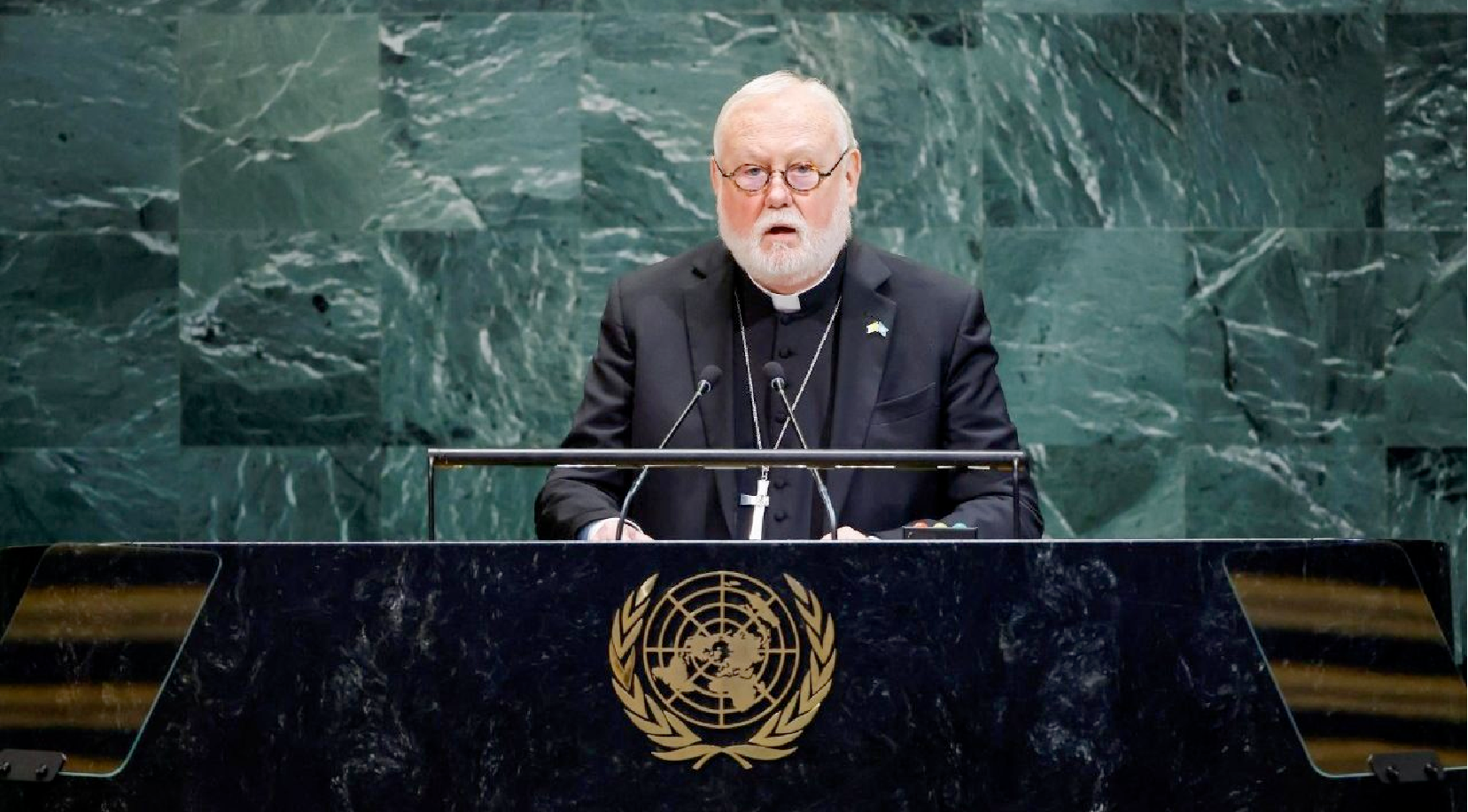
(ZENIT News / New York, 09.30.2025).- The Holy See’s top diplomat at the United Nations has delivered a stark warning on some of the world’s most entrenched conflicts, insisting that peace requires respect for international law and the preservation of moral principles that transcend political calculations.
Archbishop Paul Richard Gallagher, Secretary for Relations with States and International Organizations, addressed the UN General Assembly on Monday (september 29) with a message that blended moral urgency with pointed geopolitical observations. Representing the Vatican, a permanent observer state at the UN, he insisted that Jerusalem’s contested status cannot be altered by unilateral action.
“For the Holy See, the question of Jerusalem is fundamental,” Gallagher told the assembly. “A just solution, based on international resolutions, is essential for peace. Any unilateral decision that changes the special status of the city is morally and legally unacceptable.”
The remarks come at a time of renewed turmoil in the Middle East. Gallagher cited Pope Leo XIV’s repeated appeals for a permanent ceasefire, the release of hostages, unrestricted humanitarian access, and adherence to international law—including prohibitions against collective punishment and indiscriminate use of force. “The path to peace,” Gallagher stressed, “demands both justice and security for Israelis and Palestinians alike, through a genuine two-state solution.”
Turning to Europe, the archbishop spoke with equal urgency about the ongoing war in Ukraine. “This war must end now,” he declared, rejecting the notion that the conflict should be allowed to smolder indefinitely. He urged member states to move beyond passivity and to lend concrete support to initiatives that can lead to a just and lasting peace.
Gallagher also broadened his scope to other regions. He described drug trafficking in Latin America as a scourge that fuels cycles of extreme violence, pressing governments to join forces in addressing a problem that destabilizes entire societies. He raised the Vatican’s concern over the erosion of fundamental freedoms in Nicaragua, underscoring in particular the need to guarantee religious liberty.
The archbishop did not confine his remarks to immediate crises. He also challenged the United Nations to confront its own institutional shortcomings. Acknowledging the “limitations and difficulties” that undermine its credibility, Gallagher argued for reform that would revitalize the organization while preserving its original mission. He cautioned against replacing the UN’s core pillars—human rights, peace and security, sustainable development, and the rule of law—with new agendas that risk distorting its founding mandate.
Throughout the address, Gallagher sought to remind diplomats that the Vatican’s interventions are not merely political positions but appeals to conscience. In drawing attention to conflicts, human rights abuses, and global governance, he framed the Holy See’s role as one of moral witness in a fractured international order.
Whether the UN and its member states will heed that witness remains to be seen. But by placing Jerusalem, Ukraine, Latin America, and institutional reform on the same moral horizon, the Vatican envoy sought to underline the interconnectedness of crises—and the need for a renewed international commitment to both peace and justice.
Thank you for reading our content. If you would like to receive ZENIT’s daily e-mail news, you can subscribe for free through this link.

Publicaciones relacionadas:
 Russia confirms collaboration with Vatican to facilitate reunion of displaced children with their families
 World Leaders of the Left and Right Pronounce Themselves on Pope’s Health
 King and Queen of England postpone state visit to Pope Francis
 Where will Trump sit? Here’s how world leaders will be seated at pope’s funeral
