


(ZENIT News / Washington, 11.09.2025).- For years, the cultural narrative in the United States has treated certain social revolutions as irreversible. Once the Supreme Court, in its landmark 2015 «Obergefell v. Hodges» decision, legalized same-sex marriage nationwide, it seemed that the debate had reached its definitive conclusion. The arc of history, we were told, had bent decisively in one direction. Yet history, as it often does, appears less linear and more cyclical than many progressives assumed.
A decade later, new data suggest a surprising shift in the American mood. According to a recent YouGov/The Economist survey, public support for same-sex marriage has dropped to 54 percent, while opposition has climbed to 33 percent, with 13 percent undecided. The numbers may still show a majority in favor, but the decline is striking when compared to the euphoric majorities of the post- Obergefell years—when national approval soared well above 65 percent, even reaching 70 percent in Gallup’s 2021 report.
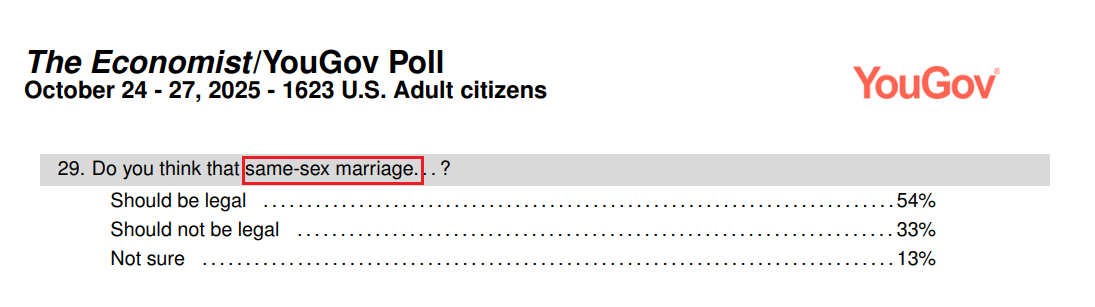
This downward movement may not signal a reversal, but it does suggest that moral and social attitudes are far less static than commonly believed. The supposed inevitability of cultural progress is meeting the complex reality of a nation still struggling to define the moral foundation of its laws and values.
Interestingly, the framing of the survey questions seems to have influenced the responses. YouGov phrased its question in terms of legality—whether same-sex marriage should be «legal or illegal»—a formulation that often elicits sharper moral instincts than Gallup’s more neutral “legal recognition with equal rights.” The result? A narrower majority. Some analysts find it telling that when the issue is posed in legal and ethical terms rather than in the language of equality, public conviction appears less certain.
Beyond the numbers lies a broader tension—one that goes to the heart of how modern America understands institutions that once carried a sacred weight. Marriage, as its etymology reminds us, derives from «matris munia», the “duties of the mother”—an institution historically tied to procreation, stability, and the social good. To many, its redefinition as a purely emotional contract between any two consenting adults has stripped it of its anthropological and spiritual core.
What we may be witnessing is the early fruit of a quiet countercurrent: a resistance not necessarily born of animosity, but of fatigue with ideological absolutes. Across the political spectrum, some Americans are beginning to question whether the so-called “progressive line of history” truly points forward, or merely away from meaning.
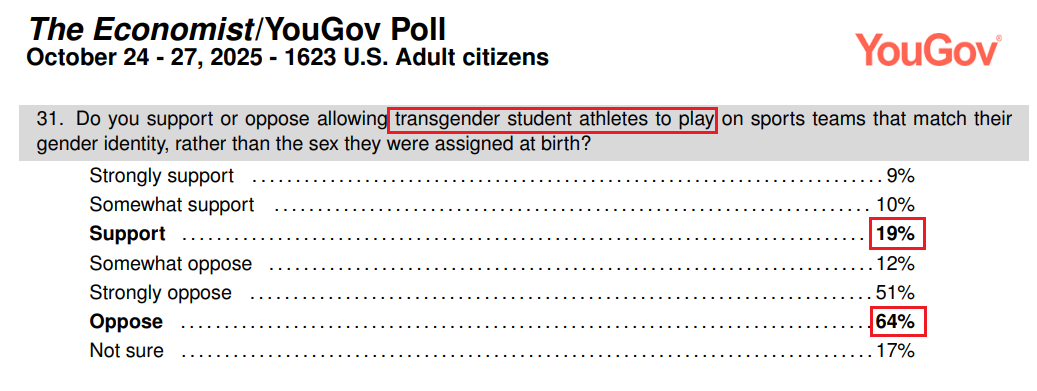
The same YouGov poll also addressed another contentious issue—the participation of transgender athletes in women’s sports. Here, the results were far less ambiguous: 64 percent of respondents opposed it, compared to just 19 percent in favor. This overwhelming disapproval has remained consistent across several studies in recent years, reflecting a rare area of consensus in a deeply divided nation.
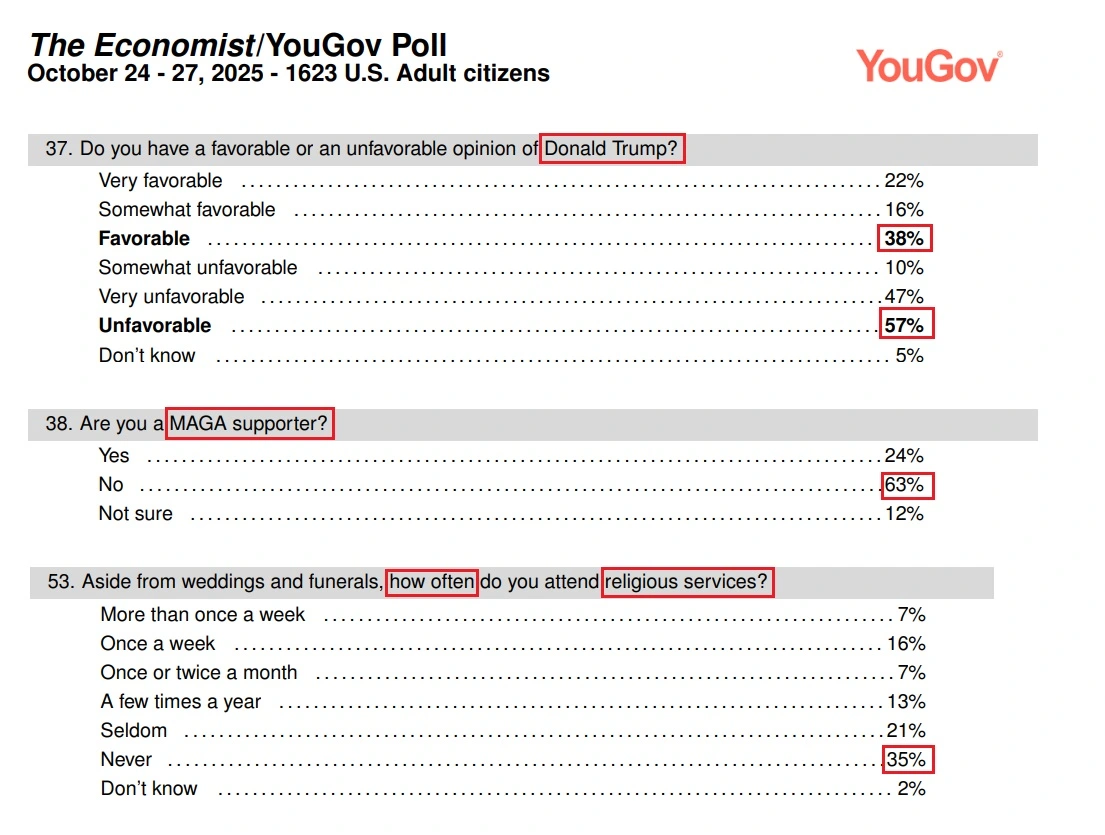
Skeptics might argue that the sample leans conservative or pro-Trump, but the data undermine that assumption. Only 57 percent of respondents described themselves as non-Trump supporters, and 35 percent said they never attend religious services—hardly a profile of a traditionalist base. Even so, the instinct to draw moral boundaries remains palpable among large segments of the population, religious or not.
Meanwhile, in several states, new legislative efforts are quietly emerging to challenge the “Obergefell” precedent itself. Lawmakers, emboldened by the Supreme Court’s 2022 reversal of “Roe v. Wade”, are filing motions aimed at inviting the justices to revisit the same-sex marriage ruling. For these advocates, the comparison is more than symbolic: if the nation could overturn a “settled” decision after nearly fifty years on abortion, why not one less than a decade old?
The United States, then, finds itself in a peculiar moral interregnum—caught between two ages, neither of which can fully claim victory. On one side stands the belief that moral progress is inevitable, that history always bends toward greater individual autonomy. On the other is a growing skepticism, a sense that some “advances” may have come at the cost of coherence, community, and truth.
Perhaps the most revealing lesson of this moment is that no cultural triumph is immune to re-examination. The assumption that moral evolution moves in one direction has always been more ideological than historical. Human beings do not live on a timeline—they live in conscience. And conscience, unlike history, can change course.
Thank you for reading our content. If you would like to receive ZENIT’s daily e-mail news, you can subscribe for free through this link.

Publicaciones relacionadas:
 About the Scandal in New York’s Cathedral of Gay Irreverence During a Funeral and What This Has To Do with Fiducia Supplicans
 Homosexuality Is Not Genetic, British Data Confirms
 Does a pontificate influence LGBT+ acceptance by the clergy? A study provides the answer
 Is the Bible clear when it comes to homosexuality? Study shows what believers think
