

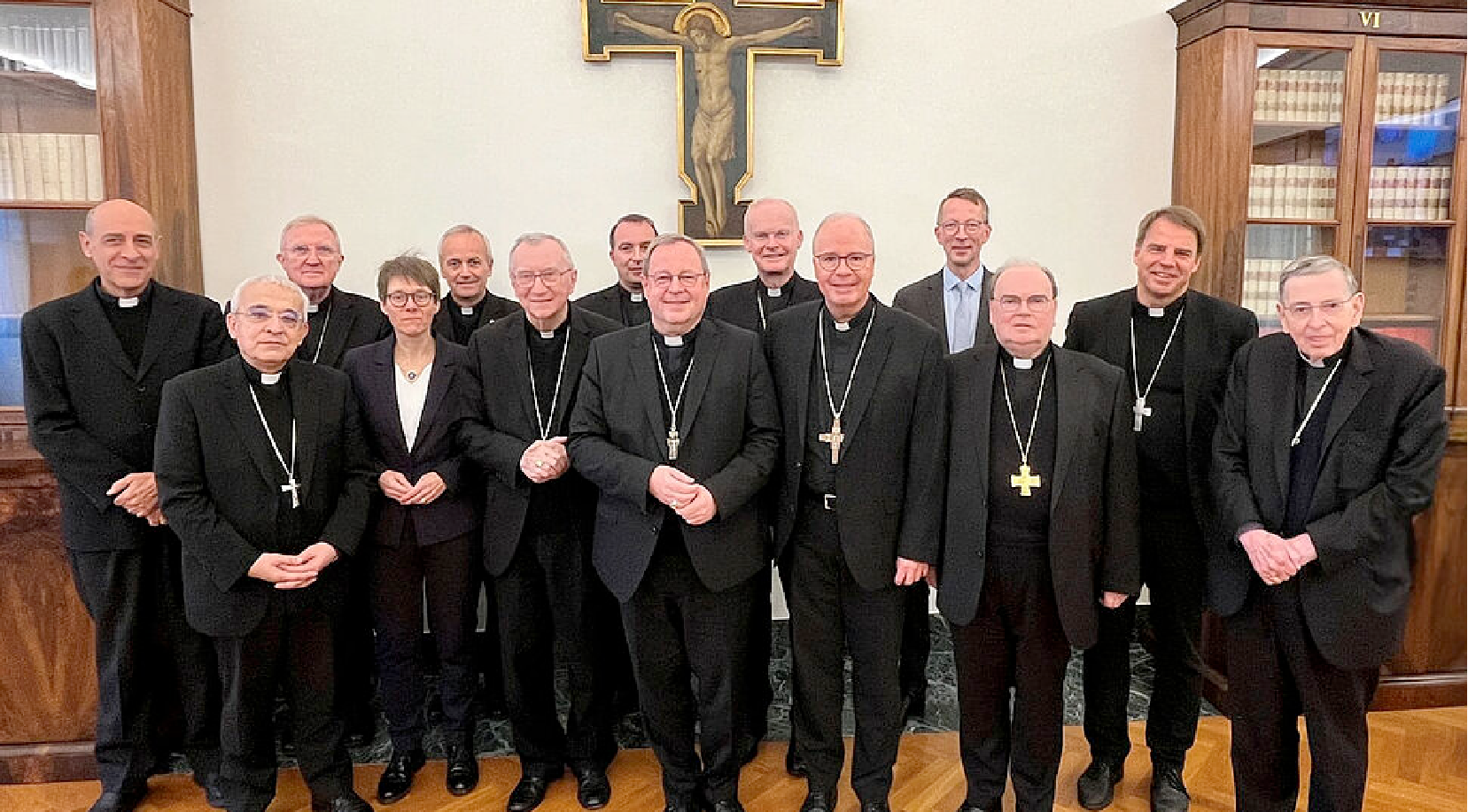
(ZENIT News / Vatican City, 11.12.2025).- Representatives of the Roman Curia and the German Bishops’ Conference met once again on November 12, 2025. It was the latest chapter in a dialogue that began three years ago amid tension, hope, and deep questions about the future of the Catholic Church in Germany—and, by extension, in the world.
The meeting, part of the continuing process set in motion during the German bishops’ ad limina visit of November 2022, follows earlier sessions held in July 2023, March 2024, and June 2024. Each encounter has sought to find a path forward for what has become one of the most ambitious and controversial ecclesial experiments in decades: the so-called Synodal Path, and its proposed governing body, the “Synodal Council” or “Synodal Conference.”
According to Vatican sources, this most recent round of discussions unfolded in what both sides described as an atmosphere of “honesty, openness, and constructive spirit.” Yet the tone of cordiality only partially conceals the magnitude of what is at stake. The German bishops, seeking to institutionalize the shared participation of clergy and laity in decision-making, are attempting to craft statutes for a national synodal body with consultative and potentially coordinating functions. The Vatican, while not opposing dialogue or participation per se, has warned repeatedly that no local structure can assume authority parallel to—or independent from—the universal governance of the Church.
The delegation from the Holy See included four influential cardinals: Víctor Manuel Fernández, prefect of the Dicastery for the Doctrine of the Faith; Kurt Koch, head of the Dicastery for Promoting Christian Unity; Pietro Parolin, the Vatican Secretary of State; and Arthur Roche, prefect of the Dicastery for Divine Worship. Archbishop Filippo Iannone, O.Carm., president of the Dicastery for Legislative Texts, also participated, reflecting the juridical sensitivity of the matter.
From the German side came Bishops Stephan Ackermann, Georg Bätzing (the conference president), Bertram Meier, and Franz-Josef Overbeck, joined by the conference’s secretary general, Dr. Beate Gilles, and its spokesperson, Dr. Matthias Kopp. Bishop Stefan Oster, SDB, attended as an invited guest, known for his careful theological approach and his concern for ecclesial unity.
While no communiqué revealed details of specific proposals, participants confirmed that the talks centered on the future “Synodal Conference”—its nature, composition, and competences. Behind those terms lie fundamental questions: How far can local churches embody synodality without fracturing the communion that binds them to Rome? Can national bodies exercise real deliberative power without eroding episcopal authority or the Petrine primacy?
Observers note that both sides have learned to navigate the complexity of these talks with increasing nuance. What began in 2022 as a confrontation—marked by Roman warnings and German frustration—has evolved into a dialogue that acknowledges differences without denying communion. One senior Vatican official described the atmosphere as “tense but maturing,” while a German participant spoke of “a necessary friction that can refine both our understanding of synodality and our sense of belonging to the universal Church.”
For Pope Leo XIV, who inherited this delicate dossier from his predecessor Francis, the German question represents both a challenge and an opportunity. It tests the balance between legitimate decentralization and doctrinal coherence, between creativity and fidelity. In recent months, the pope has spoken repeatedly of “synodality as a way of being Church,” while cautioning that “no synod can exist apart from communion.”
The German bishops, for their part, face internal divisions and mounting pressure from a laity that demands greater participation in governance, transparency in finances, and accountability in response to the clerical abuse crisis. Many see the proposed Synodal Conference as a chance to rebuild trust, to make decisions collaboratively, and to demonstrate that reform is not rebellion but renewal.
The road ahead remains uncertain. Further meetings are expected in early 2026, as working groups refine draft statutes to be presented for review in both Rome and Bonn. Whether these efforts will yield a model acceptable to both the Vatican and the German Church—or simply postpone an inevitable clash—remains to be seen.
Thank you for reading our content. If you would like to receive ZENIT’s daily e-mail news, you can subscribe for free through this link.

Publicaciones relacionadas:
 Cardinal Ouellet Says “The Interpretation and Diffusion of Accusations as Sexual Aggressions Is Defamatory”
 Third Vatican Pronouncement on Apparitions: Negative for “Our Lady of All Nations”
 Vatican Dissolves Miles Christi Religious Institute Amid Ongoing Scandals
 Vatican contradicts German bishops: text for blessing same-sex couples was not approved
