


(ZENIT News / Rome, 11.25.2025).- A new national survey suggests that Catholic college students consider themselves well informed, yet consume news in ways that would have been unrecognizable to generation-old campus cultures. For a demographic raised amid infinite scrolling and algorithmic feeds, information flows less from printed pages or long-form reporting and more from short videos, social clips and influencers who sit miles outside traditional journalism.
The study, commissioned by the National Catholic Reporter and the Wittcoff Foundation, set out to understand how young Catholics at four-year institutions—both Catholic and secular—approach not only faith and politics, but also the act of staying informed. Conducted online between October 17 and 25 and involving 401 students, it offers a portrait of a media ecosystem where attention gravitates overwhelmingly toward screens, not text.
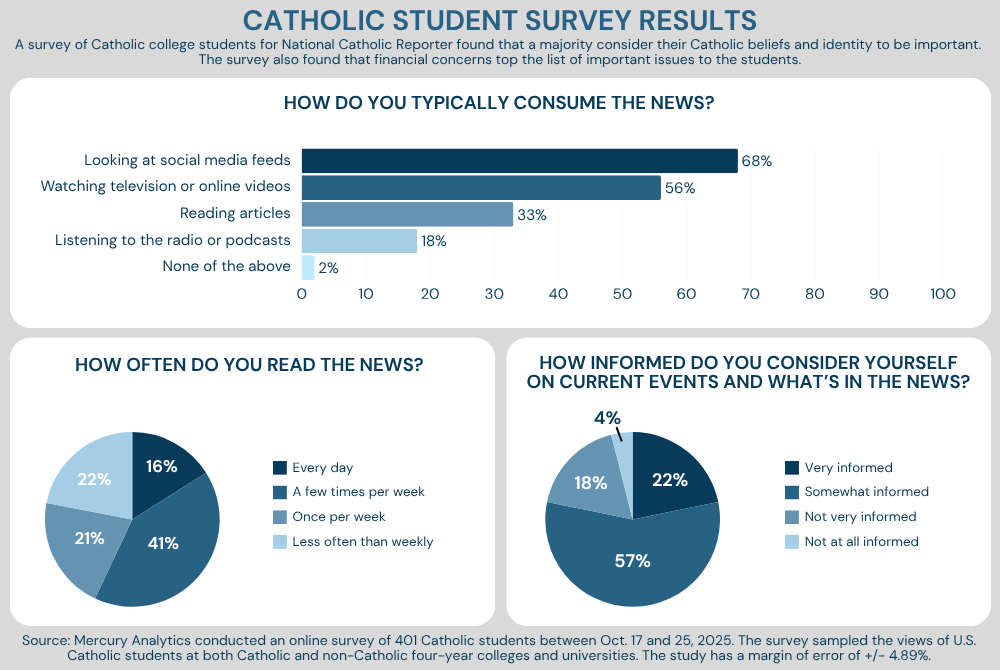
The contrast between perceived awareness and actual reading habits is one of the survey’s more striking findings. Seventy-eight percent of participants said they feel very or fairly informed about current events. Yet only sixteen percent read news daily. For most, staying up to date means dipping in and out of the stream: forty-one percent read the news several times a week, while twenty-two percent do so less than weekly. The confidence of being “in the know” does not necessarily correspond to sustained engagement with written journalism.
The dominance of visual platforms in shaping their worldview is unmistakable. Sixty-eight percent cited social media as their primary news source, followed by fifty-six percent who rely on television or online video. Only a third said they regularly read articles. Radio and podcasts—a staple for older adults—barely registered at eighteen percent.
Comments from students help explain the numbers with refreshing candor: reading, some said, feels “boring,” while videos offer “better focus,” “easier digestion,” and the guarantee of actually finishing something. In their media diet, the written word has become the optional side dish, not the main course.
The platforms they mentioned form a constellation familiar to anyone who observes Gen Z: TikTok leads the pack at fifty-six percent, followed closely by Instagram at fifty-two and YouTube at forty-five. Twitter/X, once the dominant arena for real-time updates, shows greater use among students at Catholic universities (forty-four percent) compared to their peers at non-Catholic institutions (twenty-nine). Meanwhile, those in secular universities leaned more heavily on Instagram—fifty-four percent compared to forty-one percent among Catholic-school counterparts.
Influencers, comedians and political firebrands also appear in the mix. Names such as Candace Owens, Charlie Kirk, and late-night hosts like Kimmel, Colbert and Fallon surfaced in student responses, hinting at the blend of commentary, entertainment and ideology that increasingly substitutes for conventional reporting. Kirk’s own story—his death in September after being shot at a public event—was, for many, encountered through the same channels that became their gateway to political news.
Politics itself remains the most consistently followed topic, noted by sixty percent of respondents. Sports came next, while faith and religion occupied a more divided space: forty-five percent of students at Catholic universities said they follow religious news regularly, compared to just twenty-seven percent at secular institutions. Other interests—health, science, international affairs, celebrity culture—fell into a broad middle range, claimed by roughly a quarter to a third of students.
Despite their differences, the two groups of students showed fewer than ten-point gaps in nearly every category of consumption. Whether enrolled at a Catholic university or not, young adults seem united in their preference for rapid-fire content and their reluctance to linger over text.
For Rosie Chinea Shawver, executive director of the Catholic Campus Ministry Association, none of this is surprising. She sees the same patterns in her own household and argues that religious institutions must adapt their communication style if they hope to reach these students effectively. Short videos, she says, are no longer optional—they are essential.
To her, the recent approach of the U.S. Conference of Catholic Bishops offers a model worth replicating. After issuing a written statement on the human consequences of immigration enforcement on November 12, the conference released a concise companion video. In Shawver’s view, this dual approach—clear text paired with accessible visuals—is exactly the kind of communication strategy that resonates with the young Catholics surveyed.
One student’s reflection distills the entire generational shift: “I almost never finish an article,” the respondent admitted, “but I always finish a video.”
If institutions—church, media, or academic—hope to speak into the world these students inhabit, they may need to follow the same path: shorter, sharper, more visually compelling. The challenge ahead is ensuring that what is gained in speed and convenience does not come at the cost of depth, accuracy or discernment.
Thank you for reading our content. If you would like to receive ZENIT’s daily e-mail news, you can subscribe for free through this link.

Publicaciones relacionadas:
 USA: Students With A Religious Vocation Are Unable to Enter the Seminary or Convent Because of University Debt
 Transgender Identification Surges Among Young Adults: A Generational Shift or a Social Phenomenon?
 Australia: data suggest that more and more people are seeking God
 This is the first country to legally ban social media for children, and this is what studies say about it
