

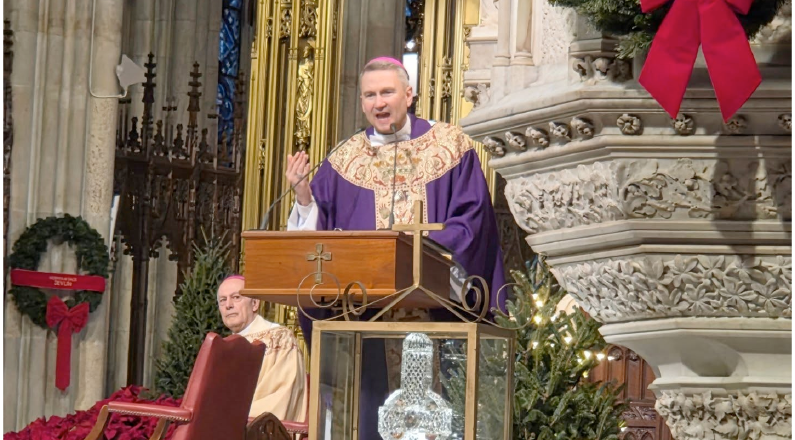
(ZENIT News / New York, 12.18.2025).- The appointment of Bishop Ronald A. Hicks as the next archbishop of New York is more than a routine episcopal transition. It signals a deliberate shift in tone and priorities for one of the most visible Catholic sees in the United States, at a moment when the Church is navigating political polarization, institutional reckoning, and profound cultural change.
On December 18, Pope Leo XIV accepted the resignation of Cardinal Timothy Dolan, who had led the Archdiocese of New York for nearly seventeen years, and named Hicks, the bishop of Joliet, Illinois, as his successor. Hicks, 58, will be installed on February 6 as the eleventh archbishop of New York, assuming pastoral responsibility for roughly 2.5 million Catholics spread across New York City and seven surrounding counties.
The contrast between the outgoing and incoming archbishops is striking. Dolan’s tenure was defined by public visibility, media fluency, and a prominent role in national political debates. He cultivated relationships at the highest levels of American power, including close ties to President Donald Trump, hosted high-profile events such as the Al Smith Dinner, and became one of the most recognizable Catholic voices in public life. His leadership style made New York a national platform for Catholic engagement, but also drew criticism from across the ideological spectrum.
Hicks arrives with a markedly different profile. Formed entirely within the ecclesial culture of Chicago, he is known less for public confrontation than for pastoral presence and institutional steadiness. Born in Harvey, Illinois, and raised in the southern suburbs of Chicago, he grew up just blocks from the childhood home of the future Pope Leo XIV, then Robert Prevost. Though the two men only met personally in 2024, Hicks has spoken openly about recognizing in Prevost a shared pastoral instinct: a preference for listening before speaking, and for building bridges rather than sharpening divides.
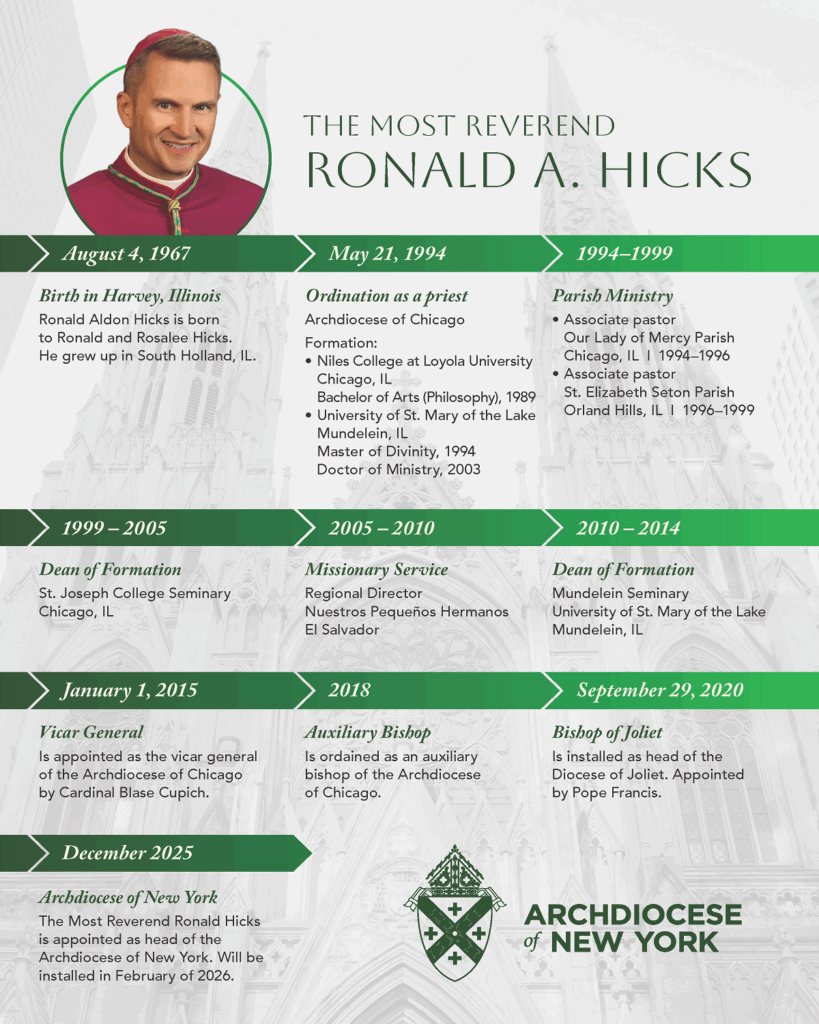
Ordained a priest in 1994, Hicks spent years in parish ministry and priestly formation before moving into diocesan leadership. His five-year period in El Salvador, where he directed a Church-run network of orphanages serving thousands of children across Latin America and the Caribbean, is often cited by colleagues as a formative chapter. The experience shaped his fluency in Spanish and grounded his pastoral outlook in lived proximity to poverty, migration, and vulnerability.
Those years resonate strongly with the realities of New York. More than one million Catholics in the archdiocese are Hispanic, and immigration remains one of the most sensitive and pressing issues facing the local Church. Hicks has not hesitated to speak on the subject. In November, he publicly supported a statement by the U.S. bishops condemning aggressive immigration raids carried out by the Trump administration, emphasizing Catholic social teaching on human dignity and the need for meaningful reform. Observers expect that voice to carry greater national weight once he assumes leadership in New York.
Institutionally, Hicks inherits an archdiocese under strain. New York is in the midst of liquidating major assets to fund a $300 million compensation program for survivors of clerical sexual abuse, part of a broader effort to resolve roughly 1,300 pending claims. The process includes the sale of historic properties and ongoing mediation with insurers, alongside declining priestly vocations and long-term decreases in Mass attendance. Only two men applied to the archdiocesan seminary in 2024, a stark indicator of the challenges ahead.
Hicks is no stranger to these realities. In Illinois, he led the Diocese of Joliet amid the fallout from a sweeping attorney general’s report that documented decades of abuse and episcopal failures across the state. While the report acknowledged improvements in safeguarding policies under his leadership, it underscored the depth of institutional wounds he now faces again on a larger scale. In public remarks following his appointment, Hicks stressed that the Church can never “rest” in its efforts to protect children and accompany survivors, even as it seeks to continue its broader mission.
Those who know him describe a leader shaped by discipline, routine, and consultation. Former mentors and colleagues consistently highlight his instinct to listen before acting, a style closely aligned with the synodal emphasis promoted by Pope Francis and continued by Leo XIV. Friends recall him walking daily between parish and office in Chicago, using the rhythm of the city as space for reflection after long hours of administration.
That temperament may define his early months in New York. Rather than arriving with sweeping reforms, Hicks has indicated a desire to learn the archdiocese from within, meeting clergy, lay leaders, and communities before setting priorities. In his first public comments, including remarks delivered partly in Spanish, he emphasized unity, cooperation across civic and religious boundaries, and a commitment to the dignity of every person.
The appointment also reflects a broader recalibration underway in Rome’s approach to U.S. Catholic leadership. By elevating a Midwestern bishop with missionary experience, bilingual fluency, and a lower media profile, Pope Leo XIV appears to be signaling continuity with a pastoral, listening-centered model of governance. The era of headline-driven Catholic politics may not be over, but it is no longer the sole template for influence.
For New York, the change closes a highly distinctive chapter and opens a quieter, but potentially transformative one. Hicks steps into a city defined by migration, diversity, and contradiction, where the Church’s credibility will depend less on rhetoric than on presence. Whether his style can restore trust, stabilize institutions, and speak credibly to a fractured society remains to be seen. What is clear is that the center of gravity in America’s most visible archdiocese has shifted.
Thank you for reading our content. If you would like to receive ZENIT’s daily e-mail news, you can subscribe for free through this link.

Publicaciones relacionadas:
 Cardinal Timothy Dolan to Open President Trump’s Inauguration with Prayer
 After just four months as bishop of Detroit, the new bishop dismisses three beloved professors from the local seminary
 This is how the inauguration of the new Catholic Archbishop of Westminster went
 Heiner Wilmer takes the helm of the German Bishops’ Conference: he will present the controversial Synodal Conference to the Vatican
