

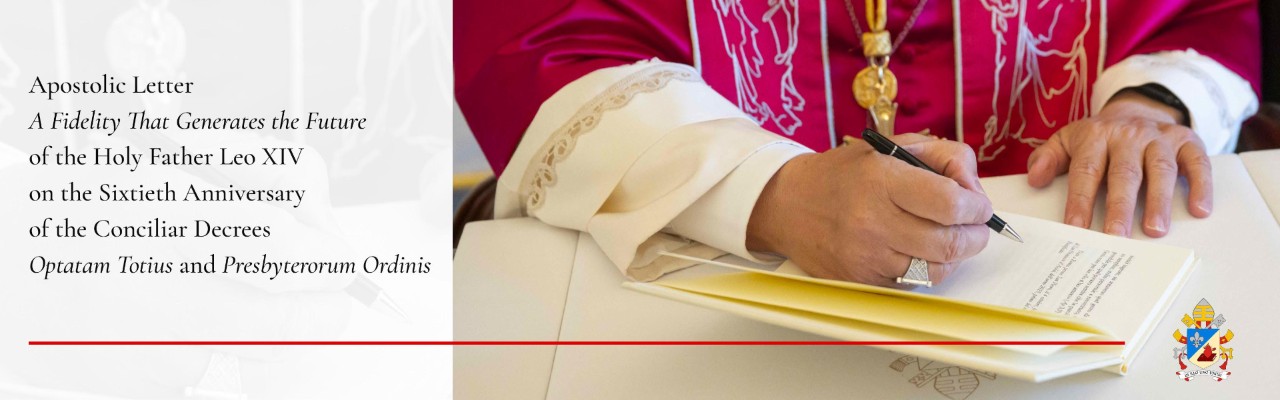
(ZENIT News / Rome, 12.22.2025).- Sixty years after the Second Vatican Council offered its decisive reflections on priestly formation and ministry, Pope Leo XIV has chosen neither nostalgia nor abstract commemoration. His Apostolic Letter, A Fidelity That Generates the Future, released on 22 December and dated 8 December, reads instead as a sober and demanding diagnosis of the present condition of the priesthood, coupled with a pastoral roadmap aimed squarely at what lies ahead.
The anniversary of Optatam totius and Presbyterorum ordinis provides the historical frame, but the Pope’s concern is unmistakably contemporary. The Church, he observes implicitly, no longer inhabits the social or cultural landscape of 1965. Priests today minister amid fractured communities, diminished trust, and a profound crisis of credibility brought about by abuse scandals and by the quiet, often painful departure of men from ordained ministry after years or even decades of service. Against this backdrop, fidelity is not presented as static loyalty to past forms, but as a dynamic posture capable of generating life, hope, and vocations.
At the heart of the letter lies a relational understanding of priesthood. Leo XIV repeatedly resists any temptation to isolate the priest as a solitary figure or to define ministry in self-referential terms. The priest exists within a web of relationships: with Christ, with the bishop, with fellow presbyters, and with the People of God. Detached from this network, the priest risks drifting into narcissism or burnout. Rooted in it, he becomes a credible sign of communion in a fragmented world.
This insistence on communion shapes the Pope’s treatment of formation, which he describes as lifelong and integral. Seminary years, important as they are, cannot bear the full weight of vocational maturation. Formation must accompany priests throughout their lives, integrating human, spiritual, intellectual, and pastoral dimensions. Leo XIV does not shy away from naming the stakes. The wounds inflicted by abuse, he writes, have forced the Church to recognize with greater clarity the urgency of genuine human and affective maturity, sustained by a solid spiritual life. Formation, in this sense, becomes not a bureaucratic requirement but a moral imperative for the credibility of the Gospel itself.
Equally striking is the Pope’s tone when addressing those who have left the ministry. Rather than framing their situation primarily in juridical categories, he calls for attentive and compassionate listening to their stories. The phenomenon, he suggests, reveals gaps in accompaniment and formation that demand renewed commitment rather than defensive reflexes. Fidelity, here, includes the humility to learn from failure and loss.
Fraternity among priests emerges as another non-negotiable pillar. Leo XIV describes it not as a slogan or optional virtue, but as a constitutive element of priestly identity, rooted in the sacrament of Orders itself. This fraternity must take concrete form, extending from spiritual companionship to material justice, including equitable financial support and adequate care for sickness and old age. Attention to priests who are isolated, elderly, or ill, the Pope insists, is not secondary to pastoral care of the faithful but part of the same evangelical responsibility.
The letter also confronts one of the most pervasive threats to contemporary ministry: solitude. In societies marked by mobility and social fragmentation, priests often find themselves without the natural networks that once sustained parish life. Leo XIV echoes his predecessors in encouraging forms of shared life and collaboration, not as nostalgic returns to past models, but as realistic responses to conditions that sap apostolic energy and foster inward withdrawal.
Synodality provides the broader ecclesial horizon for these reflections. The Pope is clear that a more synodal Church does not diminish the priesthood; rather, it purifies and clarifies it. He calls for moving beyond models of exclusive, centralized leadership toward genuinely collegial pastoral governance, where priests, deacons, and lay faithful cooperate according to their distinct charisms. Sacramental authority, he cautions, must never be confused with power. Its true measure is service.
Within this vision, particular attention is given to the permanent diaconate, which Leo XIV describes as a discreet yet essential ministry, embodying Christ the Servant. Alongside this, he urges a fuller appreciation of the vocation of the laity, inviting priests to become more familiar with the synodal path and its final documents, not as administrative texts but as instruments for shared discernment.
The Pope’s analysis extends to the spiritual and cultural pressures shaping ministry today. In a hyperconnected world, he warns against two opposing temptations. One is an efficiency-driven activism that measures worth by productivity and visibility, often amplified by uncritical use of media. The other is a defensive quietism that retreats from evangelization under the weight of discouragement. Both, he argues, hollow out priestly joy. Authentic fruitfulness arises instead from pastoral charity rooted in prayer, sobriety of life, chastity, and a renewed capacity for genuine relationships.
Looking to the future, Leo XIV frames the entire letter within a vocational horizon. The anniversary of the conciliar decrees, he hopes, will not remain a scholarly exercise but will ignite what he calls a renewed vocational Pentecost. The shortage of priestly vocations in many regions, he notes, cannot be addressed by strategies alone. It demands a searching examination of the Church’s pastoral practices and their capacity to generate and sustain generous responses to God’s call.
The closing pages return to gratitude and trust. The Pope thanks priests for their often unseen fidelity and entrusts seminarians, deacons, and presbyters to the intercession of the Virgin Mary and Saint John Mary Vianney. Beneath the document’s sober realism runs a quiet conviction: the future of the Church does not depend on novelty for its own sake, but on a fidelity humble enough to be converted, fraternal enough to be shared, and courageous enough to open new paths where the Gospel can take flesh today.
Thank you for reading our content. If you would like to receive ZENIT’s daily e-mail news, you can subscribe for free through this link.

Publicaciones relacionadas:
 Leo XIV: A Pope Who Ordains Priests Again (And Other Masses During May 2025)
 Jesus, the Liturgy, and Vocation: What Pope Leo XIV Told French Altar Boys That Every Altar Boy Should Know
 Pope Leo XIV to priests: no to homilies with Artificial Intelligence and the search for “likes” and “followers” on social media
 The sacrament of confession (reconciliation or penance), beautifully explained by Pope Leo XIV to young priests and seminarians
