

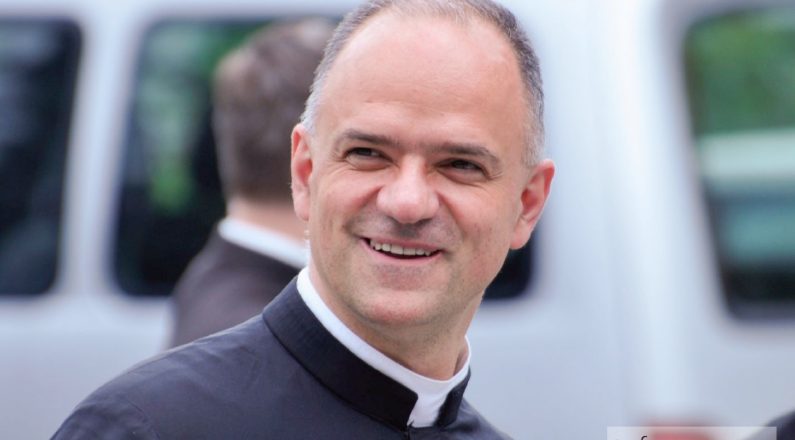
(ZENIT News / Rome, 01.09.2026).- In a packed hall in Friedrichshafen, southern Germany, on December 13, Father Davide Pagliarani, Superior General of the Society of St. Pius X (FSSPX), addressed one of the most sensitive questions surrounding the traditionalist group: the possibility of future episcopal consecrations and the deeper crisis he believes continues to afflict the Catholic Church. His approach was measured, deliberately restrained, and framed less as an announcement than as a call to prayer, patience, and what he repeatedly described as “supernatural prudence.”
Speaking in French, with portions translated into German, Pagliarani made clear from the outset that he would not provide dates or names related to any potential consecrations. Instead, he asked those present to treat the matter as a serious intention for prayer. Among the audience were prominent figures within the FSSPX, including two former Superiors General: Bishop Bernard Fellay and Father Franz Schmidberger, whose presence underscored the gravity of the moment.
At the heart of Pagliarani’s intervention was the concept of a “state of necessity,” a canonical and theological argument long invoked by the Society. He recalled that Archbishop Marcel Lefebvre reached this conclusion in 1988, interpreting the 1986 interreligious meeting in Assisi as a decisive sign that justified extraordinary measures. Far from diminishing, Pagliarani argued, that situation has intensified over time, particularly during the pontificate of Pope Francis.
“After the pontificate of Pope Francis,” he said, that period included decisions that were “transcendental, catastrophic… and enduring.” Although Francis has since died, Pagliarani insisted that the effects of those choices remain embedded in the life of the Church. In his assessment, the entire pontificate “represents and expresses this state of necessity,” a condition that, he maintained, already justifies the apostolate of the Society regardless of any discussion about consecrations.
Pagliarani gave the concept concrete form. Entering what he called an ordinary parish today, he argued, no longer guarantees access to the essential means of salvation: the preaching of truth and the sacraments. This diagnosis, he said, is “much easier to observe” now than it was in 1988, when Lefebvre took his most controversial step.
Revisiting that moment, Pagliarani portrayed the episcopal consecrations carried out in 1988 not as a reckless rupture but as “an act of virtue,” specifically an act of supernatural prudence. Lefebvre, he emphasized, waited, prayed, and acted openly only when he judged the moment to be right, despite the deep disagreements that surrounded him at the time. As years pass, Pagliarani added, the number of those who recognize the value of that decision continues to grow.
The historical consequences of 1988 remain central to the Society’s narrative. Those consecrations led to the declaration of automatic excommunication of Lefebvre himself, his co-consecrator Bishop Antônio de Castro Mayer, and the four bishops ordained in that ceremony. The FSSPX has consistently disputed the validity of that penalty. In 2009, years after the deaths of the two consecrating bishops, the Vatican formally lifted the excommunications of the four surviving men. Since then, two of those bishops have also died, leaving only Bernard Fellay and Alfonso de Galarreta among the original four.
If additional consecrations were ever to occur, Pagliarani cautioned, preparation would have to extend far beyond arguments and ceremonial details. What would be required above all is the formation of “hearts,” through prayer and spiritual readiness. Any such step, he insisted, would be taken for the good of the Church itself, not merely to address the internal needs of the Society.
In closing, Pagliarani stressed continuity rather than rupture. The FSSPX, he said, would explain its actions to Rome and to the faithful “with the greatest transparency” if and when the time comes. The Society’s spirit, he argued, has not changed. He likened it to a rocket that may alter speed or altitude but remains fundamentally the same vehicle.
The question he left hanging was deliberate and unresolved. He acknowledged the expectations of many, even at the risk of disappointing them, but returned to the same refrain: no dates, no names, only an invitation to prayer. Whether the present moment mirrors 1988, he suggested, is not merely a matter of strategy or timing, but of discerning whether the state of necessity that Lefebvre once identified continues to demand extraordinary measures today.
Thank you for reading our content. If you would like to receive ZENIT’s daily e-mail news, you can subscribe for free through this link.

Publicaciones relacionadas:
 USA: Ruling against Apple for freedom of speech and freedom of religion
 Franciscan Friar Is Appointed President of the Italian Government’s Commission for Artificial Intelligence
 Scotland: Church voices concern as government looks into banning ‘conversion practices’
 Lebanon: Maronite Catholic patriarch says Lebanese oppose war against Israel
