

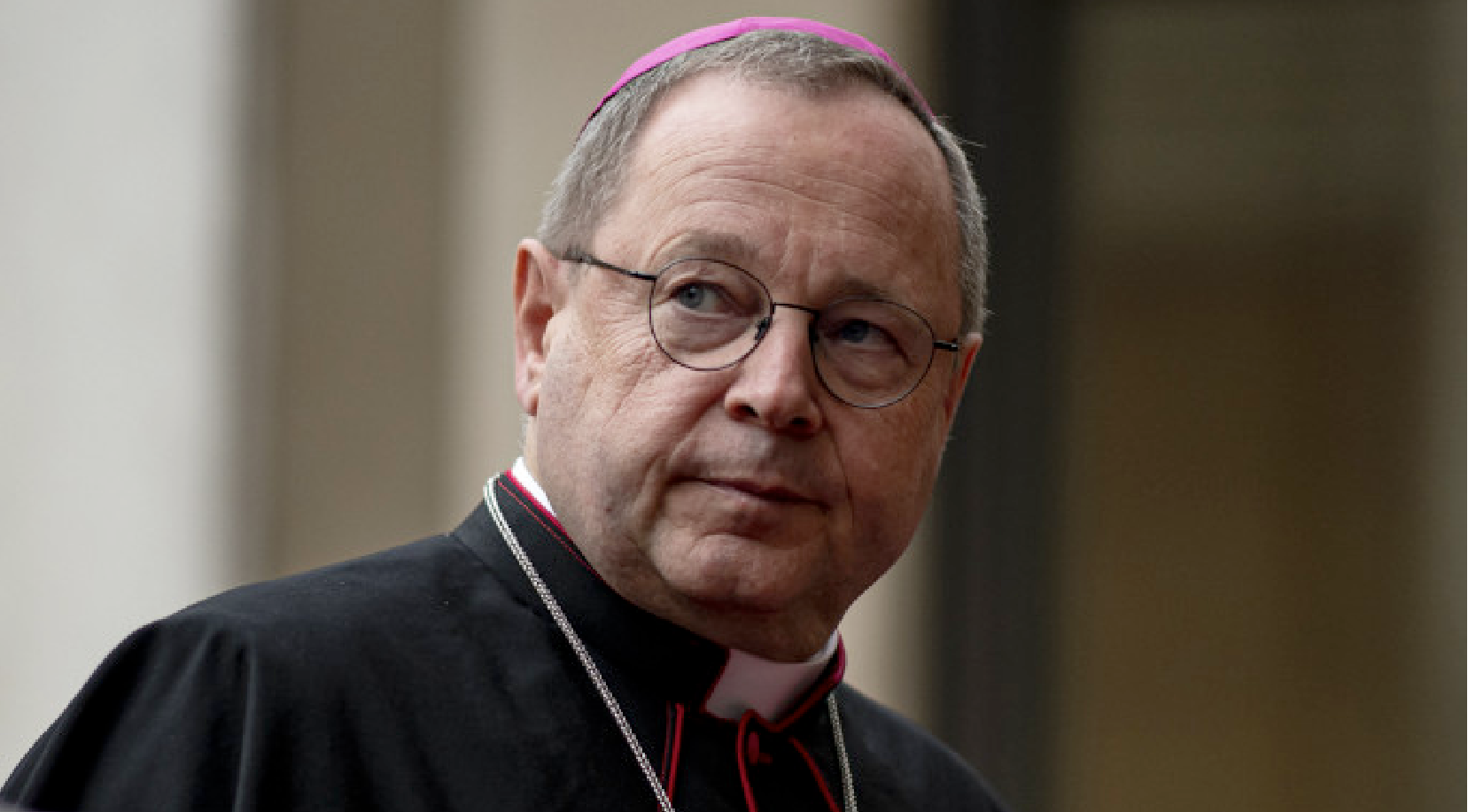
(ZENIT News / Berlin, 01.20.2026).- The German Catholic Church is preparing for a significant transition. Bishop Georg Bätzing of Limburg, one of the most influential and controversial church leaders in Europe over the past decade, has announced that he will not seek a second term as president of the German Bishops’ Conference (DBK). His decision, communicated in a letter to fellow bishops, closes a six-year chapter defined by crisis management, ambitious reform efforts, and sustained tension with Rome.
Bätzing, 64, has led the DBK since March 2020, assuming office just as the COVID-19 pandemic began to disrupt church life and broader society. From the outset, his presidency unfolded under extraordinary pressure. Public worship was suspended during lockdowns, confidence in church institutions was already shaken by the abuse crisis, and the so-called Synodal Way was gaining momentum as the most far-reaching reform process in the history of German Catholicism.
In his message, Bätzing described his leadership as a service carried out in “truly demanding times” that nonetheless opened new possibilities for shaping the future of the Church. He thanked the staff of the bishops’ conference secretariat and encouraged his colleagues to continue speaking openly, engaging in constructive debate, and strengthening mutual bonds in order to witness together to the joy of the faith in Germany and beyond.
Behind the measured tone lies a presidency that has profoundly divided opinions. As president of the DBK and co-chair of the Synodal Way’s governing body alongside Irme Stetter-Karp, president of the Central Committee of German Catholics (ZdK), Bätzing became the public face of a reform agenda addressing sexual morality, clerical power, women’s roles, and priestly life. Supporters credit him with giving institutional form to long-suppressed debates after the 2018 MHG study exposed systemic failures in dealing with sexual abuse. Critics, including several bishops and Vatican officials, accused the process of pushing Germany to the edge of ecclesial rupture.
That tension has only intensified as the Synodal Way reaches its formal conclusion. The sixth and final Synodal Assembly is scheduled to take place in Stuttgart at the end of January 2026. Despite explicit warnings from the Holy See, delegates are expected to advance plans for a permanent synodal body that would, for the first time, exercise authority above individual diocesan bishops. Rome has repeatedly questioned the compatibility of such a structure with Catholic ecclesiology, making the coming weeks particularly sensitive.
Bätzing’s decision not to stand again opens the field ahead of the bishops’ spring plenary assembly, to be held from 23 to 26 February 2026 in Würzburg. According to the statutes, the next president will be elected for a six-year term, a mandate that will inevitably be shaped by how Germany recalibrates its relationship with the universal Church after years of friction.
Several names are circulating as possible successors. Bishop Heiner Wilmer of Hildesheim is often mentioned as a candidate with strong international credentials, having spent many years working in Rome and being regarded as attentive to the concerns of the wider Church. Bishops Udo Bentz of Paderborn and Peter Kohlgraf of Mainz are also seen as plausible contenders, though they are generally perceived as closer to the reformist trajectory associated with Bätzing.
Reactions from organized lay Catholicism underscore what is at stake. Irme Stetter-Karp has expressed regret at Bätzing’s departure, praising his collegial leadership and describing him as a committed and honest partner during the Synodal Way. Her remarks reflect a broader concern among reform-minded Catholics that a change at the top of the DBK could slow or redirect a process they see as essential for the Church’s credibility and future viability in Germany.
The broader ecclesial context adds further complexity. On 20 January, the Apostolic Nuncio to Germany, Archbishop Nikola Eterović, turned 75 and submitted his resignation to the Pope, as required by canon law. Eterović has been widely viewed as critical of the German reform agenda. If Rome accepts his resignation swiftly, both the leadership of the bishops’ conference and the Vatican’s diplomatic representation in Berlin could change within the same year, potentially altering the tone of dialogue between Germany and the Holy See.
Bätzing leaves behind a Church that is, by many measures, more fragmented than when he took office, though few observers would place the responsibility solely on his shoulders. His tenure coincided with unprecedented social polarization, accelerating secularization, and internal disputes that no single leader could easily resolve. What his departure does offer is a pause for reflection—and perhaps an opportunity for a different style of leadership.
Whether the German Bishops’ Conference will choose continuity or correction remains an open question. What is certain is that the next president will inherit a demanding agenda: managing the aftermath of the Synodal Way, restoring trust among divided bishops, and redefining Germany’s role within a global Church increasingly wary of national paths that appear to diverge from common discipline and doctrine.
Thank you for reading our content. If you would like to receive ZENIT’s daily e-mail news, you can subscribe for free through this link.

