

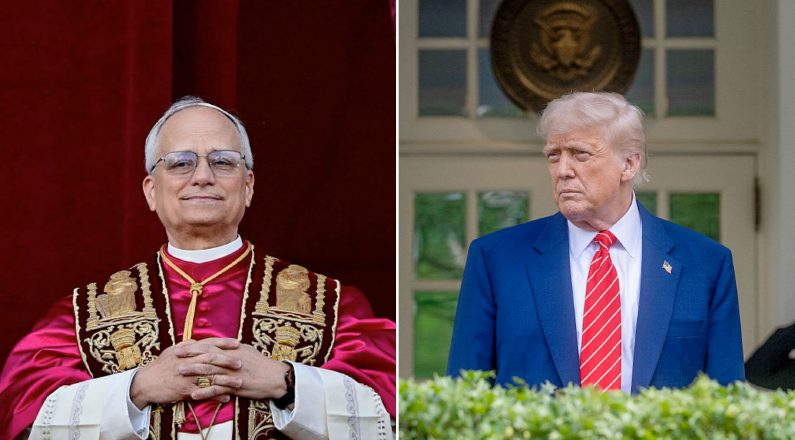
(ZENIT News / Rome, 01.21.2026).- As president Donald Trump presses ahead with an ambitious and controversial diplomatic initiative for Gaza, the Holy See has chosen a markedly cautious tone. The Vatican has confirmed that Pope León XIV himself has received an invitation to join the so-called Board of Peace for Gaza, but any decision, according to Cardinal Pietro Parolin, will require careful study and time.
Speaking in Rome on Wednesday, 21 January, on the margins of an event organized by the Osservatorio for Independent Thinking to mark its twenty-fifth anniversary, the Vatican Secretary of State made clear that the invitation places the Holy See in a distinct position compared with nation-states. “We too have received this invitation; the Pope has received it,” Parolin said. “We are examining what to do and going deeper into the matter. It is a question that requires some time in order to give an answer.”
Trump’s initiative envisions the creation of a new international body aimed at steering a political settlement in Gaza, an idea he has presented as an alternative to what he considers the chronic ineffectiveness of the United Nations. In public remarks, Trump argued that the UN “has not lived up to its potential” and suggested that the new board could even replace it in managing peace processes. Participation, however, comes at a price: each member country is expected to contribute 1 billion euros to be part of the Board of Peace.
On that point, Parolin was explicit. The Holy See, he said, is not in a position to participate financially. “We are not even able to do so,” he explained, adding that the Vatican’s role, if any, would necessarily differ from that of states with economic and military resources. His remarks implicitly recalled the Holy See’s traditional diplomatic profile, which rests on moral authority and mediation rather than financial leverage.
The geopolitical response to Trump’s proposal has been sharply divided. Israel has formally accepted the invitation, with Prime Minister Benjamin Netanyahu confirmed as a member of the board. A number of other countries have followed suit, including Argentina, Azerbaijan, Belarus, Hungary, Kazakhstan, Morocco, the United Arab Emirates and Vietnam. Kosovo’s president, Vjosa Osmani, announced her country’s participation in enthusiastic terms, recalling Washington’s decisive role in supporting Kosovo’s independence in 2008 and presenting the move as a continuation of that strategic alliance. Egypt, too, has accepted the invitation, with President Abdel Fattah al-Sisi’s government praising Trump’s Middle East policies and endorsing the board’s mission as part of a broader plan to end the Gaza conflict.
Europe, by contrast, appears deeply skeptical. France, Norway and Sweden have all declined to participate in the board “in its current form,” with Swedish Prime Minister Ulf Kristersson confirming the refusal from Davos. Italy, according to Parolin, is still reflecting on whether to join. The refusals have not been without consequences. Trump has openly threatened France with punitive tariffs of 200 percent on French wines and champagne.
Russia has adopted a wait-and-see approach. Kremlin spokesman Dmitry Peskov said Moscow still lacks essential details about the scope and mandate of the board and hopes to receive clarification through contacts with the American side. The uncertainty is compounded by the fact that both Russia and Belarus have reportedly received invitations, raising questions about whether the initiative is limited strictly to Gaza or embedded in a wider geopolitical framework.
Against this backdrop, Parolin’s broader comments on international tensions take on added weight. Asked about Trump’s assertion that he “loves Europe” but dislikes the direction it is taking, the Vatican Secretary of State refrained from polemics. “That is his point of view,” he said. What matters, Parolin insisted, is respect for international law. Personal sentiments, even when legitimate, must give way to the rules that govern the international community.
More pointedly, Parolin warned that the current climate of transatlantic friction is itself a problem. “Tensions are not healthy,” he observed. “They create a climate that worsens an international situation that is already serious.” His prescription was deliberately sober: reduce tensions, address controversial issues, but avoid escalating polemics that risk hardening positions rather than resolving conflicts.
The Vatican’s hesitation reflects more than procedural caution. Historically, the Holy See has been wary of ad hoc international mechanisms that bypass existing multilateral institutions without clear legal grounding. While it has often criticized the shortcomings of the United Nations, it has also consistently defended multilateralism as an imperfect but necessary framework for global order. Trump’s proposal, with its hefty financial threshold and its overtly political tone, sits uneasily within that tradition.
For now, the Holy See remains in discernment mode, neither endorsing nor rejecting the Board of Peace for Gaza. In a moment when international diplomacy appears increasingly transactional and polarized, the Vatican’s measured pause stands out as a reminder of a different diplomatic grammar, one that privileges patience, legal norms and moral consistency over speed and spectacle. Whether that approach will find a place within Trump’s fast-moving initiative remains an open question.
Thank you for reading our content. If you would like to receive ZENIT’s daily e-mail news, you can subscribe for free through this link.

