


(ZENIT News / Rome, 01.27.2026).- For nearly five decades, Gallup has taken the pulse of American moral confidence by asking a deceptively simple question: which professions deserve the most trust?
Since 1976, the polling giant has tracked how U.S. adults rate a wide range of occupations for honesty and ethical standards. Its latest survey, conducted between December 1 and 15, 2025, evaluated 21 professions—and the results offer a revealing snapshot of a society increasingly skeptical of institutions, authority figures, and even long-respected roles.
At the very top, one profession remains untouchable.
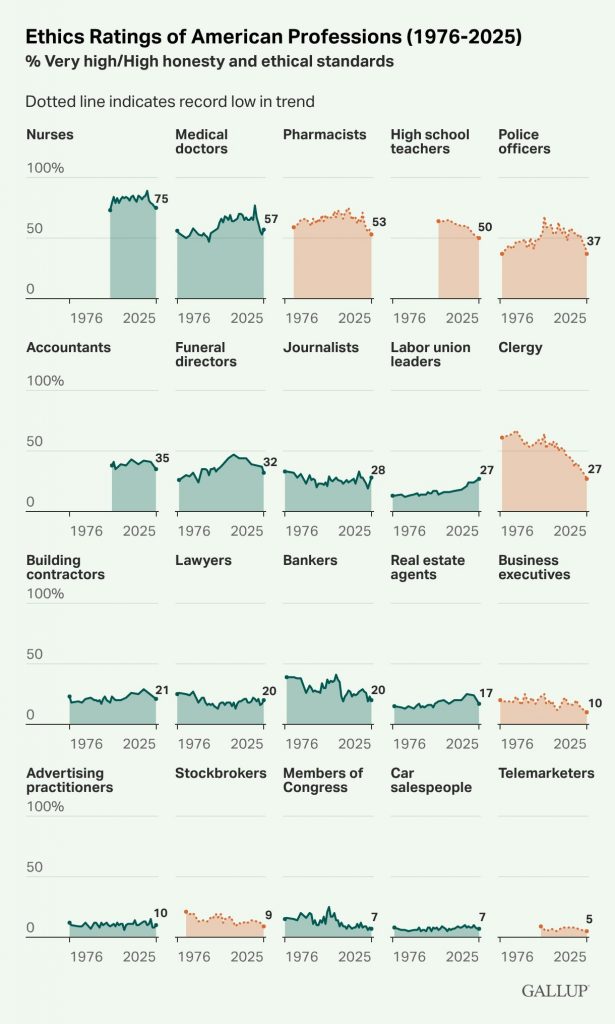
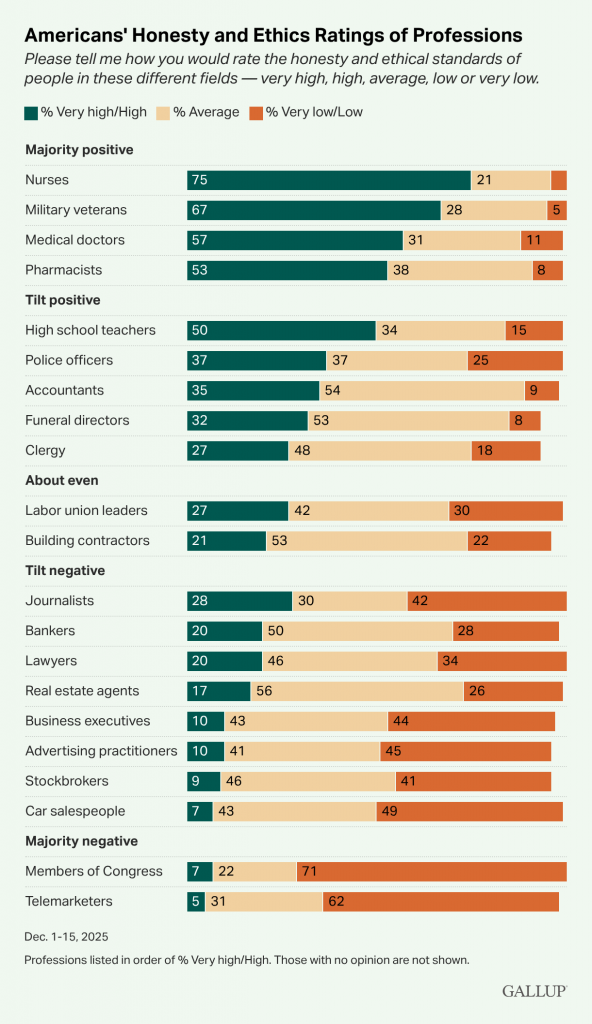
Nurses once again dominate the rankings, with 75% of respondents describing their ethical standards as “high” or “very high.” It marks roughly 25 consecutive years at number one, a remarkable run that underscores how frontline caregiving—especially in a post-pandemic era—continues to command deep public respect.
Medical professionals more broadly still fare well, though with noticeably less enthusiasm than in previous decades. Physicians earn a 57% positive rating, while pharmacists follow closely at 53%. These are the only occupations, alongside military veterans, that a clear majority of Americans still associate with high ethical conduct.
After that, the picture becomes far more fragmented.
Only four professions—nurses, veterans, doctors, and pharmacists—cross the 50% threshold. Five others are viewed more positively than negatively, but most fall into a large middle zone where Americans describe ethical standards as merely “average.”
And beneath that surface of moderation lies a troubling trend: erosion.
Seven of the 21 professions measured in 2025 either reached new historic lows or tied previous records for poor ethical perception. Pharmacists, high school teachers, clergy members, and corporate executives all slipped two to three percentage points below their former lows. Police officers, stockbrokers, and telemarketers returned to their worst-ever levels, with policing showing the most dramatic year-over-year change—a seven-point drop.
Another eight professions now hover statistically close to their own historical bottoms. This group includes accountants, advertisers, bankers, members of Congress, nurses, construction contractors, car salespeople, and real estate agents. The message is unmistakable: even traditionally stable occupations are no longer immune to public distrust.
At the opposite end of the scale, telemarketers (5%), members of Congress (7%), and car salespeople (7%) remain the least trusted professions in America.
Only one occupation—labor union leaders—achieved its highest ethical rating to date, but even that peak stands at a modest 27%, hardly a ringing endorsement.
A closer look at the distribution reveals how narrow the space of public confidence has become.
High school teachers, police officers, accountants, and funeral directors enjoy significantly more positive than negative ratings. Clergy members also fall into this relatively favorable group, though their margin is thinner, reflecting a growing ambivalence toward religious leadership.
By contrast, only two professions are viewed by a majority as having low or very low ethics: members of Congress and telemarketers. Yet eight additional occupations carry a net negative image, including car dealers, stockbrokers, corporate executives, advertisers, and journalists. Bankers, lawyers, and real estate agents also lean moderately negative.
The remaining two professions assessed in 2025—union leaders and construction contractors—split evenly between positive and negative views, with large segments of respondents labeling their ethics as simply average.
Politics, unsurprisingly, plays a decisive role.
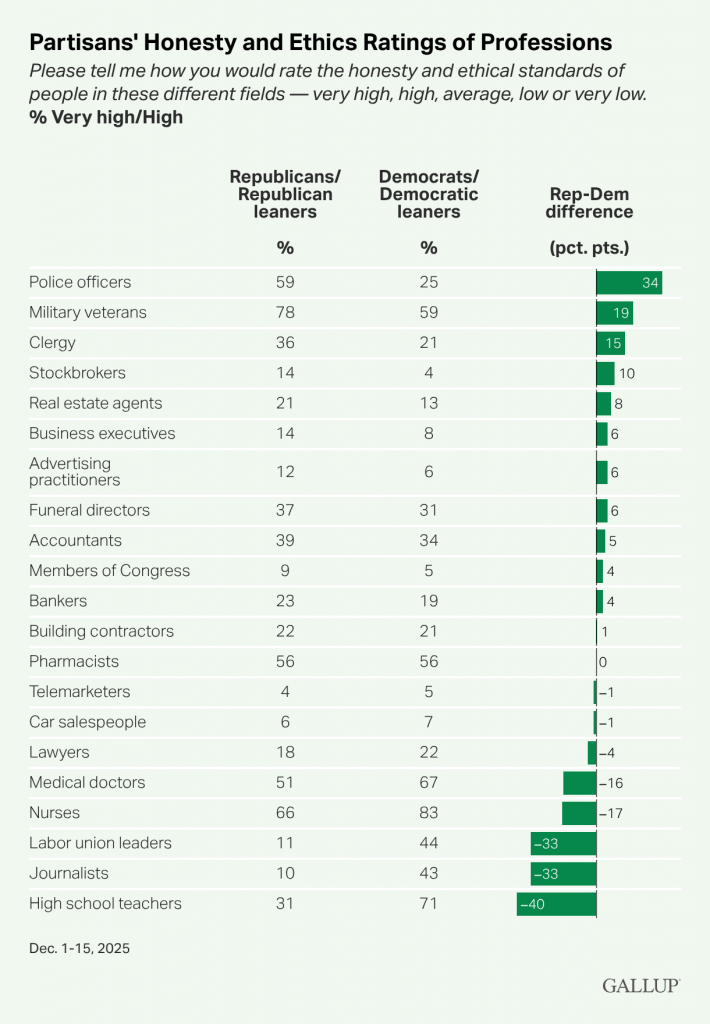
Republicans and Democrats diverge sharply in their assessments of about half the professions surveyed. Republicans and Republican-leaning independents rate police officers 34 points higher than Democrats do, and also express significantly more confidence in military veterans (by 19 points), clergy members (15 points), stockbrokers (10 points), and real estate agents (eight points).
Democrats and Democratic-leaning independents, meanwhile, give far higher marks to high school teachers (by 40 points), journalists and union leaders (33 points each), nurses (17 points), and physicians (16 points). These gaps illustrate how ethical perception has become entangled with cultural identity and partisan narratives.
For faith-based media—and particularly Catholic audiences—the position of clergy deserves special attention.
In the overall ranking, members of the clergy place ninth out of 21 professions. While that situates them above journalists (12th), lawyers (14th), and members of Congress (20th), it also confirms a longer-term decline in confidence toward religious leadership in the United States.
Historically, clergy ranked among the most trusted figures in American public life. Today, they occupy a middle tier, buoyed by loyal constituencies but weighed down by broader institutional skepticism, the fallout from abuse scandals, and a cultural shift away from organized religion.
What emerges from Gallup’s 2025 survey is not merely a list of winners and losers, but a portrait of a society recalibrating its moral compass.
Americans still place their deepest trust in professions centered on direct care and service—especially those involving health and sacrifice. But across much of public life, confidence continues to thin out, replaced by caution, polarization, and fatigue.
In that sense, the survey functions less as a popularity contest and more as a mirror: reflecting a nation that increasingly reserves its moral admiration for those who heal, while questioning nearly everyone else.
Thank you for reading our content. If you would like to receive ZENIT’s daily e-mail news, you can subscribe for free through this link.

Publicaciones relacionadas:
 About the Scandal in New York’s Cathedral of Gay Irreverence During a Funeral and What This Has To Do with Fiducia Supplicans
 USA: Publication Shows That Progressive Clergy Is Extinguishing and Conservative Is Growing
 What is the religion of the people who migrate the most? Research answers and Mexico is part of the answer
 The health (physical, mental, and spiritual) of Australian clergy in 2025: What interesting research reveals
