

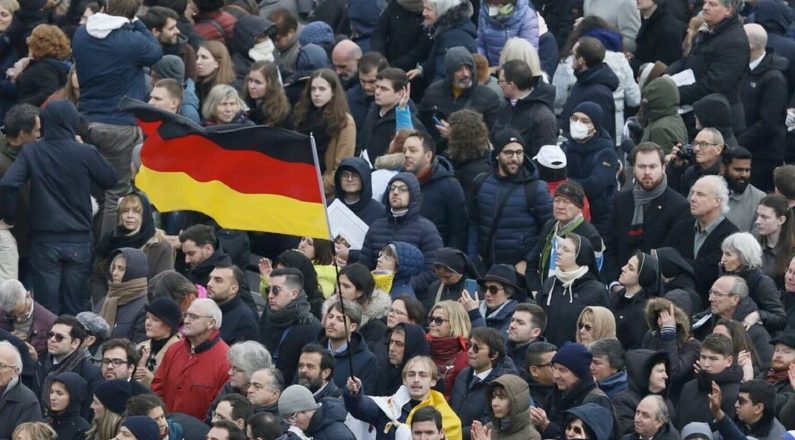
(ZENIT News / Cologne, 01.29.2026).- At a time when church pews across Germany often appear emptier than ever, a new national survey is offering an unexpected counterpoint: young people are quietly rediscovering Catholicism — even as large segments of the population grow more distant from institutional religion and skeptical of the Church’s controversial reform process.
The findings come from a poll conducted in October 2025 by the Insa-Consulere research institute on behalf of the Catholic weekly Die Tagespost, the reform-critical initiative Neuer Anfang (“New Beginning”), and the Protestant news agency Idea. Around 2,000 people were interviewed, including Catholics, Protestants, members of other faiths, and approximately 820 individuals with no religious affiliation.
The results were presented in Rome on January 12 during the annual pilgrimage organized by Neuer Anfang and Die Tagespost, where a delegation led by Tagespost editor-in-chief Franziska Harter and former Idea editor Helmut Matthies discussed the data in a roundtable and formally shared it with Pope Leo XIV.
The headline surprise: after years of steady decline, the Catholic Church in Germany is seeing measurable openness among younger generations. While departures remain high, there is also a growing willingness to enter — or re-enter — church life, especially among young adults.
According to the survey, 24 percent of Catholics say they intend to leave the Church within the next two years. Comparable figures stand at 21 percent among members of regional Protestant churches and 16 percent among free church communities. Yet at the same time, 8 percent of respondents who currently belong to no church said they could imagine joining one.
Among people aged 18 to 29, that figure doubles to 16 percent. Even more striking, 14 percent of Muslim respondents expressed openness to becoming part of a Christian church — a detail that suggests spiritual curiosity is cutting across traditional religious boundaries.
Belief itself also appears to be undergoing a generational reshuffle. Overall, 42 percent of Germans say they believe in God, while 45 percent say they do not. But among those under 30, a clear majority — 53 percent — affirm belief in God. The figure drops to 46 percent among those aged 30 to 39 and falls further, to between 33 and 40 percent, among people over 40.
In total, 44 percent of Germans describe themselves as Christian. Older respondents are more likely to use that label, yet nearly one in five self-identified Christians (18 percent) say they do not believe in God — a revealing indicator of how cultural identity and personal faith are increasingly diverging.
Among people officially affiliated with the Catholic Church, regional Protestant churches, or free churches, only 47 percent describe themselves as believing Christians.
Geography also matters. In eastern Germany — long considered one of Europe’s most secular regions due to decades of communist rule — 54 percent of church members now identify as believing Christians, compared with 46 percent in western Germany.
The survey also sheds light on growing unease with the institutional framework of German Christianity. Sixty-five percent of Catholics, and 60 percent of all respondents, oppose the state’s collection of the church tax — a uniquely German system in which registered church members pay a portion of their income to fund ecclesial structures.
And when it comes to the highly publicized Synodaler Weg (Synodal Way), the ambitious reform process launched by the German bishops and lay leaders in 2019, enthusiasm appears limited. Only 21 percent of Catholics consider it “right,” while 17 percent view it as “wrong.” A striking 58 percent either declined to answer or said they did not know — suggesting that the Synodal Way, often portrayed internationally as the voice of German Catholicism, may not resonate with the majority of the faithful.
The digital world, meanwhile, is emerging as an unexpected mission field. A supplementary Tagespost survey found that nearly one in four Germans has searched for religious content online or on social media at least once. Among young adults aged 18 to 29, that figure skyrockets to 61 percent. The trend is especially pronounced among Muslims, highlighting how spiritual exploration increasingly unfolds on screens rather than in parish halls.
Taken together, the data paint a complex portrait of Christianity in Germany: institutional loyalty is weakening, skepticism toward church structures is growing, and the Synodal Way remains deeply divisive. Yet beneath the surface, a quieter movement is taking shape — one driven by young people searching for meaning, faith, and community, often outside traditional channels.
For Church leaders in Rome and Germany alike, the message is clear. While reform debates dominate headlines, a new generation is knocking — sometimes digitally, sometimes tentatively — on the doors of belief. Whether the Church is ready to meet them there may prove more consequential than any synodal resolution.
Thank you for reading our content. If you would like to receive ZENIT’s daily e-mail news, you can subscribe for free through this link.

Publicaciones relacionadas:
 Northern Ireland’s Youth Spark Unexpected Religious Revival
 Surprising research data among French clergy: the younger they are, the more conservative… and happy they are
 Britain’s Young Christians Lead a Giving Revolution, New Report Finds
 Beyond emotion: Spanish bishops publish a critique of the emotionalism of spiritual retreats
