

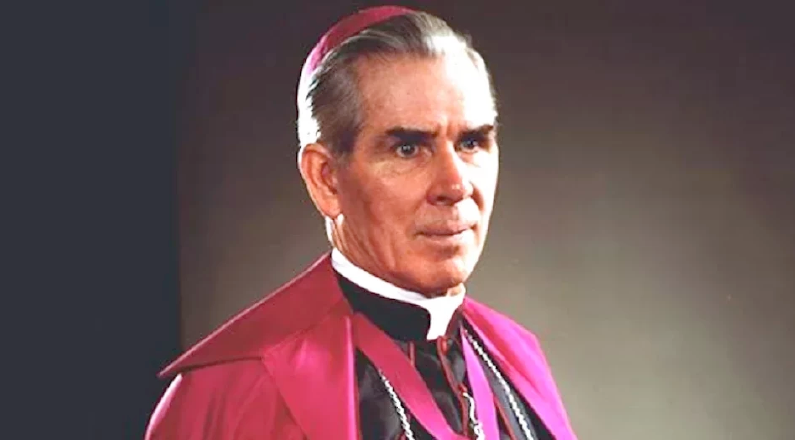
(ZENIT News / Peoria, 02.09.2026).- After more than two decades marked by enthusiasm, setbacks and prolonged silence, the cause of Archbishop Fulton J. Sheen has reached a decisive threshold. The Holy See has formally notified Bishop Louis Tylka of Peoria, Illinois, that the cause of the Venerable Servant of God may now proceed to beatification, clearing the way for the American prelate to be declared “Blessed” in the Catholic Church.
The announcement, welcomed by the Diocese of Peoria, places one of the most recognizable Catholic figures of the 20th century on the brink of official liturgical veneration. The next step, as Bishop Tylka explained, is the celebration of the beatification itself, the date and location of which are now being coordinated with the Vatican’s Dicastery for the Causes of Saints.
For Catholics less familiar with the Church’s canonization process, beatification represents a pivotal moment. It acknowledges that a deceased person lived a life of heroic virtue and that a miracle has occurred through his or her intercession, allowing for public veneration, usually at a local or regional level. Canonization, which would follow at a later stage, would extend that veneration to the universal Church and would require the recognition of a second miracle after beatification.
Few American churchmen have left a public footprint comparable to that of Fulton Sheen. Born Peter John Sheen on May 8, 1895, in El Paso, Illinois, he was ordained a priest for the Diocese of Peoria in 1919. His episcopal career unfolded largely on the national stage: he was appointed auxiliary bishop of New York in 1951, serving there until 1966, and later became bishop of Rochester, a post he held until his retirement in 1969 at the age of 74.
Yet it was not diocesan administration that made Sheen a household name. His television program Life Is Worth Living, broadcast from 1952 to 1957, brought Catholic moral teaching into American living rooms at a time when religious programming rarely reached mainstream audiences. The show earned an Emmy Award and attracted millions of viewers, a fact Bishop Tylka has often cited in calling Sheen a pioneer who anticipated the Church’s later engagement with mass media. Long before the age of digital evangelization, Sheen demonstrated how theology, philosophy and pastoral concern could be communicated with clarity and cultural relevance.
Sheen’s influence extended well beyond the United States. In his later years, he served as national director of the Society for the Propagation of the Faith, supporting missionary work across the globe. According to Bishop Tylka, this phase of Sheen’s life underscored a conviction that the Church exists for all people, especially those on the margins or in places where the Gospel is scarcely heard.
The formal cause for Sheen’s canonization was opened in 2002 by the Diocese of Peoria. A decade later, on June 28, 2012, Pope Benedict XVI declared him Venerable, recognizing his life of heroic virtue. Momentum appeared to accelerate in 2014, when a Vatican medical board unanimously approved a purported miracle attributed to Sheen’s intercession: the recovery of a baby, James Fulton, who had been declared stillborn after his parents prayed for Sheen’s help. A theological commission later confirmed the medical findings.
What followed, however, was an unexpected and protracted interruption. In September 2014, the cause was suspended amid a legal dispute over the ownership and location of Sheen’s remains, which were interred in New York. The Holy See had requested that the body be transferred to Peoria for official inspection and the taking of first-class relics, a request initially denied by the Archdiocese of New York. Only in March 2019 did a New York appeals court unanimously rule that the remains could be moved. Three months later, after years of litigation, Sheen’s body was transferred to St. Mary’s Cathedral in Peoria, reopening the path forward.
Pope Francis formally recognized the miracle on July 5, 2019, and a beatification was scheduled for December 21 of that year. Yet once again, the process stalled. At the request of the bishop of Rochester, concerns were raised about the timing of the ceremony in light of ongoing investigations into clerical sexual abuse in New York State. Although later clarifications confirmed that the delay was not linked to allegations that Sheen had witnessed or concealed abuse, the Vatican opted for further scrutiny. The Diocese of Peoria subsequently stated that Sheen’s conduct had been definitively shown to be exemplary and that his life of virtue had never been called into question.
Despite the disappointment, devotion to Sheen did not wane. Supporters continued to report favors and alleged miracles, and Bishop Tylka reaffirmed in May 2025 his determination to press the cause forward, including direct advocacy before Pope Leo XIV.
Now, with the Holy See’s green light, the long and often turbulent journey appears to be nearing its culmination. For the Church in the United States, Sheen’s beatification would carry particular symbolic weight. He remains one of the few American bishops whose voice shaped both ecclesial life and popular culture, bridging pulpits, classrooms and television studios with uncommon ease.
Sheen died on December 9, 1979, the feast of St. Juan Diego, succumbing to heart disease after decades of priestly and episcopal service. More than four decades later, the Church is preparing to place him before the faithful not merely as a celebrated communicator, but as a model of holiness.
Thank you for reading our content. If you would like to receive ZENIT’s daily e-mail news, you can subscribe for free through this link.

Publicaciones relacionadas:
 Pope Francis approves canonizations of first Venezuelan saint and first saint from Papua New Guinea
 Catholic Church in Chad reaches out to Sudanese refugees
 The Cause of Canonization Advances of Alcide De Gasperi, One of the Founding Fathers of the European Union
 Vincent, the boy alive thanks to a miracle attributed to Cardinal George Pell
