

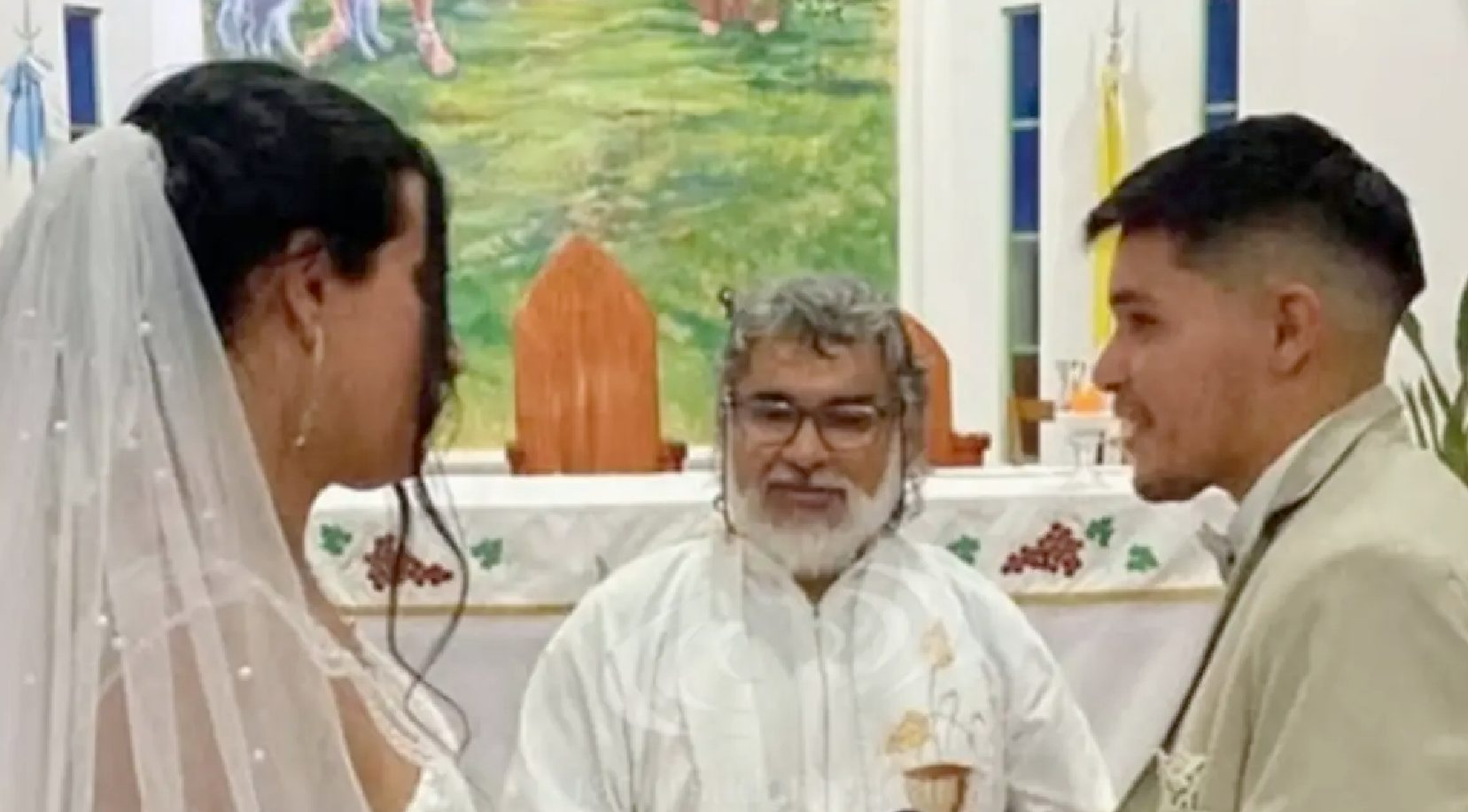
(ZENIT News / Corrientes, 02.11.2026).- When news broke that two people identifying as transgender had celebrated a Catholic wedding in northeastern Argentina, the story quickly moved beyond a local parish.
The ceremony took place on January 28, 2026, at Nuestra Señora de Pompeya parish in the Archdiocese of Corrientes. According to the couple, they completed the standard prenuptial process and received assurance from a Franciscan friar that no canonical impediment stood in their way. Their argument rested on a biological claim: one of them was born male and now identifies as a woman; the other was born female and now identifies as a man. In strictly biological terms, they maintained, they were of opposite sex and therefore eligible for sacramental marriage.
“We were able to marry because we are of different biological sex,” said Solange Ayala, a well-known LGBT activist in Corrientes, in remarks to Radio Sudamericana. Ayala described the event as deeply moving and framed it as a gesture of openness capable of drawing LGBT-identifying Catholics closer to the Church.
Under Argentine civil law, the couple had already modified their names and registered genders in the National Identity Document in accordance with the country’s Gender Identity Law. Ayala said that although their baptismal certificates still reflect their original names, the parish issued the ecclesiastical marriage documentation using their current legal identities.
The couple insisted they followed the ordinary canonical path: opening a matrimonial file, undergoing interviews, and receiving guidance from the parish priest. According to Ayala, the friar consulted Archbishop José Adolfo Larregain, OFM, and later communicated that there was “nothing to object” to the celebration of the sacrament, given the couple’s biological sex.
That narrative, however, was publicly contradicted less than two weeks later.
On February 8, the Archdiocese of Corrientes released an official statement clarifying that the ceremony did not meet the canonical requirements for the valid and licit celebration of marriage. The archdiocese stated that the necessary ecclesiastical documentation had never been submitted to the archiepiscopal curia for review, as required in cases presenting particular complexities. The omission, it warned, not only distorts the theological meaning of the sacrament but risks sowing confusion among the faithful.
In Catholic theology, marriage is not simply a religious blessing but a sacrament governed by precise juridical norms. Canon law requires, among other conditions, that the parties be free of impediments, properly instructed, and capable of giving valid consent to marriage as the Church understands it: a lifelong, exclusive union ordered to the good of the spouses and the procreation and education of children. The Church also presumes the immutability of biological sex in its sacramental discipline, a point that becomes decisive in cases involving gender transition.
The archdiocese announced that, after appropriate consultations, it would initiate disciplinary measures in accordance with canon law. It is now evaluating whether formal warnings or other sanctions should be imposed on the parish priest responsible for the celebration.
For his part, Fray Fernando Luis Gómez of Nuestra Señora de Pompeya defended the parish’s conduct, stating that it acted in line with pastoral guidance and ecclesial norms. Without disclosing details “out of respect for the privacy of those involved,” he reiterated that Christian marriage demands not only external documentation but also the absence of canonical impediments and authentic consent—namely, the intention to marry as the Church defines marriage, in rectitude and good faith. He also announced that the parish would strengthen its procedures for interviews, preparation and verification in order to safeguard the integrity of the sacraments and avoid future controversy.
The episode has inevitably been read against the broader ecclesial climate shaped by debates over pastoral outreach to LGBT persons, particularly in the wake of Fiducia Supplicans, the 2023 Vatican declaration permitting non-liturgical blessings of couples in irregular situations under specific conditions. Although that document did not alter the Church’s doctrine on marriage, its reception has varied widely, and critics argue that ambiguities in its interpretation have generated confusion at the local level.
Ayala himself acknowledged being only loosely connected to Catholic practice and said he was not “ultra-Catholic or super devout.” Yet he expressed surprise at the parish’s protective attitude during the process, suggesting that steps were taken to shield the couple from potentially hostile reactions within the community. He also described the wedding as, in part, an effort to make visible what he sees as a desired shift within certain sectors of the Church toward greater engagement with LGBT individuals.
The Archdiocese of Corrientes, however, sought to draw a clear line. In reaffirming its commitment to welcome and accompany persons pastorally, it insisted that such accompaniment must remain faithful to the Gospel, the Church’s doctrinal tradition and the juridical order that ensures the valid and fruitful celebration of the sacraments.
What began as a parish ceremony has thus become a test case in a wider ecclesial struggle: how to combine pastoral sensitivity with doctrinal coherence in an era when civil law, cultural norms and Catholic sacramental theology increasingly move along divergent tracks. The outcome of the archdiocese’s disciplinary review may clarify responsibilities in Corrientes. It will not, however, resolve the deeper tensions now visible across much of the Catholic world.
Thank you for reading our content. If you would like to receive ZENIT’s daily e-mail news, you can subscribe for free through this link.



Publicaciones relacionadas:
 German diocese announces to indoctrinate employees in gender ideology
 EWTN Research Shows that 150 “Catholic” Hospitals Inject Hormones in Children for “Gender Transition”
 U.S. Catholic Bishops Challenge HHS Proposal on Gender Identity Policy
 Bishop Emeritus of Saltillo allows Anglican “priestess” and lesbian couple to concelebrate
