

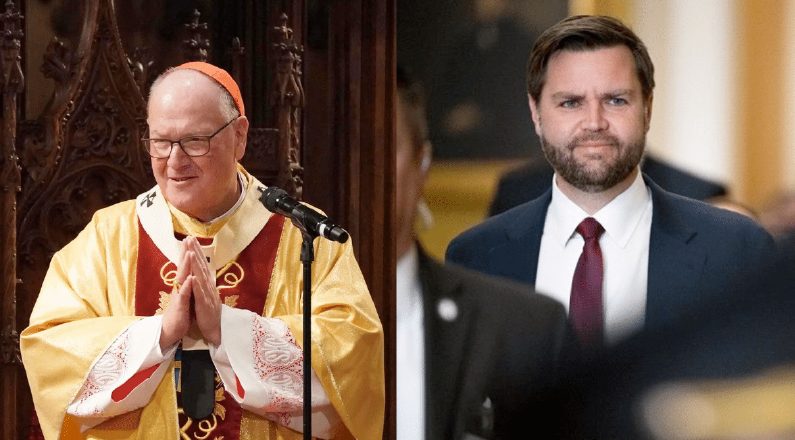
(ZENIT News / New York, 02.23.2026).- A private conversation between Vice President JD Vance and Cardinal Timothy Dolan has eased, at least personally, a dispute that briefly sharpened tensions between the U.S. Catholic hierarchy and the Trump administration over immigration policy and federal funding.
In a 32-minute interview aired February 19 on EWTN News “In Depth,” Dolan revealed that Vance had apologized for suggesting that U.S. bishops’ advocacy on immigration might be financially motivated. The exchange, Dolan said, followed remarks Vance made in a January 26 appearance on CBS’s Face the Nation, his first major television interview after becoming vice president.
During that broadcast, Vance questioned whether the U.S. Conference of Catholic Bishops (USCCB) was driven by humanitarian concerns or by “the bottom line,” noting that the conference had received more than $100 million to assist with the resettlement of immigrants. Dolan told EWTN that he confronted Vance directly, describing the claim as not only false but defamatory. According to the cardinal, Vance acknowledged that the comment was “out of line” and apologized.
The numbers behind the controversy are substantial. In 2024, the USCCB received more than $180 million in federal contracts for refugee assistance and services for unaccompanied migrant minors. That same year, the bishops report spending more than $179 million on those programs; in 2023, they spent over $130 million—nearly $1 million more than they received in government grants. The bishops have long insisted that their refugee work is not a profit-making venture but a partnership rooted in Catholic social teaching.
The dispute unfolded amid sweeping changes to U.S. immigration policy in early 2025. On January 20, President Donald Trump issued an executive order suspending the U.S. Refugee Admissions Program (USRAP), a system established by Congress in 1980 to formalize the legal resettlement of refugees vetted by federal authorities. Two days before Vance’s CBS appearance, the administration halted its decades-old partnership with the USCCB and nine other national resettlement agencies.
The immediate consequences were tangible. The suspension led to the dismissal of approximately one-third of the USCCB’s resettlement staff. The bishops subsequently filed a lawsuit seeking reimbursement of more than $24 million for services already rendered. After months of legal back-and-forth and status reports from both sides, the conference voluntarily withdrew the litigation in January 2026.
Compounding the tension was a separate executive order signed earlier in 2025 lifting certain restrictions on Immigration and Customs Enforcement (ICE) operations in schools and places of worship. That decision drew concern from Catholic leaders. Dolan recounted that when ICE vehicles appeared near Sunday Masses in New York—without necessarily conducting raids—attendance dropped. “This is a violation of religious freedom,” he said, arguing that worshippers must be able to gather without fear. After conversations between Dolan and the New York ICE director, he said, the practice ceased, and he has not since heard reports of similar incidents from other pastors.
Despite his criticism of Vance’s remarks, Dolan’s tone in the EWTN interview was far from adversarial. He described the vice president, a Catholic convert, as “a very good guy” with whom he agrees on many issues, including family life, the defense of unborn children, patriotism, and what he called “the beauty of what America stands for.” Dolan is a member of Trump’s Religious Liberty Commission and said he appreciates an administration that takes religious freedom seriously.
At the same time, the cardinal made clear that political alignment is never absolute. Using a baseball analogy—“you’re not going to get anyone batting a thousand”—he noted that even legendary St. Louis Cardinals player Stan Musial had a lifetime average of .331. Dolan said he disagrees with Vance on Ukraine policy and expressed frustration with the administration’s approach to abortion pills, arguing that their widespread availability reinforces the notion that pregnancy is a problem to be eliminated.
The interview also ventured into New York politics. Dolan criticized Governor Kathy Hochul, a Catholic, for supporting legislation to legalize medically assisted suicide for the terminally ill. He also voiced concern over the University of Notre Dame’s appointment of Susan Ostermann, who has publicly supported abortion rights, to lead its Liu Institute for Asia and Asian Studies.
Regarding New York City Mayor Zohran Mamdani, a Muslim and self-described democratic socialist, Dolan struck a mixed tone. He expressed disappointment at not being invited to Mamdani’s inauguration and noted the limited Catholic presence in the mayor’s transition team. He also pressed Mamdani directly on his socialism, which the mayor characterized not as state ownership of the means of production but as a commitment to greater wealth distribution. Dolan’s retort—“Well, who doesn’t?”—signaled both skepticism and a willingness to engage.
Beyond partisan contours, the immigration debate highlights a deeper framework within Catholic social teaching. The Church traditionally balances three principles: the right of individuals to migrate to sustain themselves and their families; the right of nations to regulate their borders; and the duty to exercise that regulation with justice and mercy. The friction between bishops and the administration reflects differing emphases within that triad rather than a simple clash between faith and state.
Dolan, who retired as Archbishop of New York in December 2025 and now serves as co-chief chaplain of the New York Police Department, situated the current tensions within a broader historical arc. As the United States approaches the 250th anniversary of its founding, he reflected on how Catholics—once a small and sometimes distrusted minority—have become a significant presence in public life. He argued that Catholic values and American values share common ground: belief in God, the centrality of family, religious liberty, subsidiarity, democracy, and the pursuit of the common good.
The episode with Vance, in that sense, may prove less a rupture than a reminder of the complex dance between ecclesial conviction and political power. An apology can settle a personal grievance. The larger questions—about migration, sovereignty, funding, and freedom—remain part of an ongoing negotiation between Church and state in an era of rapid policy shifts and heightened polarization.
Thank you for reading our content. If you would like to receive ZENIT’s daily e-mail news, you can subscribe for free through this link.

Publicaciones relacionadas:
 Who is the person appointed bishop by the Pope who also becomes prince of a country?
 Church Answers False Accusations Against Cardinal Francis Prevost
 New Brazilian cardinal confirms: new Amazonian rite and viri probati are on the table
 From Oklahoma and Brownsville: these are the new bishops chosen to lead the US episcopate
