

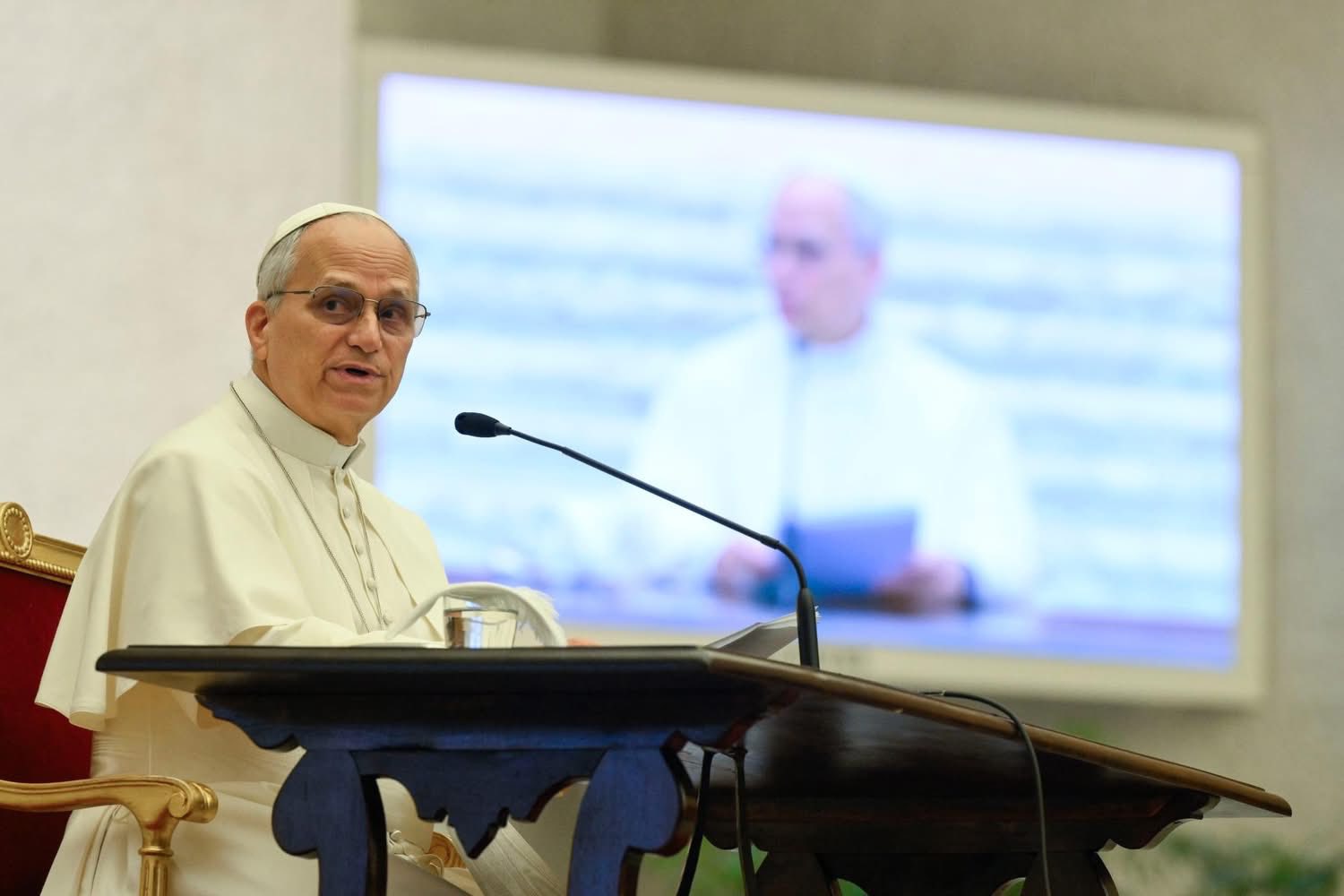
(ZENIT News / Rome, 02.23. 2026) – On Thursday, February 19, Pope Leo XIV met with the priests of the Diocese of Rome — the Diocese of which he is Bishop. After an initial address, the Holy Father gave four priests the opportunity to ask questions. The richness, realism, and depth of the Pope’s answers have applications beyond the limits of the Diocese of Rome and will surely enlighten many priests and those preparing for the priesthood. We offer them below translated into English.
* * *
Introduction (Cardinal Baldo Reina): Thank you, Holy Father. (…) We also thank you for the time you are about to dedicate to us: you spoke of your availability to dialogue with priests. Many would like to ask you numerous questions. We have grouped them into four age groups. The first will be Father Francesco Melone, one of the priests you ordained on May 31, and he will ask you a question about what you mentioned at the end of your address, namely, about the difficulties faced by young clergy.
After him, Father Giacomo Pavanello, parish priest of San Gregorio Magno alla Magliana, a parish of about 40,000 inhabitants, will ask you a question about the pastoral challenges of our time.
Next, Father Romano De Angelis, who has served as parish priest in several parishes in the city and for the past few months has been one of the chaplains at the «Bambino Gesù» Children’s Hospital, will address the topic of priestly fraternity, which has also been one of the themes you have discussed.
Finally, Father Tonino Panfili, who has been involved with consecrated life for many years in the Vicariate and is currently the Administrator of the Basilica of the Holy Cross in Jerusalem, will ask you questions related to elderly priests. In this regard, we remember at this moment our elderly, ailing brothers who reside at the «San Gaetano» Residence in Divino Amore. These four will speak on behalf of all of us. Thank you.
* * *
First Question
On the Difficulties of Young Clergy
Good morning, Holy Father, I address you on behalf of the young priests of our Diocese, although you have already answered many questions that are close to our hearts. Thank you! In most cases, we live out our pastoral ministry alongside the young people of our communities. Young people have a great desire for depth and intimacy with God, as well as a need to be heard and for communion. But at the same time, they experience numerous relational and emotional wounds, often accompanied by anxieties and fears, sadness and loneliness. Sometimes, therefore, it seems easier, and perhaps even more gratifying and convenient for us priests, to focus primarily on the emotional level, numbing the pain with sensational events and strong emotions, instead of helping them enter into dialogue with God. A relationship that, on the other hand, is not flashy, noisy, full of large numbers or measured by charismatic leaders, but is nourished in the secret of prayer, making us not protagonists, but ministers of trust in the Lord. Only friendship with Jesus fills our loneliness, as Your Holiness reminded us on January 10, when receiving young Romans and their educators here. I ask you, then, Holy Father, what advice would you give us, young priests, so that we can embody the Gospel in today’s world, particularly among our young people, presenting ourselves to them as credible adults, without, however, turning evangelization into animation and discernment into entertainment? Thank you.
Pope Leo XIV’s Reply:
Well, the first thing I’d like to say is that this is a condition, a reality of today’s society, which in a certain sense we cannot change, but of which we must be aware. It’s the reality of families and the challenges we face, especially with young people today, because many times they come from families that have experienced very serious crises: the absence of a father, divorced or remarried parents, and many who have also experienced abandonment. These are the difficulties that young people must face in the life we live today. Therefore, for the priest, accompanying these young people also means recognizing their reality, being close to them in this sense, accompanying them, but not just being one more among them. This is also important: the priest’s witness. The young priest can offer young people a model of life, showing that being a friend of Jesus can truly fill their lives. But this means that the priest himself, young or not so young, lives a life of friendship with Jesus, offering these young people not only an example, but a life experience that could change their lives. So, here too, I believe that the spirit of evangelization I mentioned a few minutes ago should also be applied to young people.
Before, all young people came to the parish. Surely many of your parishes have an oratory, that is, a place where young people meet, play games… Some still come, but we can’t be satisfied with just those who come to the parish; therefore, even with the young people themselves, we have to organize, think, and look for initiatives that can be a way for them to go out. Pope Francis spoke a lot about the Church going forth. We have to go out, we have to invite other young people, go out with them into the streets; perhaps offer different ways, activities… Sport can also be a way to invite young people. Other activities, art, culture… Invite young people to come, to start getting to know each other. Perhaps getting to know each other is above all an experience of communion. Many young people live in isolation, an incredible loneliness, after the pandemic, but it didn’t start there. With the famous smartphone, which probably everyone carries in their pocket today, they live alone, even if they say: «No, my friend is here,» but there is no human contact.
They live with a kind of distance from others, a cold indifference, unaware of the richness and value of truly human relationships. Therefore, we must also find ways to offer young people another kind of experience of friendship, of sharing and, little by little, of communion, and from that experience invite them also get to know Jesus, who invites us to be not His servants, but His friends.
To do all this requires a lot of time, sacrifice, and also reflection — seeing how to reach these young people who today are often dragged into a terrible life: drug addiction, crime, violence, hardship, isolation… Recently, a young man asked me this question: «But you talk a lot about communion and unity, why? What is their value?» In other words, he didn’t even understand, in his own experience, that there is great value in leaving loneliness and seeking friends and communion. Therefore, I believe that young priests, who are closer to young people in age, culture, and formation, can also be of great service in proclaiming this message, which, at its core, is always the Gospel.
Second Question
On the Pastoral Challenges of This Time
Your Holiness, good morning and thank you very much for this time. I would like to ask you a question about the times we are living in, marked by a progressive marginalization of religion in the contemporary social landscape, especially in large cities like Rome. How can we be incisive in this postmodern culture in which we all live and breathe, without reverting to past approaches that would seem somewhat anachronistic? What priority should our pastoral work have in order to respond evangelically to the challenges of our time? To put it another way: the Gospel has always been inculturated; today we are probably facing a new inculturation. How can we ensure that this inculturation is fostered, accompanied, and not hindered by our initiatives? Thank you.
Pope Leo XIV’s Reply:
One thing I myself am searching for is how to respond to this challenge, which begins with the need to truly know the community I am called to serve. I speak personally. I lived in Rome for four years in the 1980s, then for twelve years, from 2000 to 2012-13, and now for the last three years, and every time I return to Rome, in a sense, I find a different Rome. There are many things… The «Eternal City,» let’s say, the streets are the same, the potholes are the same, but life has changed a great deal. So, to serve also as Bishop of Rome, I had thought a lot about how, when we went to Ostia last Sunday, to talk with these people, one must begin by getting to know their reality as thoroughly as possible. I can’t even offer continuity: if I’m transferred from one parish to another, I can’t think, «That worked there, let’s keep doing the same thing.» If you want to love someone, you first have to know them. If you want to love and serve a community, it is very important to know it.
And there are many realities in this world of mobility, which I have spoken about briefly, that are constantly changing. That is why an effort is needed on the part of the parish priests, the clergy, and all those who collaborate in the parish council, to truly see what the challenges are at this moment in this place, in this parish that we must see and get to know a little better.
Then, regarding the reality of the world today, we haven’t yet discussed a reality that is upon us, whether we like it or not: artificial intelligence, the use of the Internet, which is also present in the life of a priest. (By the way, I urge you to resist the temptation to prepare homilies with artificial intelligence.) Just as all the muscles in the body, if we don’t use them, if we don’t move them, they die; the brain needs to be used, so our intelligence, your intelligence, must also be exercised a little so as not to lose this capacity. But it needs much more, because to give a true homily, which is to share the faith, AI will never be able to share the faith! This is the most important part: if we can offer a service, let’s say inculturated, in the place, in the parish where we work, people want to see their faith, their experience of having known and loved Jesus Christ and His Gospel. And this is what we must continually cultivate.
And that’s where I say very sincerely, to all the questions, that part of the answer is the importance of a life of prayer. Not just the act of reciting the Breviary as quickly as possible, which I also carry on my phone, without taking the time to be with the Lord, to listen to the Word of God, with the prayer of the Psalms, this praise to the Lord. But also the ability to enter into dialogue, to truly listen and to express the difficulties I carry in my heart: «Why, Lord? What do you want from me? What can I do?»
So, with this experience of a life authentically rooted in the Lord, we can offer something that isn’t ours. It’s not because of who I am that I offer what I am; this is often a deception on the Internet, on TikTok, and we want to be ourselves: «I have many followers, many likes, because they see what I say…» Don’t be like that: if we aren’t transmitting the message of Jesus Christ, perhaps we are mistaken, and we also need to reflect very carefully, with great humility, to see who we are and what we are doing. But with this attitude of love, service, humility, and listening, we can truly discover what we can do to respond to this community we are called to serve.
Third Question
On Priestly Fraternity
Holy Father, in these 39 years of priestly ordination, I have been able to experience that priestly fraternity is possible and beautiful. This is also because in our presbyteries in Rome, we have the opportunity to welcome priests from other Dioceses, who are a treasure, not only for the help they give, but also for nurturing priestly fraternity. It’s true that, being together, we experience what Saint John Berchmans said: «Life in common is a great penance, but I have experienced that it is also a source of immense joy.» Three simple episodes: after feeling unwell one afternoon, I realized the next morning that my brothers, without saying a word, had organized themselves during the night in one-hour shifts to discreetly come and see how things were going, how I was doing. Another episode that impressed me was when my mother died — I’m an only child, my father had already passed away — and a younger brother, seeing me a bit upset, told me: «Romano, remember that as long as I’m alive, you’ll never be alone in life.» I also experienced a painful moment, a painful misunderstanding, and there the Gospel illuminated me: to pray for that person, for that brother, and ask that the Lord bless him. And, after a few months, the joy of the message of reconciliation. So, in light of this, I say that there are, however, dangers, Holy Father, which I bring to your attention, asking for your advice and suggestions. The first is the difficulty of being oneself for fear of gossip, of being sold out for thirty pieces of silver so that someone can show off by spreading rumours. Then, the different sensitivities we may have are undoubtedly a richness, but there is a temptation, instead of transforming them into opportunities, to form opposing factions that fight each other. And then, what seems to me the greatest danger, is that of jealousy: that is, being unable to rejoice in the abilities of a brother who risks becoming an enemy simply because he is appreciated and has pastoral success. Sometimes the somewhat bitter words of a brother come to mind, but they are relevant: «If you want to harm someone, speak well of him,» because then you expose him to being attacked. But you will undoubtedly be able to give us valuable insight into all of this. Thank you, Holy Father!
Pope Leo XIV’s Reply:
Thank you. I could say, like a professor, «But you’ve already answered your question, and therefore…» I began with something truly painful — I would even say negative — which is somewhat like one of the clergy’s «pandemics» on a universal level, at times. It’s called «clerical envy,» which is when a priest, seeing that another has been called to be the parish priest of a larger, more prestigious parish, or called to be a Vicar, or called to… well, then relationships break down; and not only that, but also with gossip, criticism, and comments… Instead of seeing how to build bonds, bridges of friendship, of priestly fraternity, relationships are destroyed.
Therefore, I’ll say this immediately to put it aside, but let’s pay attention, please, to this reality. We are all human; there are feelings, emotions, many things, but as priests — and I hope starting in the Seminary — we can offer role models where priests can truly be friends, brothers, and not enemies or indifferent to one another. And I don’t know which is worse: being an enemy or being indifferent to the other; we must consider both.
I have seen beautiful examples of priestly fraternity, and I will mention a few because they can be useful for everyone, both the youngest and the oldest. A priest from Chicago had seminary classmates who, from the day of their priestly ordination, had made a pact, an agreement: that every month — I don’t know, they chose the fourth Thursday, I don’t know — they would meet together once a month. It was a «class» of quite a few priests, and I met them when one of them, who was already an Auxiliary Bishop in Chicago, was 93 years old, and those who had survived to that age continued to meet. They wanted to continue throughout their lives that beautiful friendship they had formed in the Seminary. But it wasn’t just a meeting; it was an experience of prayer, in which they dedicated a moment of the day to prayer and then to study.
And here I want to say something else to everyone: that study in our lives must be permanent, continuous. When I hear someone tell me — this is historic, a priest told me this — «I haven’t opened a book since I left the Seminary.» My goodness! — I thought –, how sad! And how sad it is for his parishioners, who have to listen to God knows what. We must also keep ourselves updated, and this group of priests, in this meeting they held every month, would tell each one, each time in turn: «It’s your turn, choose an article, something.» The person would send it to everyone in advance, everyone would read it, and then, during the sharing session, they would talk about theology, pastoral care, new initiatives, the reality of the Church, etc. It was something very beautiful. And all of it was their own initiative.
And then, there is another very important point: if I sit here saying, «Nobody comes to visit me» — which might happen to some of you — let’s not be afraid to knock on someone else’s door, to take the initiative, that is, to say to colleagues or a group of friends, to some of them: «Why don’t we get together from time to time to study together, reflect together, have a moment of prayer and then a nice lunch?» The parish priest, with the best cook, can invite the others, and so a nice lunch can be had together.
Those I mentioned, the priests in Chicago, all the diocesan priests there play golf. So, in the summer, they would also go and do some sports together. The point is that someone has to take the initiative. Perhaps it can’t be with everyone — I’m also very realistic about this — God has made us all different, thank God! No two people are the same, so to speak, but I feel more comfortable with one or the other. The other is a good person, but I won’t have the confidence –which is what you were saying in the question — , you can’t tell your whole life story to just anyone who happens to be passing by. You have to find some people with whom to share an experience, to perhaps have the possibility of forming a friendship, a fraternal relationship with a little more depth, and share life, so as not to be alone. Like that young priest who told you: «As long as I am here, you will never be alone.» We should try to build fraternal priestly relationships in this sense as well. It won’t always be the parish priest with his vicars; perhaps a group of parish priests would be better, I don’t know, we have to see the reality. But we need to create situations to break this tendency that leads us to loneliness, to isolation from one another. And really try to dedicate some time — obviously, it can’t be every day — but with some regularity, to meet, and not through a screen. That’s important; it can also have its value, but in person, being together, meeting with one another, to share the joys and also the difficulties of life, sharing experiences. There may be a time when one finds oneself in crisis, whether due to health or some difficulty; if one is alone, the crisis often distances us from what is truly our life. If I have a trusted group with whom I have shared an experience, I can continue walking alongside them, if there is someone with whom to share the difficulties, the moments of trial, etc. Therefore, this would be, in a very concrete way, a type of experience that can still be dreamed of today; this type of priestly life, to promote an authentic priestly fraternity.
Fourth Question
On Elderly Priests
On the day of your election, Your Holiness, I realized that I was already one of the oldest priests. Even the Pope is a year younger than me! And when I have meetings at the Vicariate, everyone is younger than me: the Cardinal, the Deputy Administrator, the Bishop, the Rectors — and so it’s a continuous experience of this already mature age. In the parish, there is a Bishop Emeritus, who is older than me, but there are three priests from various Dioceses, and there we have a beautiful experiences of fraternity, to continue with this very important topic. And these young people are a treasure. Therefore, I represent the generation of older priests; today I am the voice of all elderly priests. Many feel loneliness after a life totally dedicated to the Gospel and the Church: after so many people, so much loneliness. Many, sadly, marked by illness, have been forced to retire even before retirement. The question is twofold: what is suggested to those of us who are alone and sick, and who now offer our fragility and limitations, along with the Eucharistic Bread, to Jesus, the victim? But I also ask you this, Your Holiness: how can we, the older priests, in our presbyteries, help the younger ones to remain spiritually young, enthusiastic in proclaiming the Word, passionate in building up the Church, the Bride of Christ?
Pope Leo XIV’s Reply:
One thing I do say is that, although you can’t do everything perfectly, you have to prepare yourself in life, in a certain sense, to be able to accept, when the time comes, age, old age, illness, and also loneliness. However, if you have lived your whole life with a certain spirit of dialogue, friendship, communion, and fraternity, you can actually find more concrete answers to this experience of being alone and ill, for example. There are people — we say this with a certain frankness — who, even as young people, travel the paths of life with a certain bitterness; they have never known how to experience friendship, fraternity, or communion. And so, from youth or middle age, they live with this bitterness, never content with anything and always with this somewhat negative spirit.
If one lives one’s whole life as a journey that carries us forward, even with the weight of years, and often — whether young or old — with illnesses and difficulties, one will have the capacity, with God’s grace, to accept the cross, the suffering that comes, because one does so with the same spirit of prayer and sacrifice that one desired on the day of one’s priestly ordination, when one said to the Lord: «Yes, Lord, I want to follow You in all things and accept what life gives me as part of your will.» Then, a whole spirituality is needed, which must be cultivated, also from the Seminary onward. I cannot tell a 22-year-old: «Prepare yourself for when you reach 80,» but everything is a journey, everything is a way of entering into life with a certain spirit of gratitude. I haven’t spoken about this yet, but let’s begin with gratitude for having been called to be priests. We often forget how great our vocation is and how important it is for the life of the Church. Not out of a sense of clericalism –«Here I am» — but because the Lord has called us to be His friends, disciples, servants of all His people, and that is something most beautiful! So, living with a spirit of gratitude from the first day of my priesthood will help me to live, even as an elderly person, as a person with the cross of illness, to say: «Thank you, Lord, for life, for the gift you give me.»
You know very well that in many countries — in Europe, in Italy… In Canada it’s already legal — euthanasia is widely discussed: the question of the end of life, people who no longer find meaning in life and are there bearing the cross of an illness and say: «I don’t want to carry it anymore, I prefer to end my life.» If we are so negative about our own lives, and sometimes with less suffering than many people endure, how can we tell them: «No, you can’t end your life, you have to accept iI … But then we behave like that ourselves, very negative about everything. In other words, we must be the first witnesses that life has great value. And gratitude throughout life is very important.
Also humility. Humility: the attitude of wanting to recognize that it is not I, it is the Lord who has given me life, it is the Lord who accompanies us and carries us in His arms, even in those moments when I am weakest. The Lord is there with us. And living with this spirit gives life, hope.
In addition to this, there is closeness. And here I would like to invite everyone present to think: surely we all know someone elderly, someone sick, a priest, a layperson, a nun… who is going through a very difficult time. Let’s call them, let’s go to them. Let’s also make an effort to help these people who are suffering. Institutionally, in the past, it was more common for the parish priest — for example, every Thursday — to bring Communion, and Oil (of the sick) to visit all the sick people in the parish. Today, with fewer priests and more elderly people, it has become: «Well, let’s send the laypeople, let them do it.» It’s a beautiful service that the laypeople do, bringing Communion, for example, to people’s homes. But that doesn’t mean the priest can stay home watching the Internet while the others are out visiting. In other words, for us too it is a service, an apostolate, a very important form of pastoral work to live this closeness with those who suffer.
Elderly priests also have a service to offer. Even if they are bedridden, if they have truly lived a life of service and sacrifice, they know very well that their prayer can also be a great service, a great gift. Their life continues to have great meaning. And they can still remember and accompany many people, situations, and communities that need their offering. To live this spirit — of course, if someone hasn’t prayed for forty years and then says, «Here I am, in bed, I don’t know what to do,» it’s difficult — there, too, we must live a continuous formation in our spiritual life. It begins with preparation, before we become, let’s say, elderly and infirm.
And here I can add one more thing, for everyone, and it can take different forms: let’s not be afraid to continue with the beautiful practice of spiritual accompaniment, of having someone in your life who knows you. A friend, yes. But often a good confessor, who can be a priest, or a person of great spiritual wisdom, can accompany and help you in moments of great difficulty. We are all human, we all go through difficult times, through pains of all kinds, but having someone trustworthy who can truly accompany us very closely, in our hearts, in our spirits, is also a great gift that we can recognize as a help in our lives. And some of you, I hope many of you have this gift — not all of you do — may also have the gift of knowing how to accompany others when they experience these kinds of difficulties.
That was the last question. If you ask me more, there might not be any answers today. But I want to say again, and very sincerely, that I am very happy about this meeting with you. Unfortunately, it can’t be done more often… As a diocesan Bishop, I had a meeting with the priests every month, and I say this also for the Bishops. I heard of a Diocese where the Bishop would arrive for the first ten minutes of the meeting with the clergy and then leave… I hope it wasn’t you… but it was in another country!
It’s necessary to know how to live, accompany, and walk together: Cardinals, Archbishops, Bishops, Episcopal Vicars; the Parish Priest with his Vicars… to live this spirit. Not just what is written in a program, but a genuine spirit of fraternity, and the commitment to do together what is our mission: to serve the Church.
Therefore, I sincerely wish you a good Lenten journey, which is a time of conversion and joy for all. And may we also have opportunities in the future to live in this spirit. We can conclude with the blessing.

