

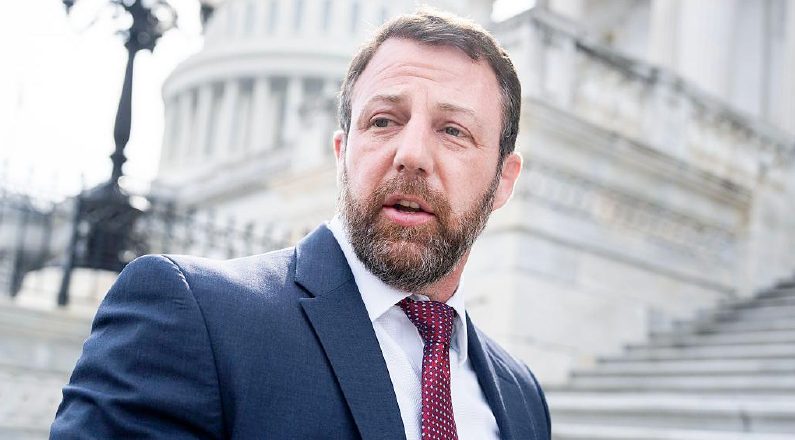
(ZENIT News / Washington, 03.06.2026).- A significant shift in the leadership of U.S. domestic security policy is underway after Donald Trump announced the nomination of Markwayne Mullin, a Republican senator from Oklahoma, to serve as the next secretary of the United States Department of Homeland Security.
The announcement, made on March 5 through the president’s social media accounts, sets the stage for a major change at the helm of the department responsible for border control, immigration enforcement, and national security within the United States. Mullin is expected to assume the position on March 31, 2026, replacing Kristi Noem, whose tenure has recently been overshadowed by political controversy.
Trump framed the decision as part of a broader effort to intensify enforcement of immigration law and strengthen security along the southern border. In his message, the president praised Mullin as a “very respected” senator and said he would work tirelessly to curb illegal immigration, combat drug trafficking, and prevent violent criminals from entering the country.
“Markwayne will work relentlessly to keep our border secure,” Trump wrote, emphasizing the administration’s longstanding campaign pledge to reinforce border control and reduce transnational crime.
The leadership change at Homeland Security comes amid a wider reorganization of the administration’s security strategy in the Western Hemisphere. Under Trump’s plan, Noem will transition to a newly created diplomatic role as Special Envoy for “The Shield of the Americas,” an initiative focused on regional security cooperation. The program was formally presented on March 7 in Doral, Florida, and is intended to strengthen partnerships with countries across the Americas on migration control, anti-drug efforts, and transnational crime.
Before taking up the new diplomatic assignment, however, Noem’s departure from Homeland Security followed mounting criticism from political opponents and some policy analysts. The controversy centers partly on the department’s immigration enforcement operations in Minneapolis and partly on a $220 million advertising campaign authorized during her tenure, which critics argued was an inefficient use of federal funds.
Mullin, who must still be confirmed by the United States Senate before assuming the post, has spent more than a decade in federal politics. A native of Westville, Oklahoma, he served in the House of Representatives before winning election to the Senate. Reflecting on his career after the nomination was announced, Mullin described his years in Washington as “an honor and privilege” serving the people of his home state.
As a kid from Westville, it has been the greatest honor and privilege to serve the people of Oklahoma for the past thirteen years in both the House and Senate.
I am grateful to President Trump for nominating me to lead the U.S. Department of Homeland Security. I look forward to…
— Markwayne Mullin (@SenMullin) March 5, 2026
Beyond his positions on national security and immigration policy, Mullin is widely known for his strong social conservative views. A father of six children—three of whom are adopted—he has frequently spoken about his Christian faith and its influence on his political convictions.
In Congress he has been a vocal advocate for anti-abortion legislation, supporting efforts to enact a nationwide ban on abortion and opposing the procedure even in situations where it is argued that a mother’s life may be at risk. Responding to the Supreme Court’s decision in Roe v. Wade, Mullin said that protecting unborn life was a personal commitment shaped by both his religious beliefs and his experience as an adoptive father.
“As a Christian and an adoptive parent, the fight to protect life is personal,” he said at the time. “We cannot stop until every child of God has the chance to live.”
His legislative record also reflects opposition to policies linked to contemporary debates over gender identity and sexuality. Mullin has criticized gender-transition procedures for minors and voted against the Respect for Marriage Act, which expanded federal recognition of same-sex marriage.
If confirmed, Mullin will assume control of a department created in the aftermath of the September 11 attacks and now one of the largest agencies in the federal government. The Department of Homeland Security oversees border enforcement through agencies such as Customs and Border Protection and Immigration and Customs Enforcement, coordinates disaster response through FEMA, and manages a wide range of intelligence and counterterrorism operations.
The nomination therefore places Mullin at the center of some of the most contentious debates in American politics—immigration, border control, and the balance between security and civil liberties.
Whether the Senate will confirm him smoothly remains uncertain. Cabinet nominations often become arenas for broader political disputes, especially when the nominee holds strong ideological positions.
What is clear is that Trump’s choice signals a continued emphasis on border enforcement and national security as defining priorities of his administration.
Thank you for reading our content. If you would like to receive ZENIT’s daily e-mail news, you can subscribe for free through this link.

Publicaciones relacionadas:
 New S*exual Colonialism in UN Treaty on Development
 Texas doctor sues Biden-Harris admin over unlawful changes to federal health privacy laws
 USA: Bishops Thomas and Barron Applaud Move to Defund Abortion and “Gender Transition” Industries, Call for Authentic Health Care
 UN Maternal Health Coalition Attacks Religious Voices
