

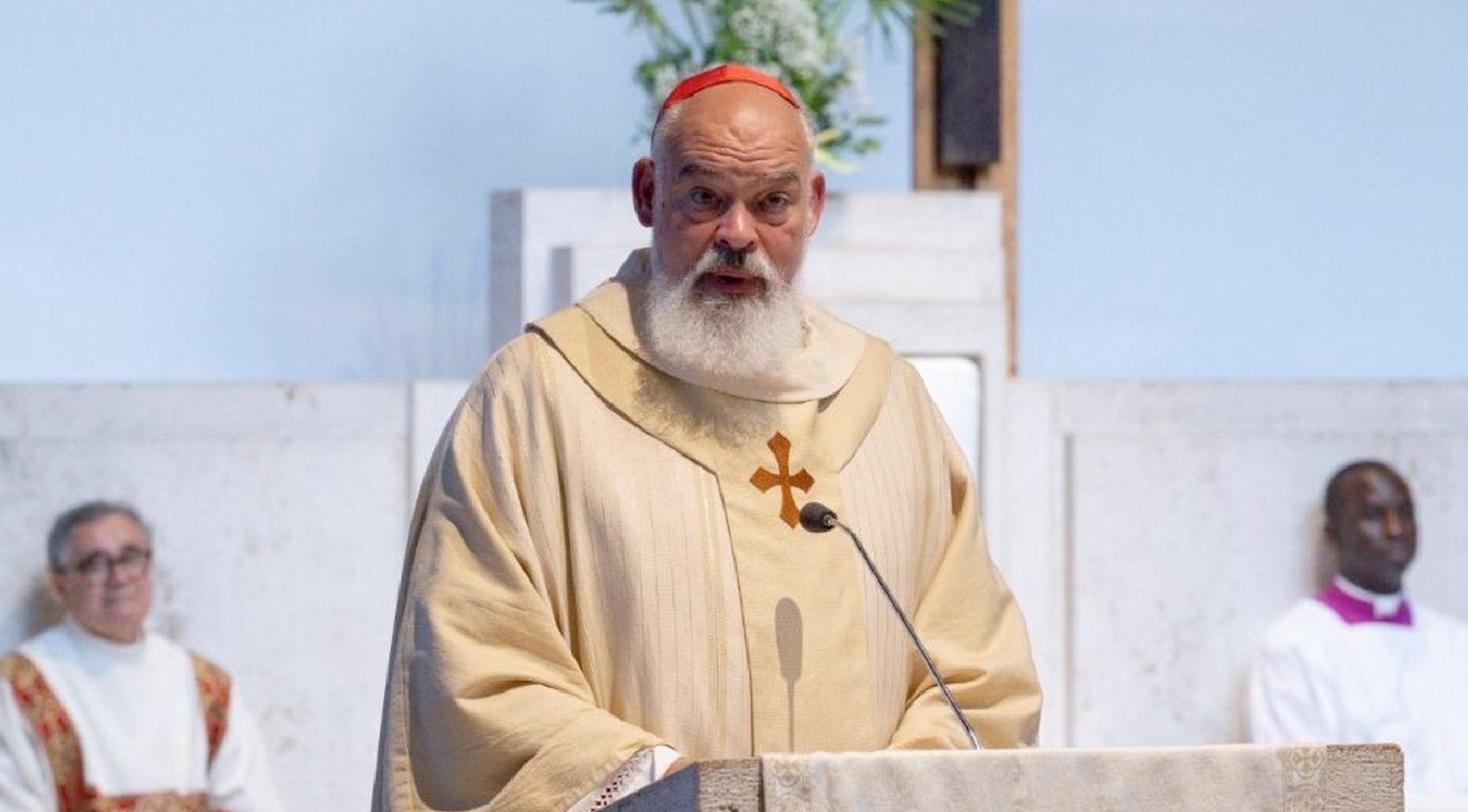
(ZENIT News / Rome, 03.10.2026).- When the explosions began in Iran at the end of February 2026, the small Catholic community in the country suddenly found itself almost completely cut off from the outside world. For several days, no one knew what had happened to the only Catholic cardinal living there.
Now the mystery has been resolved: Dominique Mathieu, the Catholic archbishop of Tehran–Isfahan, has been evacuated from Iran and is safe in Rome after leaving the country together with the staff of the Italian embassy in Tehran.
The 62-year-old cardinal arrived in the Italian capital on March 8 after the embassy carried out a full evacuation operation amid the ongoing military confrontation triggered by the strikes launched on February 28 by the United States and Israel against Iranian targets. Communication disruptions inside Iran had left the outside world almost entirely in the dark about events on the ground—and about Mathieu’s fate.
“I arrived in Rome not without sorrow and pain for our brothers and sisters in Iran,” the cardinal said in a message sent to the Belgian Catholic outlet CathoBel, referring to the community he left behind. “While waiting to return, pray for the conversion of hearts to interior peace.”
A cathedral inside a diplomatic compound
Mathieu’s evacuation was unusual but almost inevitable given the particular structure of the Catholic Church’s presence in Iran. The headquarters of the Archdiocese of Tehran–Isfahan are located inside the compound of the Embassy of Italy in Tehran.
Within that diplomatic enclave stand the archdiocesan offices, the archbishop’s residence and the Latin-rite cathedral known as the Cathedral of the Consolata. When the Italian government decided to evacuate its diplomatic personnel because of the deteriorating security situation, the cardinal—whose residence and church are effectively inside the embassy—had little choice but to leave with them.
His departure came after several days of intense uncertainty. The Iranian government had drastically restricted internet access once the military confrontation began, cutting off most communications. Even members of Mathieu’s own religious family, the Order of Friars Minor Conventual, were unable to reach him for days.
Their last confirmed contact had been on February 28, the day the conflict erupted. Only on March 5 were the Franciscans able to re-establish communication, confirming that the cardinal was alive, though no further details were initially made public.
Concern spread throughout the Catholic world. Leaders such as Bashar Warda, the Chaldean archbishop of Erbil in neighboring Iraq, said repeated attempts to contact the cardinal had failed.
A Church of only a few thousand
The anxiety surrounding Mathieu’s disappearance reflected the extreme fragility of the Catholic presence in Iran. The Church there is one of the smallest and most isolated Catholic communities anywhere in the world.
Estimates vary, but roughly 20,000 Christians of different denominations live in Iran. Within that population, the Catholic community is much smaller: around 3,500 faithful in total, including approximately 1,300 Latin-rite Catholics.
According to Vatican statistics, there were only three Catholic priests in the country in 2024. In practice, Mathieu himself had been carrying the pastoral responsibility for the five parishes of Tehran, a ministry often described by observers as one of quiet “presence” rather than expansion.
The legal and social environment for Christians is restrictive. Iran’s constitution, adopted after the Iranian Revolution, recognizes Christians, Jews and Zoroastrians as official religious minorities. However, the freedom of these communities is tightly circumscribed.
Churches operate under close state surveillance. Evangelization is forbidden, distributing Bibles in Persian (Farsi) is illegal, and converts from Islam often face severe pressure or prosecution. Human-rights organizations have repeatedly documented arrests of Christians accused of offenses such as “propaganda against the regime” or “enmity against God.”
A worsening climate for minorities
The difficulties facing Christians have intensified in recent years. Reports published in 2025 described what observers called a significant escalation in repression. According to documentation compiled by four human-rights groups, at least 254 Christians were arrested in Iran last year alone.
Analysts say the authorities have increasingly used national-security legislation to prosecute members of religious minorities, especially converts from Islam.
Tensions were already high following the brief but intense war between Iran and Israel in 2025. That confrontation was widely described as a turning point that triggered new reprisals against Christian communities suspected of having cultural or political ties with Western countries.
Given the current communication blackout and the chaos generated by the new conflict, it remains difficult to determine whether similar measures are now being taken again.
A cardinal from the peripheries
Mathieu himself embodies the Vatican’s strategy of maintaining a quiet presence even in some of the world’s most difficult environments.
A Belgian Conventual Franciscan, he was appointed archbishop of Tehran–Isfahan in 2021 by Pope Francis. Three years later, in December 2024, Francis elevated him to the College of Cardinals—part of a broader effort to give greater visibility to Catholic communities located on the global Church’s geographic and political margins.
His red hat symbolized Rome’s interest in maintaining dialogue with Iran despite the many obstacles that complicate relations between the Islamic Republic and Western powers.
For now, the cardinal’s immediate mission is different. During his stay in Rome, he is expected to brief officials of the Holy See on the humanitarian and religious situation unfolding inside Iran.
He is also likely to meet Pope Leo XIV, who has repeatedly appealed for an end to the conflict since the first strikes on February 28.
Speaking during the Angelus prayer on March 1, the pope warned that the escalating confrontation risked becoming “a tragedy of enormous proportions,” urging all parties to halt what he described as a dangerous spiral of violence. A week later he repeated his call, praying that “the roar of bombs may cease and that space for dialogue may be opened.”
A Church waiting in uncertainty
For the moment, the cardinal is safe in Rome. But the same cannot be said for the Christians who remain in Iran.
Thousands continue to live in a country shaken by military strikes, political tensions and growing isolation from the outside world. Their situation—like that of the wider Iranian population—remains uncertain.
From Rome, Mathieu has asked the global Catholic community for something simple yet revealing: prayers not only for peace between nations, but for what he called “the conversion of hearts to interior peace.”
Thank you for reading our content. If you would like to receive ZENIT’s daily e-mail news, you can subscribe for free through this link.

Publicaciones relacionadas:
 New Brazilian cardinal confirms: new Amazonian rite and viri probati are on the table
 Vatican Assembles Independent Tribunal to Try Former Jesuit Marko Rupnik
 Cardinal Makrickas takes the helm of the Roman basilica of St. Mary Major: the oldest Marian church in the West
 Vatican to Release Marian Document Clarifying Supernatural Phenomena Guidelines
