

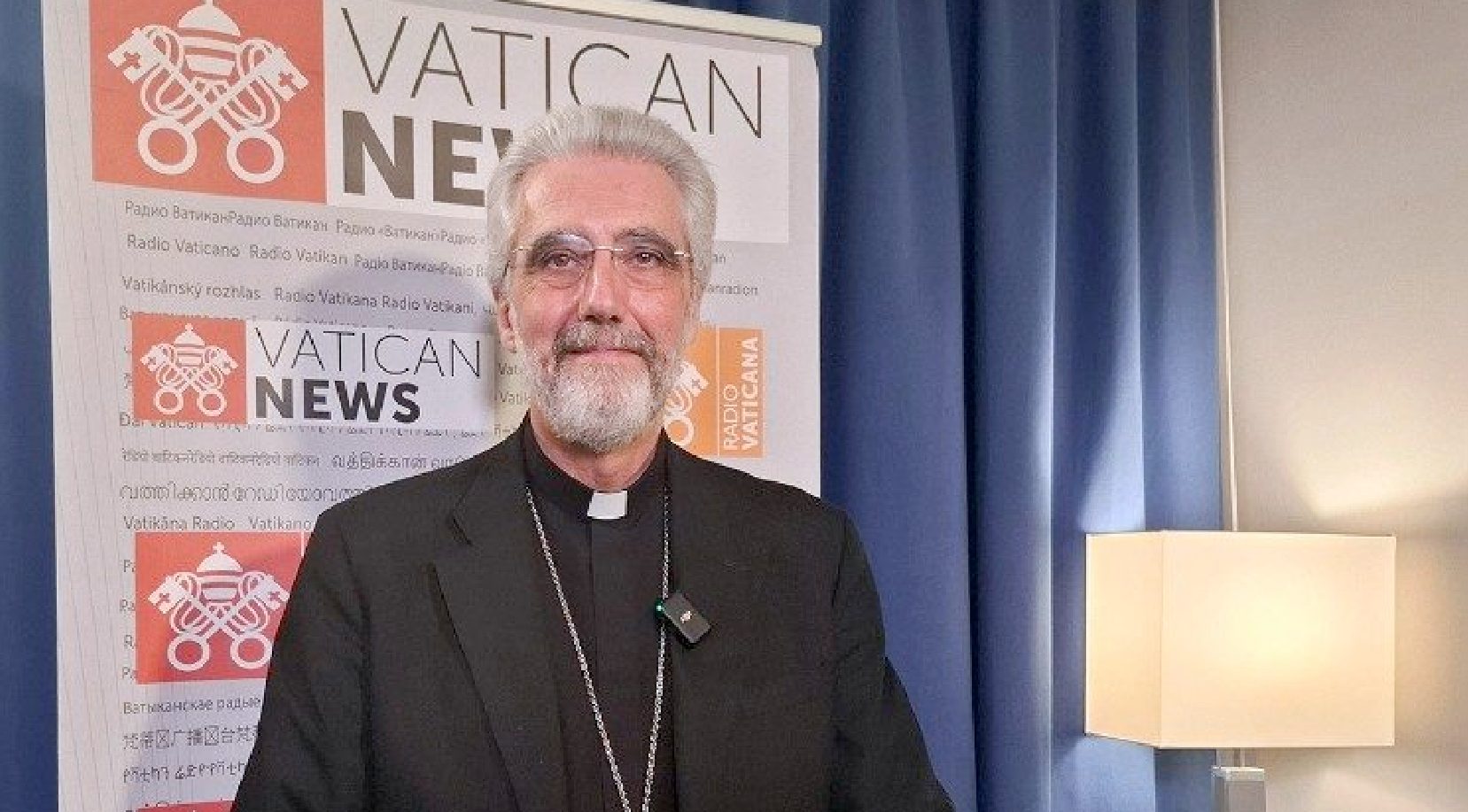
(ZENIT News / Vatican City, 03.12.2026).- In one of the most consequential personnel shifts in the Roman Curia since the beginning of his pontificate, Pope Leo XIV has appointed the Spanish Augustinian bishop Luis Marín de San Martín as the new papal almoner and prefect of the Vatican’s Dicastery for the Service of Charity, entrusting him with the mission of coordinating the Holy See’s charitable outreach to the poor and to people suffering in areas of crisis.
The decision, announced March 12, also brings a major change for the outgoing almoner, Cardinal Konrad Krajewski. After more than a decade directing the Pope’s charitable initiatives from Rome, the Polish cardinal has been appointed metropolitan archbishop of Łódź, returning to the diocese where he began his priestly formation.
The transition marks the end of a distinctive chapter in Vatican charity and opens another, led by a theologian and religious who has spent much of his life in academic, pastoral and synodal work.
A ministry at the heart of papal charity
The office now entrusted to Marín de San Martín is one of the oldest institutions in the papal household. Historically known as the Apostolic Almonry, the body was formally reorganized in 2022 by Pope Francis as the Dicastery for the Service of Charity through the apostolic constitution Praedicate Evangelium, which reshaped the Roman Curia.
Unlike many Vatican departments focused on doctrine, diplomacy or administration, this dicastery performs a direct and symbolic function: it distributes aid and assistance in the name of the Pope. Its initiatives range from helping homeless people in Rome to coordinating humanitarian support in conflict zones.
The papal almoner also has a unique ceremonial role, issuing apostolic blessings in the Pope’s name through traditional parchment certificates and participating in official papal ceremonies as part of the pontifical household.
With his appointment, Marín de San Martín receives the rank of archbishop and assumes one of the most visible charitable responsibilities within the Catholic Church.
A theologian shaped by the Augustinian tradition
Born in Madrid on August 21, 1961, Marín de San Martín entered the Order of Saint Augustine as a young man, professing his first vows in 1982 and solemn vows in 1985. He was ordained a priest in 1988.
His intellectual formation reflects a strong academic background: he studied theology at the Pontifical University of Comillas in Madrid and later at the Pontifical Gregorian University in Rome, eventually completing a doctorate in theology at Comillas with a dissertation focused on the ecclesiology of Pope John XXIII.
Over the years he has held numerous responsibilities within the Augustinian order. These included serving as prior of the historic Monastery of Santa María de La Vid in Burgos between 2002 and 2008 and later acting as general archivist of the order, assistant to its superior general and president of the Institutum Spiritualitatis Augustinianae in Rome.
His academic career ran parallel to those responsibilities. He taught theology in various Augustinian centers in Spain, including El Escorial and Valladolid, and also lectured at the Faculty of Theology of Northern Spain in Burgos.
For many Vatican observers, his name became widely known in 2021 when Pope Francis appointed him undersecretary of the General Secretariat of the Synod of Bishops. In that role he helped coordinate the global consultation process of the Synod on Synodality, one of the most ambitious ecclesial initiatives of the last decade.
Reflecting recently on those years, Marín described them as a period of “immense richness,” during which he encountered countless ordinary believers whose faith, he said, countered pessimism and resignation within the Church.
“I have met many ‘saints next door,’” he wrote in a message after his new appointment, referring to laypeople who live the Gospel quietly through everyday acts of faith and courage.
A personal connection with the Pope
Marín’s appointment also highlights a long-standing relationship with the current pontiff. Both belong to the Augustinian tradition, and their paths crossed years before Leo XIV’s election to the papacy.
In 2008, when Leo XIV served as superior general of the Augustinians, he asked Marín to take responsibility for the order’s archives in Rome. That collaboration deepened over time and eventually brought the Spanish priest into wider Vatican responsibilities.
Now, as papal almoner, he inherits a ministry that in recent years has become unusually visible thanks to the dynamic personality of his predecessor.
The legacy of the “cardinal with the van”
Cardinal Krajewski, born in 1963 in Łódź, first arrived in Rome as a student and later served in the Office for the Liturgical Celebrations of the Supreme Pontiff, working closely with the papal masters of ceremonies.
In 2013, Pope Francis appointed him papal almoner and titular archbishop of Benevento. Five years later he was created a cardinal and assigned the deaconry of Santa Maria Immacolata all’Esquilino.
His decade-long tenure was marked by an unusually hands-on approach to charity. In Rome he became known informally as “the cardinal with the van,” personally delivering food, blankets and aid to homeless people and marginalized communities.
Beyond the Italian capital, he was repeatedly sent by Pope Francis to conflict zones, most notably to bring humanitarian assistance to Ukraine after the Russian invasion. His initiatives often attracted media attention and occasionally sparked debate within Vatican circles for their unconventional style.
Now, returning to Poland as archbishop of Łódź, he will assume leadership of the metropolitan see where his ecclesiastical journey first began in the diocesan seminary in 1982.
A renewed focus on the poor
In his first public reflections after the appointment, Marín de San Martín described his new mission as both “beautiful and demanding.” He praised the work of Cardinal Krajewski and expressed his desire to continue placing the poor at the center of the Church’s attention.
“The cry of the poor is the cry of Christ,” he wrote, asking friends and faithful to support him through prayer as he begins the task.
He also emphasized that service to those in need is not simply a humanitarian activity but an essential expression of the Gospel.
Thank you for reading our content. If you would like to receive ZENIT’s daily e-mail news, you can subscribe for free through this link.

Publicaciones relacionadas:
 Vatican decrees excommunication against former papal nuncio to the U.S. for canonical crime of schism
 Pope Leo entrusts the important Dicastery that elects bishops to a Carmelite and canonist
 Pope Leo XIV continues to reshape the Roman Curia: Meet the new Australian prefect of the Dicastery for Legislative Texts
 Russian Orthodox Church issues formal document condemning Fiducia Supplicans
