

(ZENIT News / Rome, 03.18.2026).- The Mediterranean has once again become a strategic horizon for the Catholic Church. Under Pope Leo XIV, the ecclesial “Mediterranean process” launched by his predecessor is not only continuing but gaining renewed momentum, with a clear focus: transforming a region marked by conflict into a space for dialogue, coexistence and peacebuilding.
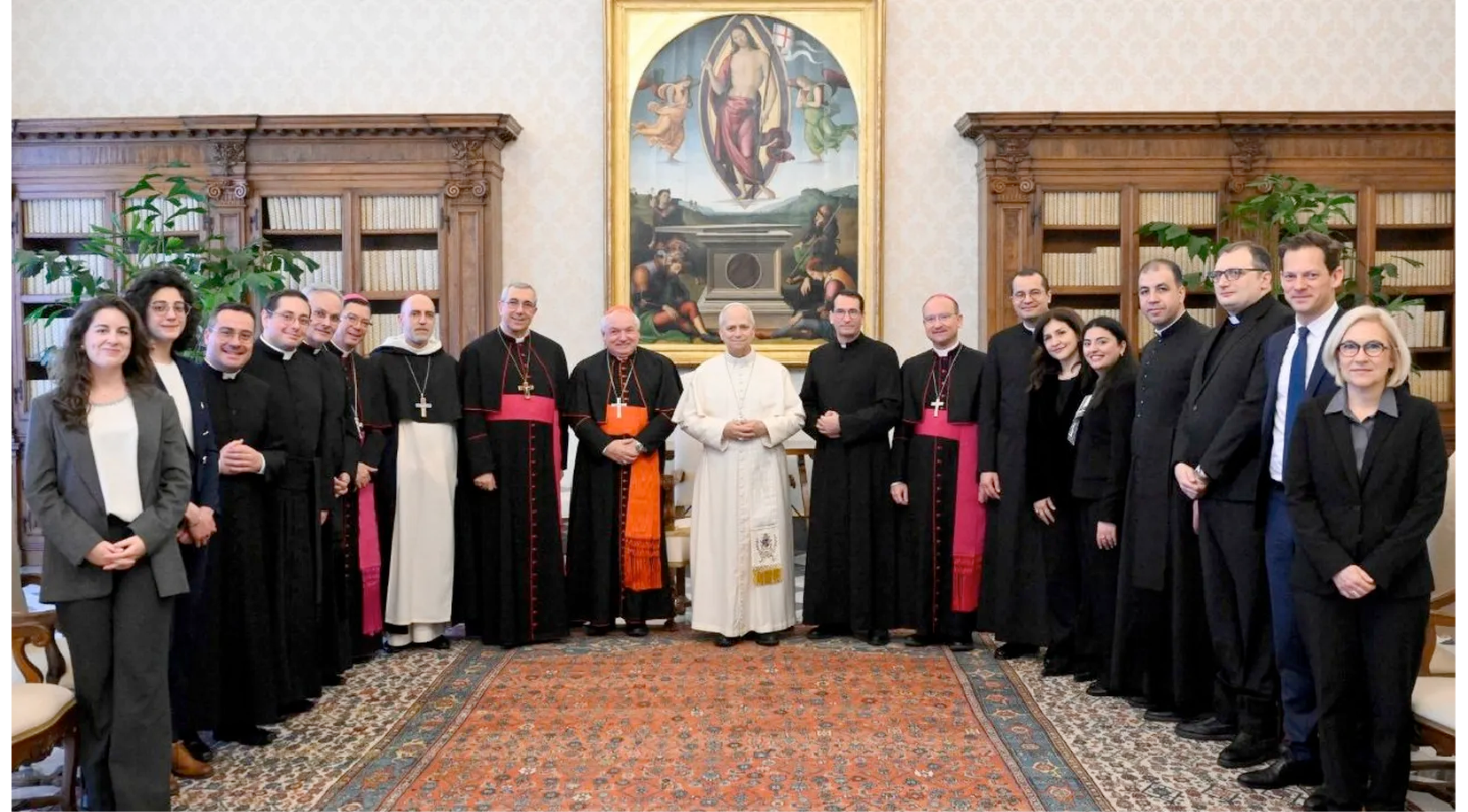
That intention took concrete form on March 12, when the Pope received in private audience a delegation from the Coordination for the Mediterranean, a body created in the wake of the 2023 Mediterranean Meetings in Marseille. The group, led by Jean-Marc Aveline, brought together bishops and representatives from across the basin, including prelates from Bari, Tunis and Nicosia, alongside clergy, laypeople and young participants engaged in Mediterranean initiatives.
Their meeting with the Pope, held in the Apostolic Palace, lasted about an hour and centered on preparations for the next major milestone: a gathering of Mediterranean bishops scheduled for June 9–12 in Barcelona. It will be the fourth such assembly, following earlier encounters in Bari (2020), Florence (2022) and Marseille (2023), and will revolve around a single, urgent theme—peace.
The choice of Barcelona is not merely logistical. It carries symbolic weight. The city is home to the Sagrada Familia, the unfinished masterpiece of Antoni Gaudí, whose death centenary is being marked this year. For Church organizers, the basilica’s intricate and still-unfolding architecture offers a metaphor for peace itself: complex, patient, and built over time through the contribution of many hands.
Nearly 200 participants are expected in Barcelona, including around 60 bishops, 70 young people from different religious traditions, and 60 individuals involved in networks of solidarity, migration assistance and interreligious dialogue. The gathering aims to deepen communion among local Churches, strengthen collaborative structures and, above all, invest in younger generations as agents of reconciliation in a region often defined by division.
According to organizers, the Mediterranean today is shaped by overlapping crises—armed conflicts, forced migration, economic disparity and cultural fragmentation. It is also one of the most militarized regions in the world. Against this backdrop, the Church’s initiative seeks to create what might be described as a “parallel geography”: a network of relationships that transcends political fault lines.
The Coordination for the Mediterranean, which meets regularly—both online and in person—has become the operational backbone of this effort. Its recent gathering in Rome, following an earlier meeting along the Bosporus, reflects a method that combines continuity with mobility, mirroring the transnational nature of the region itself.
A distinctive feature of the process is the central role assigned to young people. This was evident in the “Bel Espoir” project, a training ship for peace that sailed across the Mediterranean during the 2025 Jubilee Year. The vessel, originally blessed by Pope Francis, hosted around 200 young participants who contributed to a “White Paper on the Mediterranean,” drafted during the voyage and presented to Leo XIV during the recent audience.
The current Pope is not a newcomer to this initiative. As Cardinal Robert Prevost, and later as prefect of the Dicastery for Bishops, he participated in the Marseille meeting in 2023 and followed subsequent developments closely. His election appears to have ensured continuity rather than rupture, particularly in relation to the Mediterranean, a region that Francis had turned into a focal point of his pontificate—beginning with his first trip to Lampedusa and concluding with a final visit to Corsica.
Leo XIV has already signaled his intention to maintain that trajectory. In the first year of his pontificate, he has either visited or scheduled visits to five Mediterranean countries, including Turkey and Lebanon, with Monaco, Algeria and Spain on the agenda. These journeys form part of a broader diplomatic and pastoral strategy aimed at re-centering the Mediterranean in the Church’s global vision.
Three weeks after the Barcelona meeting, the Pope is expected to deliver another message to the region from Lampedusa—a place that has become emblematic of migration tragedies and humanitarian crises. The choice of location underscores the continuity between symbolic gestures and concrete concerns: migration, conflict and the fragility of human life at sea.
What is emerging is not a single event but a sustained ecclesial process—one that blends diplomacy, theology and grassroots engagement. Its ambition is not limited to issuing declarations but extends to building networks capable of enduring beyond individual pontificates.
Thank you for reading our content. If you would like to receive ZENIT’s daily e-mail news, you can subscribe for free through this link.

