

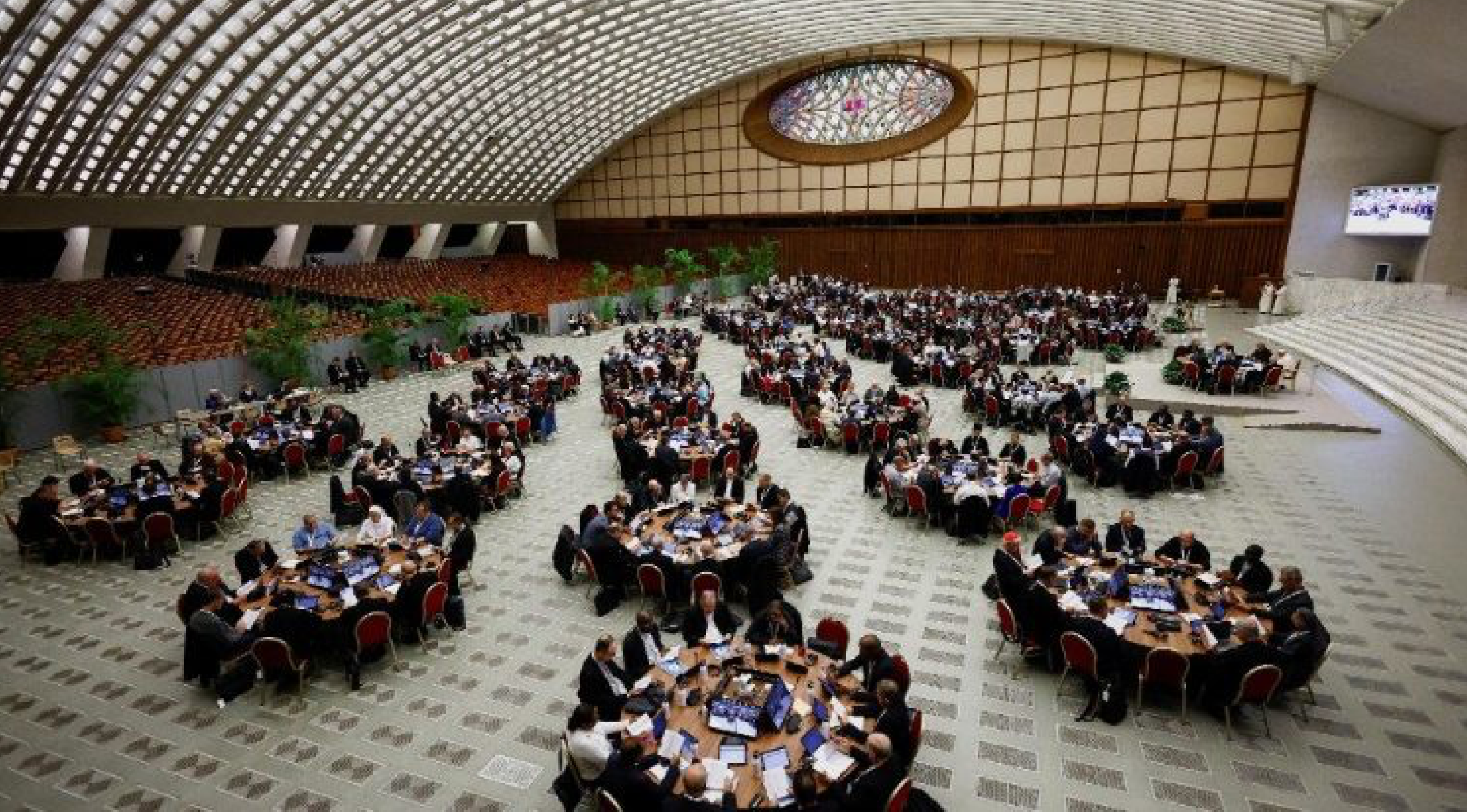
(ZENIT News / Rome, 03.25.2026).- Two newly released synodal reports, made public on March 24 by the General Secretariat of the Synod, offer a revealing snapshot of the Catholic Church’s current self-examination: one document turns outward, asking how to hear “the cry of the poor and the earth”; the other turns inward, addressing the deeply rooted and contentious pastoral reality of polygamy in Africa. Together, they illustrate both the ambition and the constraints of a Church attempting to navigate global diversity without diluting doctrinal coherence.
The first report, produced by Study Group No. 2, emerges from a theological premise that is as demanding as it is expansive: listening is not a pastoral strategy but an act of faith intrinsic to the Church’s mission. This conviction, articulated in a reflection by Cardinal Michael Czerny, reframes what might otherwise be seen as social engagement into something more radical. To “listen,” in this context, is not merely to hear, but to encounter, interpret, act, evaluate and sustain—an ongoing process that implicates every baptized person.
The document’s central question—how the Church can better hear two interconnected cries, that of the poor and that of the earth—places social justice and ecological concern within a single theological horizon. The linkage is not rhetorical. The report insists that responding to human suffering cannot be separated from addressing environmental degradation, suggesting an integrated vision that echoes, without repeating, the ecological anthropology that has marked recent Catholic teaching.
At a practical level, the report acknowledges that the Church already possesses a dense network of structures capable of mediating this listening: parishes, grassroots communities, charitable organizations such as Caritas, and international ecclesial networks. Yet it warns against what it calls an “illegitimate delegation”—the temptation to outsource responsibility to specialized bodies. The implication is clear: the credibility of the Church’s response depends less on institutional innovation than on personal conversion.
Even so, the report does propose new instruments. Among the most concrete is the idea of an ecclesial observatory on disability, conceived as a platform to amplify the voices of marginalized groups and potentially replicable at local and regional levels. This proposal reflects a broader methodological shift: those traditionally considered objects of pastoral care are to become subjects of theological reflection. In that sense, the document calls for a theology “born from listening,” urging that theologians from vulnerable communities participate directly in shaping magisterial discourse.
Formation is identified as a critical frontier. Training programs for clergy, religious and laity, the report argues, must go beyond theoretical instruction to include direct encounters with what it terms “existential peripheries.” Listening itself is to be cultivated not as a technique, but as a spiritual discipline—an idea that subtly challenges prevailing models of pastoral efficiency.
If the first report projects a Church seeking to expand its capacity to listen, the second—prepared by the Symposium of Episcopal Conferences of Africa and Madagascar—confronts a situation where listening meets a doctrinal boundary. The issue is polygamy, a practice present in roughly 30 African states and deeply embedded in certain cultural, social and economic frameworks.
The SECAM document approaches the topic with anthropological realism. It recognizes that polygamy is often linked to values such as fertility, lineage and social status, and that it cannot be reduced to a purely individual choice. At the same time, it offers a stark moral assessment: polygamy is described as incompatible with the Christian understanding of marriage and, in some formulations, as a form of subjugation of women.
This judgment is grounded in a biblical trajectory. While the Old Testament contains examples of polygamous unions, the report emphasizes that the New Testament, and particularly the teaching of Christ, restores the original vision of marriage as a union that is both one and indissoluble. The monogamous structure of Christian marriage is thus presented not as a cultural imposition, but as a theological necessity.
The pastoral consequences are significant. The report explicitly rules out any form of recognition of polygamous unions within the Church. More concretely, it establishes that individuals in such situations cannot receive baptism unless they commit to monogamy. This is not a conditional promise to be fulfilled later, but a prerequisite to be met beforehand. Baptizing a polygamous individual who intends to remain in that state, the document warns, would risk distorting the very meaning of the sacrament.
Yet the approach is not purely exclusionary. The report outlines a range of pastoral practices designed to accompany those affected. Some proposals suggest that a man in a polygamous union who seeks full sacramental participation must choose one wife, while ensuring justice and support for the others and their children. Other approaches envision a form of “permanent catechumenate,” allowing individuals to remain within the ecclesial community without access to the sacraments.
Particular attention is given to women, who are often described as the most vulnerable actors within these arrangements, subject to social pressures and economic dependency. The Church’s pastoral response, the document insists, must prioritize their dignity and protection, even as it upholds its doctrinal position.
The coexistence of these two reports—one emphasizing openness, listening and shared discernment, the other drawing firm doctrinal lines—captures a central tension within the synodal process itself. Initiated under Pope Francis and continued under Pope Leo XIV, the network of study groups was tasked with addressing complex issues ranging from digital evangelization to priestly formation and the role of women in the Church. Their findings are being released progressively, in what the Vatican has described as a gesture of transparency.
What emerges from this latest set of documents is not a uniform strategy, but a multifaceted approach. In some areas, the Church seeks to deepen its capacity to listen and adapt; in others, it reaffirms boundaries it considers non-negotiable. The underlying challenge is to hold these two movements together: to remain attentive to human realities without surrendering the doctrinal framework that defines its identity.
In that sense, the reports do not resolve tensions so much as make them visible. They portray a Church that listens, certainly—but also one that judges, accompanies and, at times, refuses.
Thank you for reading our content. If you would like to receive ZENIT’s daily e-mail news, you can subscribe for free through this link.

