

Isabella Piro
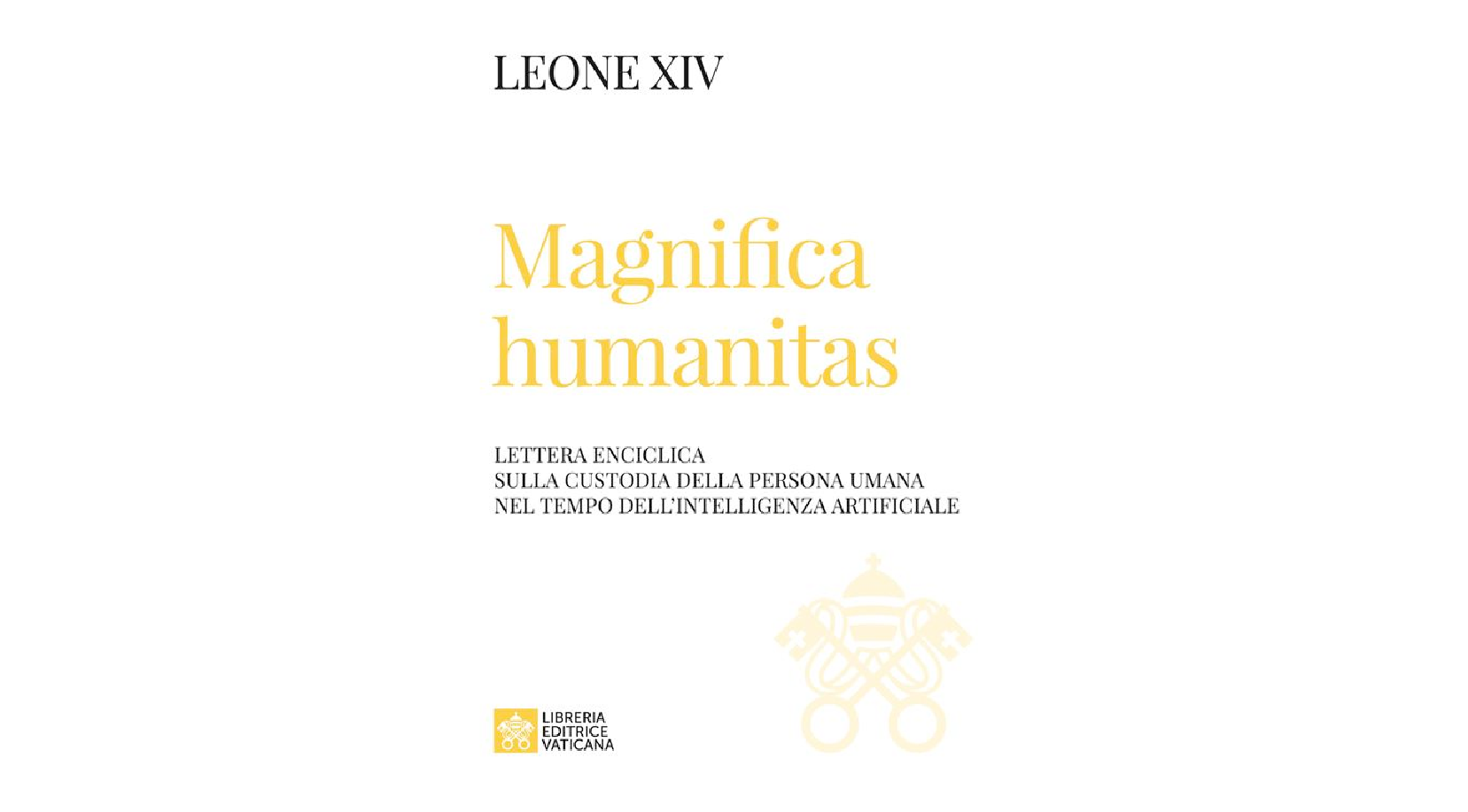
(ZENIT News / Vatican City, 05.25.2026).- “Humanity, created by God in all its grandeur, is today facing a pivotal choice: either to construct a new Tower of Babel or to build the city in which God and humanity dwell together.” The opening words of Pope Leo XIV’s first encyclical, Magnifica humanitas: On Safeguarding the Human Person in the Time of Artificial Intelligence, summarize its underlying reasons and purpose. Published on Monday, May 25, the Pope signed the encyclical on May 15, the 135th anniversary of the promulgation of Pope Leo XIII’s Rerum novarum. Pope Leo XIV has taken up the legacy of his predecessor, writing a social encyclical which addresses one of the principal challenges of the contemporary age: artificial intelligence.
Divided into five chapters, Magnifica humanitas has an underlying premise: technology is not “a force antagonistic to humanity” (4), nor is it “inherently evil” (9). However, “technology is never neutral, because it takes on the characteristics of those who devise, finance, regulate, and use it. Therefore, Pope Leo XIV appeals for people to build “for the common good” and to “remain human,” following a courageous mentality of shared responsibility and communion, so that the world “will come to recognize the human heart as the place where God desires to dwell” (16).
Church’s social doctrine
The first chapter—“A Dynamic Approach Faithful to the Gospel”—traces the Social Doctrine of the Church in recent magisterium and the Second Vatican Council, highlighting “its dynamic character” (17). Far from being “a handbook of principles and norms to be applied,” the Church’s social teaching is rather a “theology of communion in history” (27), which guides our reading of events in light of the Gospel. Pope Leo XIV recalls the writings of his predecessors: from Pius XII – the first to use the expression “Social Doctrine of the Church” in his Apostolic Exhortation Menti Nostrae of 1950 – to Pope Francis. He recalled Pope Leo XIII’s Encyclical Rerum Novarum of 1891, which “constitutes a milestone in the development of the Church’s social teaching” (30). In the years following, each successor of Peter “interpreted historical changes according to the Gospel, bringing to light different aspects of a single heritage: the dignity of the person, the value of work, the universal destination of goods, solidarity and subsidiarity, care for creation and the centrality of peace and fraternity” (45).
Safeguarding human dignity
In the second chapter, Pope Leo XIV explores the “Foundations and Principles of the Social Doctrine of the Church”. These foundations, he says, include the dignity of the person, created in the image and likeness of God. It is important to recall this since “the pressure of new ideologies or certain highly powerful interests” can reduce the human person to “a resource to be used and exploited” or “on what they achieve or produce” (51). On the contrary, “the fundamental dignity of each person…is neither acquired nor earned, nor does it need to be justified” (53). A second foundation of the Social Doctrine of the Church is the inviolability of human rights, among which the first is the right to life “from conception to its natural end.” In this regard, Leo XIV defines induced abortion, the killing of the innocent, and euthanasia as “choices that the Church considers gravely wrong” (55). The third foundation is the recognition of the rights of minorities, with particular attention to women. The Pope calls for “concrete decisions” in their favor regarding laws, employment, education, in social and political responsibilities, so that they may be truly heard and valued (57).
‘Gravely immoral’ to subjugate a nation
Pope Leo XIV then identifies five principles of the Social Doctrine of the Church. The first is the common good, and the Pope defines it as “the social expression of the dignity recognized in every person” (59). He forcefully affirms that “the promotion of the common good can never be separated from respect for the right of peoples to exist, to preserve their own identity and to contribute their unique qualities to the family of nations.”Therefore, he says, “any attempt or plan to eliminate or subjugate a nation is gravely immoral and therefore unacceptable” (64).
Technology must not be in the hands of a few
The Pope then identifies the second principle of the “universal destination of goods.” At this point, and in other parts of the encyclical, Pope Leo XIV insists on the need to ensure that technologies are not concentrated in the hands of only a few people, thereby widening the gap between those included and those excluded from the digital revolution (67). The third principle, subsidiarity (68), requires humanity to overcome “any form of paternalistic or welfare-based management of societal life” in favor of shared responsibility. Solidarity (73), the fourth principle, is both “a principle and a virtue,” says the Pope, noting it is opposed to indifference and takes into account people and future generations.
Social justice and the ‘litmus test’ regarding migrants
Social justice is the fifth principle of the Social Doctrine of the Church. In the digital age, social justice requires ensuring fair access to opportunities for all people, protecting the most vulnerable, combating hatred and disinformation, and subjecting the use of technologies to public oversight, “so that the guiding principle is not solely profit but the dignity of every person and the common good of all people” (80). Pope Leo XIV identifies migrants, refugees, displaced persons as a “litmus test” for social justice. The way society treats migrants, he says, “reveals whether its sense of justice is driven by fear or by the spirit of fraternity.” He therefore appeals for societies to protect “the rightful hopes” of those forced to leave, by ensuring them safe and legal routes, dignified welcome, and genuine paths to integration, while promoting “the right to remain” in one’s homeland in peace and security, by addressing “the root causes” of migration (81).
Abuse and the examination of conscience by the Church
The Pope says these five principles should be applied not only to society, but also to the Church herself, which is called to carry out “an examination of conscience.” The Pope says living out this justice calls for “purifying ecclesial relationships and structures from distortions that give rise to inequality, lack of transparency and abuse of power.” This means to listen to the “victims of spiritual, economic, institutional, sexual and power-based abuse, as well as abuses of conscience.” This examen, he says, “is an integral part of a journey toward justice, which includes acknowledging the harm done, just reparation and taking steps to prevent it from happening again” (89).
An ethical code for AI
The third chapter—Technology and Dominance. The Grandeur of Humanity in Light of the Promises of AI—stresses the need to approach artificial intelligence with vigilance. Pope Leo warns about the “technocratic paradigm” already denounced by Pope Francis and how it can require that every choice be dictated exclusively by measuring efficiency and profits (92). On the contrary, the most powerful technology is not necessarily the best. AI can imitate and simulate the person, but it does not possess a moral conscience, empathy, or affective, relational or spiritual capabilities. The Pope urges clarity about responsibilities and accountability at every stage of the development process, focusing on adequate AI policies and legal frameworks, independent oversight, and user education. Above all, Pope Leo calls for an ethical code subject to shared standards of social justice, because “a more moral AI is not enough if that morality is determined by a few” (107). Nor, he adds, should the environmental impact of new technologies be overlooked, since they require large quantities of energy and water, affecting Creation (101).
Disarming AI
AI must be “disarmed,” Pope Leo XIV continues, in order to free it from the mentality of military, economic, and cognitive competition. “To disarm means discrediting the assumption that technical power automatically confers the right to govern,” he says. “To disarm does not mean rejecting technology, but preventing it from dominating humanity” (110). He devotes ample space to a critique of transhumanism and posthumanism, which interpret progress as the overcoming of human limits. Instead, limitations are not defects to be eliminated, but a constitutive dimension of the human person, because it is in fragility and finitude that relationship and openness to God and to others mature. He says we must remember that “humanity flourishes not despite limitations, but often through them” (118).
Technological progress without regression of the heart
Pursuing technological innovation at the expense of eliminating human limitations, he says, would cause an anthropological regression. “Humanity—in all its grandeur and woundedness—must never be replaced or surpassed,” he says. Technology can alleviate humanity’s sufferings and open new possibilities, but it must not deny the essence of humanity, which is our “capacity for relationship and love” (126). In the face of AI, says the Pope, “the true alternative is not between enthusiasm and fear, but between two paths of development: a progress that serves individuals and peoples, or a progress that subjects them to the mentality of power” (129).
An ecology of communication and the centrality of schools
In the fourth chapter—Safeguarding Humanity at a Time of Transformation. Truth, Work, Freedom— the Pope calls for an “ecology of communication” based on truth. He urges transparency in how content is selected, protection of personal data, serious journalism founded on argumentation and verification, a new awareness in the “proper and critical” use of digital tools, and the integration of different forms of knowledge. The Church must also embody transparent and honest communication, especially in cases of injustice and abuse. The Pope also appeals for a renewed educational alliance, so that the “desire to ask questions” may not be extinguished in young people by perfect machines that make human thought seem useless (140). Pope Leo XIV therefore calls for renewed attention to schools as places where people learn to “seek and love the truth” (147).
The dignity of work
In the “fourth industrial revolution” represented by the digital transition, the Pope emphasizes the importance of protecting the dignity of work by designing systems centered on the person and not only on performance. “The ‘new ways’ of working are not necessarily better,” he writes, “while AI promises to boost productivity by taking over mundane tasks, it frequently forces workers to adapt to the speed and demands of machines, rather than machines being designed to support those who work” (150). Technology can certainly free human beings from burdensome or repetitive tasks, but it must not lead to unemployment in the name of reducing costs and increasing profit. In this regard, the Pope expresses his hopes for a renewal of labor organizations (155).
Peace and development
Pope Leo then notes the need to move beyond GDP as the measure of a country’s level of development, focusing instead on the dignity of work, shared prosperity, the reduction of inequalities, and environmental protection. Finance, he says, must focus on the development, creation, and evolution of work (159-160). Following in the footsteps of Pope St. Paul VI, the encyclical underscores the interdependence between peace and development. It calls for international cooperation capable of defining shared strategies, especially in favor of the most vulnerable countries and groups, because prosperity contributes to peace “only if it is widespread, inclusive, and sustainable” (163).
The family, “primary social good”
The Pope upholds the role of the family, saying it is founded on the stable union between a man and a woman. The family is a “primary social good” and the “fundamental and irreplaceable cell of every community organization” (165), which must be supported, including through labor policies that favor stability and humane rhythms, so as to protect society’s ability to “build the future.”
‘Architecture of visibility’ and risks for freedom
Pope Leo XIV then discusses the theme of human freedom in an age when digital platforms are designed to capture users’ time and exploit their vulnerabilities. He reiterates the need to strengthen each person’s interior freedom, while also confronting the risk of social control arising from the mass collection of data and the use of algorithmic systems. Profiling, predicting, and directing behavior, he says, is “a new form of power” (171) that risks discriminating against the weakest. The Pope particularly criticizes the “architecture of visibility,” which amplifies only what is visible and shapes opinions.
New forms of slavery and colonialism
AI also generates new forms of slavery, such as that of the “scarred, injured, and worn down” bodies (173) of those who work in the extraction of the “rare earth elements” needed for technology. Therefore, the Pope upholds the importance of combating new forms of slavery as another “decisive test for ethical discernment” in the digital transformation. Pope Leo XIV stresses that “the Church renews her firm condemnation of every form of slavery, trafficking, and commodification of persons” and he underscores that to not react or to tolerate grave violations of human dignity means becoming accomplices to them. At the same time, the Pope “sincerely asks forgiveness” for the delay with which the Church in the past condemned “the scourge of slavery” (174-176). The encyclical also refers to the vital information—for example, on health and demographics—used to guide economic strategies. He calls this a new face of colonialism that turns personal lives into exploitable information, making the digital environment a “space of exploitation” (178-179).
Overcoming ‘just war’ theory
In the fifth chapter—The Culture of Power and the Civilization of Love—Pope Leo XIV turns his gaze to war, saying “the digital revolution is changing the nature of conflict.” The Pope calls for an ethical approach, without which decisions about the life and death of persons will become increasingly impersonal due to a use of force regarded as an “immediate and viable option” (182- 183). At the root of all this is a “culture of power” that normalizes war and rehabilitates it as an “instrument of international politics,” favoring rearmament.
Today, he says, public opinion is burdened by polarizing media narratives, as well as by “a disconcerting loss of historical memory,” which leaves people without a long-term vision (191). Consequently, he says, peace today is no longer understood as a task to be undertaken, but as an interval between conflicts. For this reason, Pope Leo XIV reiterates that—while preserving the right to legitimate defense in the strictest sense—the theory of “just war” must be overcome, and dialogue, diplomacy, and forgiveness must instead be promoted (192).
Algorithms do not make war morally acceptable
Pope Leo expresses criticism of the growth in the arms industry, the nuclear arms race, and the emergence of new armed actors—including jihadist groups—who aim to perpetuate conflicts as a source of power and profit. He also warns against the use of weapons linked to AI, because “there is no algorithm that can make war morally acceptable.” The Pope writes, “AI does not remove the intrinsic inhumanity of conflict; indeed it can only bring about conflict more quickly and render it more impersonal, lowering the threshold for resorting to violence, transforming defense into threat prediction and thus reducing victims to data. In this way, it will accustom us to the idea that violence is inevitable and needs only to be optimized.” The Pope urges strict ethical limits, which are shared at the international level and based on personal responsibility and the protection of civilians.
“Any technology that facilitates attacks without seeing the face of human beings lowers the moral threshold of conflict” (199).
Crisis of multilateralism
The culture of power also emerges from the crisis of multilateralism and the emergence of “a disorderly and conflict-ridden multipolarism” with a prevailing sense of mistrust (201). The Pope laments that the rule of law has been replaced by the law of the strongest, while the logic of power prevails over peace building and institutions established to safeguard the common destiny of peoples have now been weakened. In this regard, the Pope hopes for “profound reforms” of the UN that can overcome the current crisis of values in favor of the common good (226).
An irresponsible Realpolitik
The encyclical notes that today “hybrid” wars are fought “also on the economic, financial and cyber fronts, where disinformation and campaigns that feed people’s fears are used to manipulate public opinion” so that increases in military expenditures are seen as the “only response” to an uncertain future. But all of this is only a “false realism”, an irresponsible Realpolitik that sows in people’s consciences and cultures a resignation to an unavoidable war and describes peace as a utopia (204- 205). He notes that there is the possibility that some “may consider armed conflict as an effective way of diverting attention from domestic problems and a cynical tool for managing difficulties (208).
The civilization of love
Christians, says Pope Leo, are called to respond to the culture of power by building “the civilization of love” and by choosing whether to feed the logic of force or safeguard peace. He recalls the memory of the saints, “righteous people and the oft-forgotten peacemakers, show us that grace does not magically eliminate conflict, but instead it inspires active resistance to evil and an astonishing creativity in doing good” (211). The Pope indicates five paths of responsibility, which include disarming words by speaking the truth; building peace in justice; adopting the perspective of victims by taking a stand, because there are conflicts in which “it is unjust to remain neutral”; cultivating “a healthy realism” that seeks practicable paths of peace through deeds, not only words.
Importance of interreligious dialogue
Finally, relaunching dialogue by moving from a culture of power to a culture of negotiation is highlighted. And of decisive importance is “interreligious dialogue”, being bearers of a message of peace. He writes that “those who use the name of God to legitimize terrorism, violence or war betray his true nature, for to fight in the name of religion means attacking religion itself” (223). The diplomacy of the Holy See, he notes, “adopts the Gospel’s principle of mercy as a concrete criterion for political action.” And from this the exhortation to prayer, since peace comes above all from God (227-228).
Grandeur of humanity
At the conclusion of his first encyclical, Pope Leo XIV invites the faithful to navigate this new technological era in the light of the Gospel, following “a sober yet demanding program of Christian life.” Even in the age of AI, concludes the Pope, “we may bear witness to the grandeur of humanity, in which God has made His dwelling.”
Thank you for reading our content. If you would like to receive ZENIT’s daily e-mail news, you can subscribe for free through this link.

Publicaciones relacionadas:
 Monaco will be the second destination for a trip by Pope Leo XIV at the end of March 2026: here is what is known
 From Africa to Spain via Monaco: this is Leo XIV’s global travel schedule for 2026
 What Does the Pope Think About Violence Against Women? A Revealing Letter Signed by Leo XIV
 Confirmed: The 4th Mediterranean Meeting will take place in Barcelona with the Pope in attendance
