

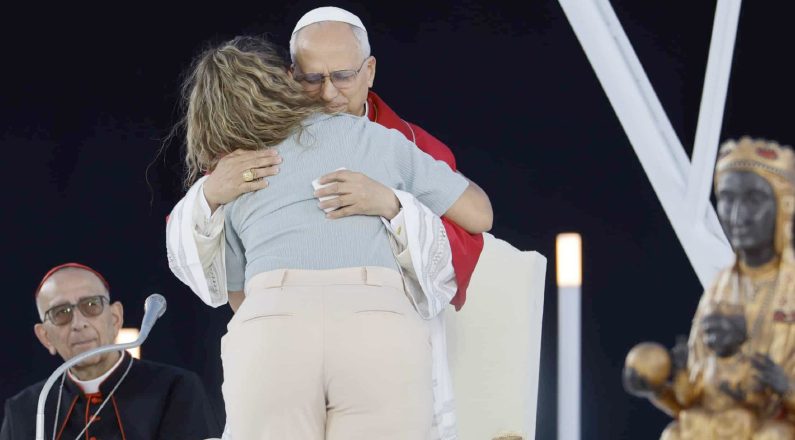
(ZENIT News / Barcelona, 06.08.2026).- During the prayer vigil with faithful from the Catalan dioceses, held on the evening of Monday, June 8, at the Olympic Stadium in Barcelona, Carmina, a Catalan high school teacher and suicide survivor, shared her testimony and asked the Holy Father a couple of questions regarding depression and mental health. Below, we present both the question and Pope Leo XIV’s very interesting response, translated into English:
***
Question: Holy Father, in a world where so many things are shouted from the rooftops, there are aspects of life that remain hidden in silence and shame, such as depression, a silent illness that affects many people — both young and old — and brings with it darkness, isolation and immeasurable pain. Sometimes, the pain is so overwhelming that the idea of disappearing seems like the only way out. I myself struggled to overcome this illness in silence for years, and one Friday night I lost the battle and tried to take my own life. I am here because God gave me a second chance, and I will be eternally grateful to him, but there are many others who continue to face this darkness. That is why I ask you with all my heart: Where can we see God when the darkness is absolute and we cannot take it anymore? How can we trust in God when it seems that nothing — not even our own life — is worth it?
***
Response from Pope Leo XIV:
First of all, thank you for sharing your experience of suffering with us today. I am moved that you are able to speak about it, that you are here among us and that you have found the strength to embrace this second chance that the Lord has given you. You have risen and continued your journey, and this is a remarkable miracle that we see in many Gospel passages. Through contact with Jesus, even those who feel lost regain confidence in life; healed of their illness, they can rise to live again.
In your question, you first referred to depression as a “silent illness.” It is important to recognize how mental health is increasingly threatened in the context of societies that consider themselves advanced. This is a sign that there is something deeply wrong with a certain notion of progress that subjects people to pressures, expectations and tensions that compromise healthy balances. For this reason, we need a healthcare system that prioritizes this invisible and widespread malaise, which also affects young people.
Your words, however, have also shown us that suffering tests our faith and the meaning we give to life. This is true for everyone, not just for those who at some point face the trial of illness.
As I listened to you, I thought of the hours of darkness, anguish and pain that Jesus experienced as the hour of his death drew near. The Gospels, in the accounts of the Last Supper and the prayer in Gethsemane, emphasize that evening was falling and that night was coming. Shortly before his death on the cross, we read that “darkness came over the whole land.” But, in reality, this was not merely a matter of personal suffering. The Son of God took all the anguish, loneliness and suffering of humanity upon himself, in his own flesh. In those dark hours, as he was dying on the cross, Jesus shared our pain and revealed to us the face of a compassionate God, who bears our sorrows, who suffers with us, weeps our tears and remains at our side with his presence full of love and mercy.
Going through this experience is difficult, as Sacred Scripture attests time and again. There are moments of darkness and suffering that our society silences because certain cultural norms demand that we always be victorious and perfect, and so our limitations, fragility and pain must be eliminated or confined to the deafening silence of loneliness or even shame. And in these moments, we may instinctively think that God has abandoned us as well. However, the cross of Jesus tells us that God does not abandon us, that he is at our side, crucified with us in moments of pain and extreme loneliness, that he gathers not only our tears but also the cry of our suffering that others do not hear — a cry that Jesus made his own on the cross, saying, “My God, my God, why have you forsaken me?”
In a catechesis on the final hours of Jesus, Benedict XVI says that his suffering becomes a cry of prayer, and this is true for us as well: in the face of the most difficult and painful situations, when God seems absent, we must entrust to him once again the burdens we carry in our hearts, even crying out to him, even protesting like Job, confident that in some way he is present and near even when he appears to be silent. But I believe we cannot do this alone. In times of pain, at least as much as possible, we must open ourselves to someone who can help us utter a simple prayer, who can accompany us with discretion without rushing to explain that pain, who can take us by the hand and lead us out of this cry.
These experiences also offer a message to us believers, to the whole Church: we must not spiritualize pain, superficially attributing it to “God’s will” or to some mysterious plan of his, because this risks minimizing that suffering, silencing it and hurting people. God does not want suffering. He carries it with us and invites us to trust in him with perseverance. Let us remember what Pope Francis said: with God, life is always reborn.
Thank you for reading our content. If you would like to receive ZENIT’s daily e-mail news, you can subscribe for free through this link.

Publicaciones relacionadas:
 The Pope’s ecumenical and interfaith message in Lebanon
 Second setback for the previous pontificate: Pope Leo repeals Pope Francis’ financial measure
 13 new ambassadors are presented to the Pope, who tells them that the Holy See will not be a spectator in human rights violations
 Pope Leo speaks with Israeli president and reiterates condemnation of anti-Semitism
