

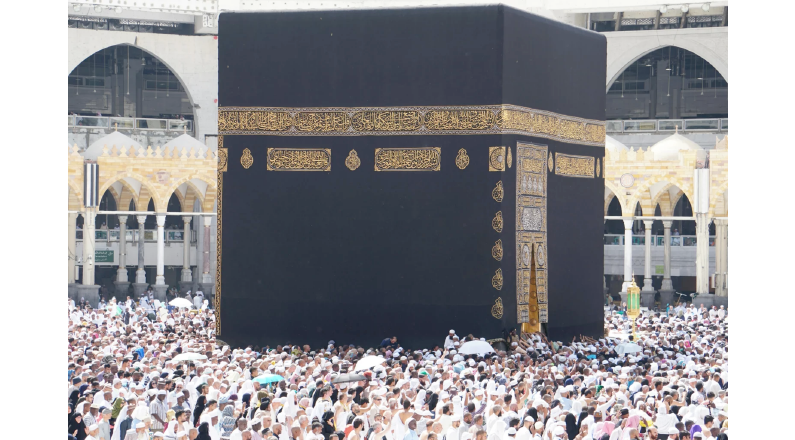
(ZENIT News / Paris, 07.18.2026).- For centuries, Christians have grown accustomed to seeing their faith examined under the lens of archaeology, textual criticism and historiography. The Church has never feared this scrutiny; in fact, it has often welcomed it, confident that truth—historical and theological—ultimately converges. What is striking today is that similar questions are finally being asked of other world religions, including Islam, whose origins have long been treated as historically settled. A new wave of scholarship suggests that this certainty may no longer hold.
One of the most provocative contributions comes from French historian Odon Lafontaine, whose forthcoming book argues that the Mecca described in Islamic tradition does not correspond to any identifiable city of the 7th century. According to his research, the environment of Mecca—arid, resource‑poor and lacking the agricultural and commercial features mentioned in the Qur’an—could not have supported a significant settlement at the time of Muhammad. Lafontaine also highlights the absence of archaeological or documentary evidence confirming Mecca’s central role during the Prophet’s lifetime. His thesis is bold: the Mecca of Islamic origins may be a later construction, shaped by political needs rather than historical memory.
This idea is not entirely new, but it is gaining renewed attention thanks to scholars such as Rémi Brague, one of Europe’s most respected historians of religion. Brague notes that Saudi archaeologists have found no material remains in Mecca predating the 9th century, a gap difficult to reconcile with the city’s supposed prominence two centuries earlier. He also recalls the work of Patricia Crone, who observed that the Qur’an refers to landscapes, crops and events incompatible with the Hijaz region. Instead, the text seems to evoke areas closer to the Mediterranean and the Holy Land—an observation that, if confirmed, would reshape our understanding of Islam’s geographical cradle.
Both Lafontaine and Brague point to the same possibility: that early caliphs, seeking to consolidate religious and political authority, gradually anchored Islam’s origins to Mecca, transforming what may have been a minor sanctuary into the epicentre of a vast religious tradition. Such a process would not be unprecedented. Throughout history, rulers have often shaped sacred geography to reinforce legitimacy, from imperial Rome to medieval Christendom. The difference here is that the implications touch a global community of more than a billion believers.
Yet Brague urges caution. Questioning the historical narrative of Islam’s beginnings does not invalidate Muslim faith, which rests primarily on the theological message of the Qur’an rather than on archaeological certainties. Many Christians understand this distinction well: the spiritual truth of Revelation does not depend on every historical detail being verifiable. Still, Brague suggests that Muslims could benefit from engaging more openly with historical research, especially now that the traditional narrative appears increasingly difficult to sustain. At present, scholars agree on one point only: the classical account of Islam’s origins cannot be upheld as historically reliable. What remains missing is a coherent alternative reconstruction capable of earning broad academic consensus.
This emerging debate is not an attack on Islam. It is part of a wider and necessary effort to understand the past with intellectual honesty. Just as Christians have long confronted challenging historical questions—sometimes painfully—other religions also deserve the opportunity to explore their origins without fear. Truth, after all, is not the enemy of faith. It is its most demanding companion.
The discussion surrounding Mecca’s historical status will undoubtedly continue, and perhaps intensify, in the coming years. Whether it leads to a new understanding of Islam’s beginnings or simply to a more nuanced appreciation of its early development, it marks a significant moment: the opening of a conversation long overdue, and essential for anyone committed to genuine interreligious dialogue and the pursuit of historical truth.
Thank you for reading our content. If you would like to receive ZENIT’s daily e-mail news, you can subscribe for free through this link.

Publicaciones relacionadas:
 French government security office confirms that Christians in the country are being targeted by Islamism
 What about feminism? Mexico declares the use of Islamic veils in official document photos legal
 Trump announces the killing of the second-in-command of the Islamic State in Nigeria
 Threats of Islamist attacks come to light during Pope Leo XIV’s visit to Spain
