

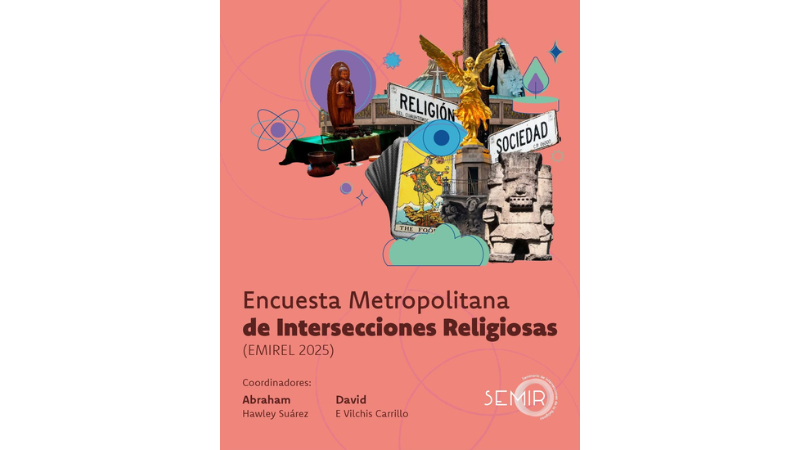
(ZENIT News / Mexico City, 11.23.2026).- Catholicism remains the largest religious affiliation in Mexico City, but its dominance is increasingly challenged by the growth of evangelical and Protestant communities, people without religious affiliation, and a wider range of spiritual identities. The shift also reveals a city where religious belief remains widespread even as traditional institutional ties weaken.
According to the Metropolitan Survey of Religious Intersections (EMIREL 2025), conducted by the Seminar on Religious Intersections (SEMIR), 63.19% of Mexico City residents identify as Catholic, while 13.79% identify as Protestant, evangelical or biblical Christians, and 11.64% say they have no religious affiliation.
The survey also records 3.28% associated with alternative or marginalized spiritualities, 3.74% who describe themselves as believers without belonging to a religion, and 3.53% who identify as secular, including atheists, agnostics and freethinkers. The findings point to a religious landscape that is no longer adequately described by the traditional division between Catholics and non-Catholics.
The decline in Catholic affiliation has been visible over time. According to Mexico’s national statistics institute, INEGI, Catholics represented 82.5% of the capital’s population in 2010, falling to 75.9% in 2020. EMIREL’s 2025 findings suggest the downward trend has continued, although its methodology differs from that of the national census and the figures should not be treated as a directly comparable statistical series.
The expansion of evangelical and Protestant communities is particularly significant given their differing religious and moral outlooks. The survey found substantial gaps between Catholics and evangelicals on questions such as same-sex marriage and abortion legalization. Support for same-sex marriage stood at 53.64% among Catholics, compared with 33.63% among Protestants and evangelicals, and 80% among secular respondents. On abortion legalization, support was 49.17% among Catholics, 35.58% among Protestants and evangelicals, and 80% among secular respondents.
These differences illustrate how religious affiliation continues to shape public attitudes toward family, sexuality and the protection of unborn life, even in a society where secular perspectives have gained considerable ground. They also suggest that the growth of evangelical communities may bring a more visible presence to religiously conservative positions in the capital’s public debate.
Yet the survey’s findings challenge the assumption that those who leave organized religion necessarily abandon belief in God or spirituality. Among respondents who identify as having no religion, 39.67% believe in a single God, 51.08% in a higher power and 58.53% in karma. Even among those classified as secular, 44.29% reported believing in a higher power. Institutional disengagement, therefore, does not always translate into a purely secular worldview; for many, faith has become more personal, eclectic or detached from religious structures.
The survey found that 95.49% support the freedom to profess any religion, while 86.29% favor religious neutrality on the part of the state. At the same time, 63.09% oppose churches participating in the implementation of public policies, and 78.88% reject the use of religious symbols or language by political actors.
The research also highlights the vulnerability of religious minorities. Overall, 12.52% of respondents reported discrimination because of their beliefs, but the proportion rose to 41.18% among those belonging to alternative spiritualities and 38.10% among members of world religions other than the dominant traditions. The figures underscore that religious freedom involves not only the right to believe or worship, but also protection from hostility and exclusion.
EMIREL 2025 was conducted between September 1 and 20 through 1,018 representative household interviews, with a 95% confidence level. Researchers also carried out an additional exploratory sample of 220 interviews among minority religious and nonreligious communities to examine experiences that conventional surveys often overlook.
Mexico City is not simply becoming less religious. It is becoming more religiously fragmented, with traditional Catholic identity losing ground, evangelical communities expanding, and belief persisting in forms that increasingly escape institutional boundaries.
Thank you for reading our content. If you would like to receive ZENIT’s daily e-mail news, you can subscribe for free through this link.

Publicaciones relacionadas:
 Poland: Experts express serious concerns about Overbeek’s book about John Paul II
 USA: Catholics At The Top of Religions That Inspire Positive Sentiments Among the People in General
 What is the religion of the people who migrate the most? Research answers and Mexico is part of the answer
 The health (physical, mental, and spiritual) of Australian clergy in 2025: What interesting research reveals
