

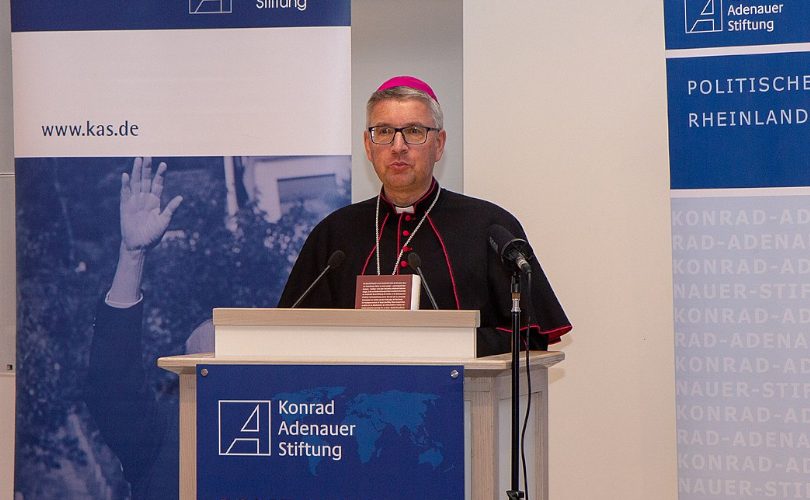
(ZENIT News / Mainz, 08.17.2026).- A new dispute over who may preach at Mass in Germany is exposing a more complicated fault line than a simple confrontation between Rome and the German Church.
Bishop Peter Kohlgraf of Mainz says he will not authorize lay preaching during the Mass. But he also says he will not discipline parishes where the practice continues, even though Rome has recently reaffirmed that the homily is reserved to priests and deacons.
The distinction may sound technical. In practice, it raises a much larger question about how universal Catholic norms are applied when local pastoral habits have developed in a different direction.
Kohlgraf’s position emerged after the Vatican rejected a request from the German bishops for an exemption allowing laypeople to preach homilies during Mass. In a June 17 letter issued in the name of Pope Leo XIV, Cardinal Arthur Roche, prefect of the Dicastery for Divine Worship and the Discipline of the Sacraments, reaffirmed the existing rule.
The provision is not a new measure aimed specifically at Germany. It is part of the Church’s universal liturgical discipline. The General Instruction of the Roman Missal states that the homily is normally given by the celebrating priest, may be entrusted to a concelebrating priest and, when appropriate, to a deacon, but not to a layperson.
Kohlgraf acknowledges that boundary.
«If a laywoman is qualified to preach, can she give the homily?» he was asked.
His answer was unequivocal: not under current Roman rules. He said neither he nor another diocesan authority could simply grant permission because canon law does not allow it.
Yet the bishop’s practical response is considerably less confrontational.
In some Mainz parishes, he acknowledged, laypeople have already become accustomed to preaching. He does not intend to encourage the practice, but neither does he plan to impose disciplinary measures when he learns that it has occurred.
«I take note» of such cases, he explained, and refers complaints to the relevant pastor or pastoral director.
That approach has effectively created an unusual middle ground: the rule remains the rule, but violations of it will not automatically produce sanctions.
Kohlgraf says this is partly because he fears that the Vatican’s reaffirmation will generate a culture of denunciation within parishes. He described receiving complaints from Catholics urging him to intervene and said that some now contact the apostolic nuncio or Rome directly.
For the bishop, the problem is not merely liturgical enforcement. It is the effect that enforcement can have on relationships inside already divided Catholic communities.
The controversy also has a historical dimension.
Germany once had an exemption allowing suitably trained laypeople to preach in certain circumstances, including school Masses. Kohlgraf noted that such arrangements existed in the 1970s and were not regarded at the time as inherently problematic. The exemption was later withdrawn.
He believes a new, carefully defined exemption could be considered.
His argument is essentially pastoral: Germany has a substantial number of lay Catholics with theological training and pastoral experience who are capable of communicating Scripture effectively. Rather than treating that expertise as a threat, he considers it a resource that could serve the Church.
«I consider it a treasure for the Church,» he said.
But this is precisely where the distinction between pastoral usefulness and canonical authority becomes important.
Kohlgraf is not claiming that his assessment overrides Rome. On the contrary, he explicitly accepts that he cannot grant the permission he would like to see restored. His position is instead that the current practice in some parishes should be tolerated without becoming a formal diocesan policy.
That leaves the bishop walking a narrow line between fidelity to universal discipline and accommodation of established local practice.
There is also a significant detail in Kohlgraf’s criticism of the Vatican’s reasoning. He suggested that if the restriction were understood to mean that only the priest presiding over Mass may preach, then a concelebrating priest or a deacon participating in the celebration should likewise be excluded.
That interpretation, however, does not accurately reflect Roche’s letter. The Vatican explicitly allows a concelebrating priest to preach and, when appropriate, permits a deacon to do so.
The distinction is important because it reveals what the Roman rule is actually regulating. The issue is not simply whether someone other than the principal celebrant may speak from the pulpit. It is whether the person delivering the homily is ordained.
For Rome, therefore, the question is tied to the sacramental and liturgical structure of the Mass, not merely to theological competence or public-speaking ability.
Kohlgraf’s preferred solution would be an exemption rather than an open conflict.
That option would allow the Church to recognize the pastoral reality in some German communities while preserving the authority of the Holy See to define the circumstances under which lay preaching could occur. Such an arrangement would also be fundamentally different from a diocesan bishop unilaterally deciding that the universal rule no longer applies.
For now, however, Rome has not granted it.
The result is an arrangement that is neither outright rebellion nor strict enforcement: the Diocese of Mainz formally accepts the prohibition, while its bishop says he will not actively suppress a practice that already exists in some parishes.
The episode also illustrates a recurring difficulty in the Catholic Church: universal law and local pastoral culture do not always evolve at the same pace.
A practice can become normal in a parish without becoming lawful in canon law. Conversely, a rule can be universally binding while its application encounters pastoral circumstances that make enforcement contentious.
Kohlgraf appears to be betting on that distinction.
He accepts Rome’s authority but argues that the Church should reconsider whether the existing discipline makes the best pastoral use of the theological resources available in Germany.
Thank you for reading our content. If you would like to receive ZENIT’s daily e-mail news, you can subscribe for free through this link.

Publicaciones relacionadas:
 Cardinal Timothy Dolan to Open President Trump’s Inauguration with Prayer
 Pope Leo XIV continues to reshape the Roman Curia: Meet the new Australian prefect of the Dicastery for Legislative Texts
 Why Is the Pope Going to Lebanon? What Is the Dialogue with Muslims Like? And What Is the Role of Charles de Foucauld? ZENIT’s Interview with the Cardinal of Algeria
 What should a bishop be like, and how should doctrinal issues be discussed, according to the Synod? The Vatican releases the findings of the synodal reports
