

(ZENIT News / Rome, 11.02.2026).- The presence of the Bill & Melinda Gates Foundation among the principal sponsors of the international interfaith gathering held in Assisi has raised questions about the consistency of the partnerships cultivated by Catholic organizations. The controversy is striking given the foundation’s extensive involvement in reproductive health programmes, contraception and family planning initiatives that conflict with fundamental elements of Catholic moral teaching.
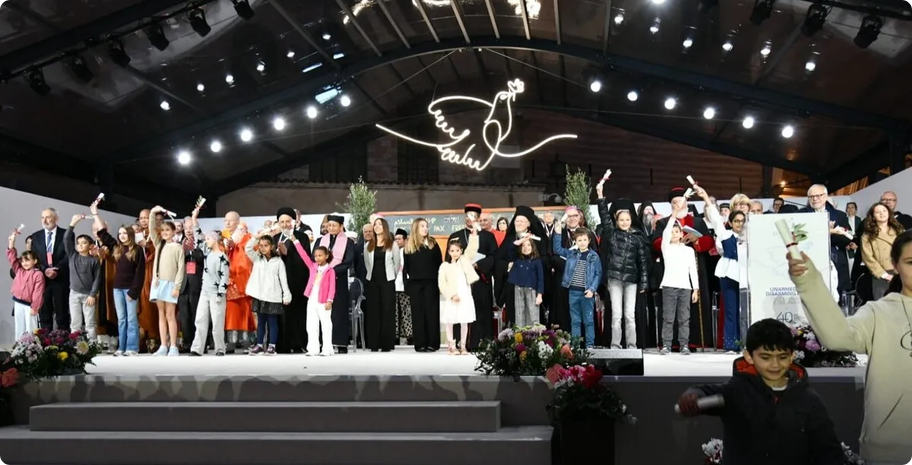
The foundation was listed in the Platinum category of sponsors at the meeting, placing it among the event’s principal financial supporters. Its logo appeared prominently on the official sponsorship display photographed and publicised by Father João Silveira on October 29. Organised by the Community of Sant’Egidio, the gathering marked the 40th anniversary of the World Day of Prayer for Peace initiated by Saint John Paul II in Assisi in 1986.
This year’s meeting brought together approximately 160 religious leaders representing Christianity, Judaism, Islam, Buddhism, Hinduism, Jainism, Shintoism and various African and American traditional religions. Pope Leo XIV, who did not travel to Assisi because of medical recommendations during his post-operative recovery, nevertheless participated through a video message broadcast on October 27. In it, he delivered a clear reminder of the Christian understanding of peace: “There is no holy war; only peace is holy.”
The Pontiff’s appeal provided the spiritual framework for an event intended to encourage dialogue across religious boundaries. Yet the identity of some of its financial backers has prompted a broader discussion about the distinction between legitimate interreligious cooperation and the risk of compromising Catholic principles.
The Gates Foundation’s involvement is especially sensitive because of its longstanding support for reproductive health programmes in developing countries, particularly in Africa. In August 2025, the organisation announced a commitment of $2.5 billion through 2030 for research and initiatives addressing women’s health, including the development of new contraceptive technologies. Its wider international activities have also included funding for family planning and organisations advocating abortion-related policies.
These priorities raise an evident question for Catholic institutions. The Church’s teaching, reaffirmed by Saint Paul VI in the 1968 encyclical Humanae Vitae, maintains that the unitive and procreative dimensions of marital relations cannot legitimately be separated through deliberate contraceptive intervention. The disagreement is therefore not simply a matter of differing approaches to healthcare, but touches on a fundamental understanding of human sexuality, marriage and the transmission of life.
One of the main sponsors of the Assisi Interreligious Meeting is the Gates Foundation. What interest would Bill and Melinda Gates have in promoting this kind of initiative?
To “commemorate” the 40th anniversary of the Assisi Meeting, convened by Pope John Paul II in 1986, Pope Leo decided to stage a new edition of that meeting, that took place yesterday in the town of Saint Francis.
According to Vatican News, around 160 “religious leaders” were present, within a larger group of 384 representatives of religions, cultures, and institutions from 53 countries. The “beliefs” represented included Christianity – Catholics, Orthodox, Protestants, etc. – Judaism, Islam, Buddhism, Hinduism, Jainism, Shintoism, and traditional African and American religions.
The Gates Foundation has a major interest in this event, to the point of being the Main Sponsor / Platinum. The Bill & Melinda Gates Foundation (along with initiatives associated with Melinda French Gates) is one of the world’s largest funders of contraception, family planning, and pro-abortion groups, especially in Africa and developing countries. Melinda Gates, who describes herself as Catholic, has publicly rejected the Church’s teaching on contraception and has channelled tens or hundreds of millions into organizations that promote abortion.
This latest Assisi Meeting also received support from the German Bishops’ Conference. Most German bishops promote the ‘Synodaler Weg’ (Synodal Path), which has proposed changes to sexual morality (including the blessing of same-sex unions), questioned mandatory clerical celibacy, advanced the ordination of women, and promoted governance structures that dilute episcopal authority.
One of the partners in this meeting was Soka Gakkai, a Japanese neo-Buddhist religious movement (based on Nichiren Buddhism) that is explicitly non-Christian. Historically, it has practised aggressive conversion methods (*shakubuku*) and has criticized Christianity as a “false” or inferior religion.
The question remains: What interest would all these people have in sponsoring an interreligious meeting – with a serious risk of leading to syncretism – in Assisi? Who benefits from religious indifferentism?
— Father João Silveira (@joaosilveiraaa) October 29, 2026
The more difficult question is whether accepting prominent sponsorship risks lending institutional credibility to an organisation whose wider agenda includes initiatives incompatible with Catholic moral teaching.
The relationship between Sant’Egidio and the Gates Foundation, however, predates the Assisi gathering by two decades. In 2006, Bill Gates pledged $200,000 annually for three years, amounting to $600,000, to support DREAM, Sant’Egidio’s programme providing HIV/AIDS treatment, nutritional assistance and medical care in African countries. That partnership had a clearly identifiable humanitarian purpose. The current sponsorship is different in nature, since it associates the foundation directly with a major religious gathering rather than a specific medical programme.
Founded in Rome in 1968 by Andrea Riccardi, Sant’Egidio has become an influential Catholic-inspired community through its work with the poor, international mediation and peace initiatives. Its involvement in diplomatic and interreligious encounters has given it an international profile, but also places particular responsibility on its organisers to ensure that dialogue does not blur essential doctrinal distinctions.
Father Silveira has questioned the interests behind the financial support for this year’s meeting, pointing not only to the Gates Foundation but also to the involvement of the German Bishops’ Conference, associated with the controversial German Synodal Way, and Soka Gakkai, a Japanese religious movement with explicitly non-Christian beliefs and a history of criticism of Christianity. He warned that such alliances could encourage religious indifferentism: the notion that all religions are equally valid paths to God.
This concern has a long history in Catholic theology. Several popes, including Gregory XVI and Pius IX, condemned religious indifferentism, while Pius XI addressed the issue explicitly in his 1928 encyclical Mortalium Animos. The distinction remains important today: the Catholic Church recognises the value of dialogue, cooperation and mutual respect between believers, but does not regard religious differences as irrelevant or all religious claims as doctrinally equivalent.
Indeed, the original Assisi initiative of 1986 was intended to bring religious leaders together in prayer for peace, not to establish a common religion. Its legacy therefore requires a careful distinction between working together to prevent violence and suggesting that theological differences can be set aside in the pursuit of unity.
There are also unanswered questions concerning the financial arrangements behind the latest gathering. The organisers have not disclosed the amount contributed by the Gates Foundation or whether its sponsorship involved specific commitments or conditions. Joanne Driels, the foundation’s head of global policy and institutional relations, defended cooperation with religious communities in the field of healthcare during the event.
Thank you for reading our content. If you would like to receive ZENIT’s daily e-mail news, you can subscribe for free through this link.

Publicaciones relacionadas:
 Pope Francis Breaks His Silence on Nicaragua and Speaks Out Clearly from Saint Peter’s Square in the Vatican
 Miracle of Faith in Iraq: 1,700 Young People Take Part in Catholic Festival
 USA: Family Foundation Donates US$150 Million to Strengthen Catholic Schools in Indiana
 The state of ecclesiastical marriage in a Catholic European country: Italy
