

(ZENIT News / Taranto, 08.17.2026).- In Konotopie, a Polish village so small that barely 120 people live there, the latest symbol of Catholic Poland is impossible to miss.
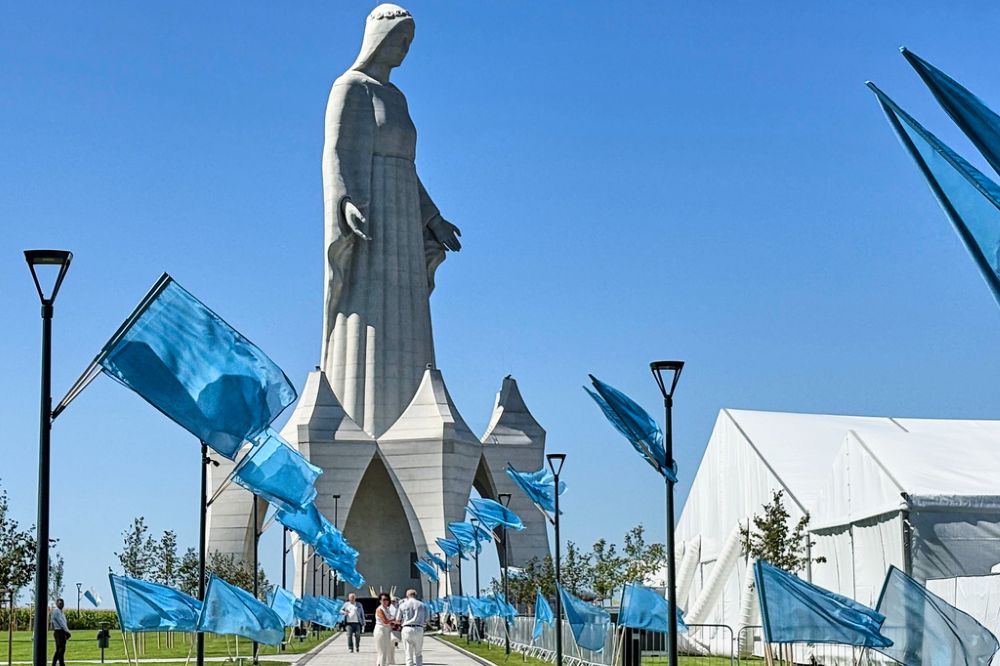
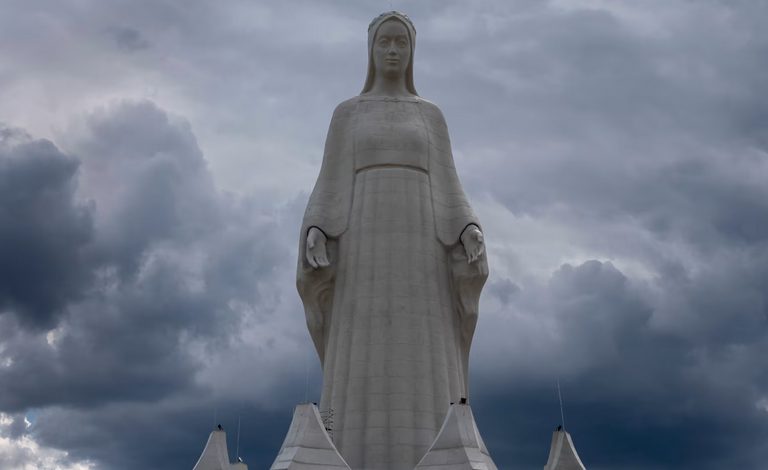
On August 15, the solemnity of the Assumption, the Church inaugurated a 55.6-metre statue of Our Lady of Mercy, now regarded as the tallest Marian monument in Europe. Conceived as an expression of gratitude by entrepreneurs Roman and Grażyna Karkosik, the enormous figure rises above the countryside of the Diocese of Włocławek, close to a chapel already associated with Marian pilgrimage.
Its scale is striking. Its location may be even more revealing.
The monument has appeared in a country where Catholicism remains deeply woven into national memory but where religious practice and institutional influence have been weakening, particularly among younger and urban Poles. In that sense, Konotopie is more than another monumental religious attraction. It raises a question about what remains of Poland’s distinctive Catholic identity when the generation that inherited the faith of the communist era is gradually being replaced.
Few people embody that older Poland more vividly than Lech Wałęsa, the former Solidarity leader and president who attended the inauguration. At 82, he watched the statue rise in a ceremony that brought together bishops, priests, pilgrims, musicians and local residents. Wałęsa has long associated his resistance to communism with his Catholic faith and famously wore an image of the Black Madonna, the Marian icon venerated at Jasna Góra.
His presence gave the ceremony an almost circular quality. The man who helped challenge communist power with a small Marian image pinned to his clothing was now standing beneath a Marian monument taller than Rio de Janeiro’s Christ the Redeemer.
Wałęsa described the moment in deeply personal terms, recalling that his journey had begun with Mary and was now ending with Mary. The remark captured something larger than nostalgia: for many Poles of his generation, Marian devotion was not merely a private religious practice. It was intertwined with resistance, national identity and the conviction that faith could survive political domination.
The Konotopie monument belongs to a very different Poland.
The communist regime disappeared in 1989. The Catholic Church, which had played a major role in supporting the opposition, entered the new era with enormous moral authority. Poland was also the homeland of John Paul II, whose pontificate from 1978 to 2005 became inseparable from the country’s transformation.
But that inheritance is no longer uniformly secure. Bishop Wiesław Mering, who attended the ceremony, openly acknowledged the weakening of the Church and the departure of some social groups from Catholicism. Yet he also pointed to the persistence of Marian devotion, suggesting that the country’s religious history cannot be measured simply by institutional statistics.
The choice of August 15 was particularly significant. The Assumption has a prominent place in Polish Catholic life, and this year the ceremony also resonated with a series of anniversaries involving two of the country’s most influential Marian primates: Cardinal August Hlond and Cardinal Stefan Wyszyński. Eight decades ago, Wyszyński’s predecessor consecrated Poland to the Immaculate Heart of Mary at Jasna Góra before a vast crowd, while Wyszyński later renewed the country’s act of entrustment to Mary in 1956.
The new statue therefore stands within a much older Polish tradition: looking to Mary not only as an object of devotion but as a figure through whom believers understand national endurance, suffering, hope and dependence on God.
That was precisely the theological emphasis of Bishop Krzysztof Wętkowski during the inauguration. After the Rosary, he celebrated Mass with several priests and fellow bishops and urged those present to raise their gaze beyond the immediate world around them. The message was deliberately countercultural: human beings, he argued, do not become greater by eliminating God from their horizon.
The title chosen for the monument adds another layer. Our Lady of Mercy connects Konotopie with the spiritual landscape of the Diocese of Włocławek, the birthplace of St. Faustina Kowalska, whose message of Divine Mercy became one of the most recognizable expressions of modern Polish Catholic spirituality. Wętkowski used that connection to insist that mercy must not remain an idea but become visible in words and actions.
The monument itself is engineered on a remarkable scale. Approximately 2,500 cubic metres of concrete were used in its construction, reinforced by a steel structure designed to withstand strong local winds. Eight crown-shaped pillars surround the base, whose structure also incorporates a viewing platform approximately 15.3 metres above ground. The project took about 18 months to complete, while estimates cited in the supplied material place its cost at around 23 million euros.
It is not the world’s tallest Marian monument. That distinction belongs to the 98-metre Mother of All Asia in the Philippines. Nor is Poland the only country where enormous statues of Mary have recently become pilgrimage attractions. Brazil has a 54-metre statue in Crato and a 50-metre monument to Our Lady of Aparecida; Venezuela’s Monument to Our Lady of Peace reaches 46 metres.
But Konotopie has a particular European resonance. It is a monumental statement built not in a major city, but in a rural community where the local population is smaller than the crowds expected to visit the statue.
That is why local officials hope the project will generate pilgrimage, tourism and economic activity for the surrounding area. A viewing platform is intended to make the monument an attraction as well as a place of prayer, while residents hope visitors will bring business to shops and services in a predominantly agricultural region.
The project is not entirely free of controversy. Roman Karkosik, whose fortune was built through business and investments, has recently announced collective layoffs affecting about 200 workers at one of his metal plants, nearly half the workforce. That juxtaposition inevitably complicates the public discussion surrounding a monument presented by its sponsors primarily as an expression of gratitude to God.
Yet the Karkosiks have consistently described the statue in spiritual rather than political terms. Grażyna Karkosik has said that it should invite visitors to reflect on their lives as well as on God. In that sense, the monument’s intended audience is not necessarily the convinced Catholic alone. It is meant to become a place where people stop, look upward and think.
That may ultimately be the most interesting aspect of the project.
A 55.6-metre statue cannot reverse secularization by itself. Nor can a spectacular monument recreate the Poland of John Paul II, Solidarity or the communist era. Faith cannot be restored simply by making its symbols larger.
But neither should the monument be dismissed as merely a record-breaking construction project.
In a tiny Polish village, an enormous image of Mary now dominates the landscape. The question it poses is therefore not how tall a statue of Mary can become. It is whether the people who look up at it will still recognize what it is asking them to see.
Thank you for reading our content. If you would like to receive ZENIT’s daily e-mail news, you can subscribe for free through this link.

Publicaciones relacionadas:
 This is the largest statue of the Virgin Mary in the world, which is in Argentina
 Europe’s Largest Statue of Virgin Mary Will Be in Poland, Financed by One of the Country’s Richest Men
 Juanito.ai Takes a Bold Leap: From Guadalupan AI to Platform for Catholic Formation
 Attendance record broken at Basilica of Guadalupe on December 12, 2025. President of Mexico speaks with the Pope
