

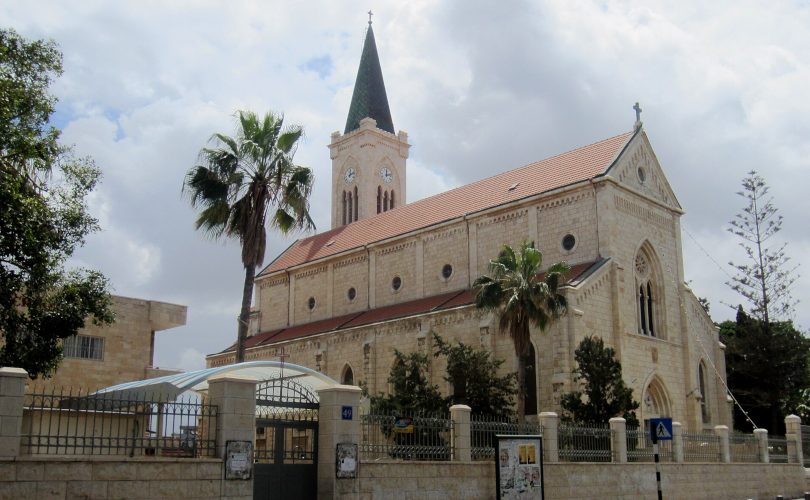
(ZENIT News / Tel Aviv, 08.21.2026).- The destruction of statues and crosses at a Catholic church in Jaffa has once again brought an increasingly uncomfortable question to the surface in Israel: how secure is the Christian presence in the Holy Land when hostility toward Christians is increasingly visible in public spaces?
Israeli police arrested a local man in his twenties on August 16 on suspicion of vandalizing the Church of St. Anthony of Padua in Jaffa, after several religious statues were found smashed and crosses broken. The suspect was identified and taken into custody for questioning. The police subsequently released photographs showing the damaged objects scattered across the church.
The arrest is important, but it does not by itself resolve the larger concern expressed by Christian leaders: whether individual acts of vandalism are being treated as isolated incidents when they form part of a broader pattern.
Data cited by the Religious Freedom Data Center, an independent Israeli organization, point to a marked increase in reported anti-Christian harassment. Between April and June alone, the organization recorded 76 incidents involving 83 acts of harassment. Spitting was the most frequently reported form, accounting for 47 incidents, followed by verbal abuse, threats, physical attacks and vandalism. Almost 90 percent occurred in Jerusalem, particularly in the Old City.
The longer trend is also striking: 107 incidents were recorded in 2024, 181 in 2025 and 120 by the middle of 2026. These figures suggest that the problem cannot simply be dismissed as a handful of isolated provocations.
Cardinal Pierbattista Pizzaballa, the Latin Patriarch of Jerusalem, has previously warned that radical elements increasingly feel protected by the prevailing political and cultural climate. Christian leaders have repeatedly complained that perpetrators are often not held properly accountable, while some cases are treated primarily as the actions of disturbed individuals rather than as deliberate hostility toward a religious community.
That concern matters because freedom of religion is not measured only by whether Christians are formally permitted to worship. It is also measured by whether they can enter churches, wear religious symbols, maintain cemeteries and conduct pilgrimages without intimidation or fear. A legal right that exists on paper but is routinely undermined by harassment is a fragile form of religious freedom.
The Jaffa incident is particularly significant because the damaged building is a Catholic parish belonging to the Latin Patriarchate of Jerusalem and serving a local Christian community. The attack therefore struck not simply at works of religious art, but at a place in which a minority community gathers for worship.
The problem extends beyond Israel’s Mediterranean cities. Christian leaders in the Holy Land have also raised alarms about attacks and intimidation against Palestinian Christians in the West Bank, including incidents affecting the Christian community of Taybeh. In those cases, church authorities have accused local authorities of failing to enforce laws adequately and of allowing settler violence to continue with insufficient consequences.
These accusations should not be confused with a judgment on Israeli society as a whole. Nor should attacks by extremists be used to erase the legitimate security concerns faced by Israel or the violence perpetrated by other armed actors in the region. But precisely because Israel presents itself as a democratic state committed to religious freedom, attacks on Christians require an especially firm response from law-enforcement authorities.
The Christian presence in the Holy Land is small but historically significant. Churches, monasteries, schools, cemeteries and pilgrimage sites are part of a religious heritage shared by the wider world. When they are vandalized, the damage is therefore both local and symbolic.
The figures supplied by the Israeli religious-freedom monitoring organization also point to a problem of normalization. If harassment becomes routine — if spitting, insults, threats and vandalism are accepted as unpleasant but inevitable features of public life — the effect can be cumulative even when individual incidents appear minor.
For Christians living in the Holy Land, the issue is consequently not only the protection of buildings. It is the right to remain visibly Christian without being treated as a target.
The arrest in Jaffa offers one positive element: authorities identified a suspect and acted quickly. The more consequential test will be whether such enforcement becomes consistent enough to deter future attacks.
For the Catholic Church and other Christian communities, the principle at stake is straightforward. Religious freedom cannot depend on the goodwill of extremists. It requires the state to protect minorities, investigate attacks and ensure that those who desecrate places of worship are held accountable, regardless of their identity or ideology.
Thank you for reading our content. If you would like to receive ZENIT’s daily e-mail news, you can subscribe for free through this link.

Publicaciones relacionadas:
 Christian survivor of Islamist attack in Nigeria receives award
 Chinese Bishop Is Arrested for Celebrating Mass, Marking the Beginning of the Jubilee Year, Without the Permission of the Communist Government
 Two More Catholic Priests Are Abducted in Nigeria
 Nigeria: Fulani Militias Kill 19 Christians in Plateau Attacks
