

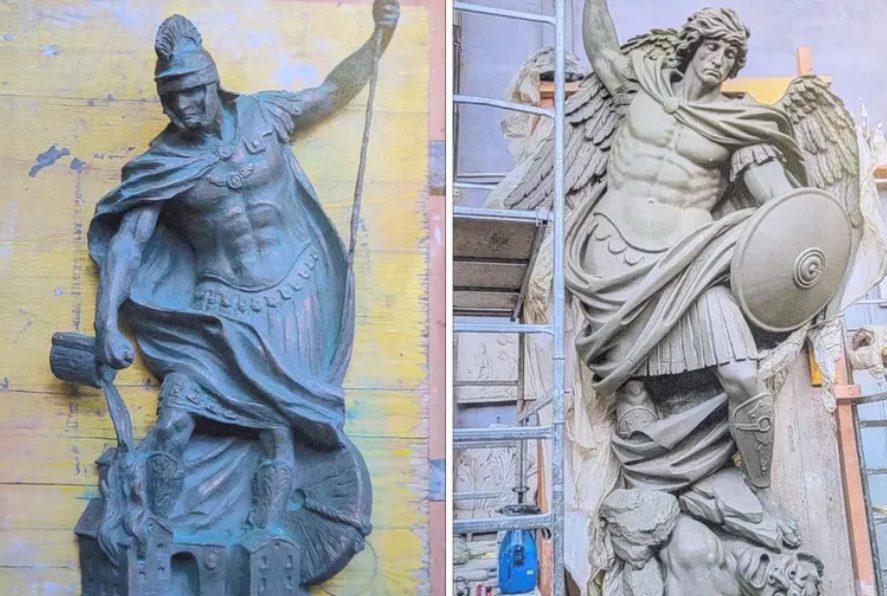
(ZENIT News / Boston, 08.24.2026).- A dispute over two bronze statues in Quincy, Massachusetts, has become an test. The Massachusetts Supreme Judicial Court has unanimously upheld a preliminary injunction preventing the city from placing three-meter statues of St. Michael the Archangel and St. Florian outside its new public safety building, ruling that their prominent display could be perceived as government endorsement of Catholicism.
The sculptures, which cost approximately $850,000 and are already completed, were selected by Quincy officials to honor police officers and firefighters. St. Michael has long been associated with police and military personnel, while St. Florian is traditionally regarded as a patron of firefighters. The city argues that their intended purpose is therefore civic rather than devotional: to commemorate the courage and sacrifice of first responders.
The court, however, focused less on that intention than on how the monuments could reasonably be perceived in their setting. In its 34-page decision of August 20, the justices noted that the statues would be large, newly installed and standing alone rather than forming part of a broader collection containing secular or religious figures from different traditions. In that context, the court concluded, members of the public could interpret them as an implicit governmental preference for one faith.
The ruling does not finally determine the fate of the statues. The case now returns to the Norfolk Superior Court, where the underlying litigation will continue, and the city could potentially seek review by the U.S. Supreme Court.
For Quincy, however, the issue is not merely architectural.
Mayor Thomas Koch and municipal officials maintain that the city was trying to recognize public servants, not promote Catholic doctrine. The city’s attorney, Joe Davis of Becket, described the ruling as disappointing but emphasized that the injunction is preliminary. Koch likewise said the city would continue seeking a lawful way to honor those who risk their lives in service of the community.
The opposing side sees precisely that public setting as the problem. Residents who challenged the project, with support from the American Civil Liberties Union of Massachusetts and other organizations, argued that placing explicitly religious figures at the entrance to a government facility could communicate that Catholicism enjoys a privileged status.
That argument prevailed at this stage, but the case exposes a more complicated question: does religious neutrality require government institutions to remove religious symbolism from public life, or does it require government to treat religious and nonreligious expression fairly without establishing a preferred faith?
That distinction matters particularly in the United States, where religious imagery has historically occupied a complicated place in civic culture. Supporters of the Quincy project point out that St. Michael and St. Florian are not simply figures appearing in Catholic devotional spaces. Both have longstanding associations with emergency services, and their imagery is used within traditions extending beyond Roman Catholicism, including Eastern Orthodoxy, Anglicanism and Lutheranism. St. Florian’s name, for example, survives in the Boston area in Florian Hall, a firefighters’ venue in Dorchester.
Critics of the ruling therefore argue that the court’s reasoning risks treating religious heritage as inherently sectarian whenever it is visible in a government setting. They also point to religiously significant works of art already displayed on public property elsewhere in Massachusetts, arguing that the Commonwealth has historically accommodated religious references without necessarily turning them into official acts of worship.
The case could have implications beyond two statues in Quincy. A genuinely pluralistic society must protect citizens from religious coercion, but religious freedom also includes the right of believers to see their traditions represented in public life. Neutrality should not automatically mean the disappearance of religious references; nor should public recognition become a mechanism for governmental preference.
The next stage of the litigation will have to confront that tension more fully. For now, St. Michael and St. Florian remain in storage rather than standing before the building they were commissioned to adorn.
The unusual irony is difficult to miss: statues chosen to symbolize courage, protection and service have themselves become the subjects of a constitutional battle over what religious freedom should look like in public space.
Thank you for reading our content. If you would like to receive ZENIT’s daily e-mail news, you can subscribe for free through this link.

Publicaciones relacionadas:
 Israel invades the famous Pater Noster church in Jerusalem and sparks diplomatic conflict with France
 USA: Court awards $12 million to Catholic woman fired for not vaccinating in COVID pandemic
 ADF honors Dr. Thomas Farr with 2024 Edwin Meese III Award
 Priests, Dissidents, and a Warning from Havana: Cuba Tightens the Screws on Voices of Conscience
