

(ZENIT News / Jerusalem, 08.27.2026).- A Jerusalem court has ended the criminal case against the Israeli man who violently attacked a French Catholic nun in the city’s Old City area in April, finding that he was experiencing a psychotic episode and was therefore not criminally responsible for his actions. The ruling has closed one legal chapter, but it has not removed the wider question raised by the assault: how secure are Christians and their places of worship in Jerusalem when hostility becomes increasingly visible?
The court’s decision on August 26 ordered Yona Simcha Schreiber, 36, to be placed in a psychiatric residential treatment facility for up to six years. The period may be shortened if psychiatric authorities conclude that his condition has sufficiently improved. The prosecution had sought his conviction for assault and hostility toward a religious group, but the judge accepted the conclusions of a psychiatric assessment that Schreiber was in a psychotic state when the attack occurred.
Reports on the psychiatric evaluation said that Schreiber had been diagnosed with schizophrenia. The assessment did not establish conclusively how his mental condition produced the assault, but concluded that his illness had influenced his behavior. The court therefore treated the case as one of criminal incapacity rather than imposing a conventional prison sentence.
That distinction matters. A finding of legal insanity is not an exoneration in the ordinary sense: the court accepted that the defendant committed the physical act, but determined that his mental state prevented him from being held criminally responsible in the same way as a mentally competent offender. His confinement is consequently intended as psychiatric treatment and public protection rather than punishment. The decision can be appealed.
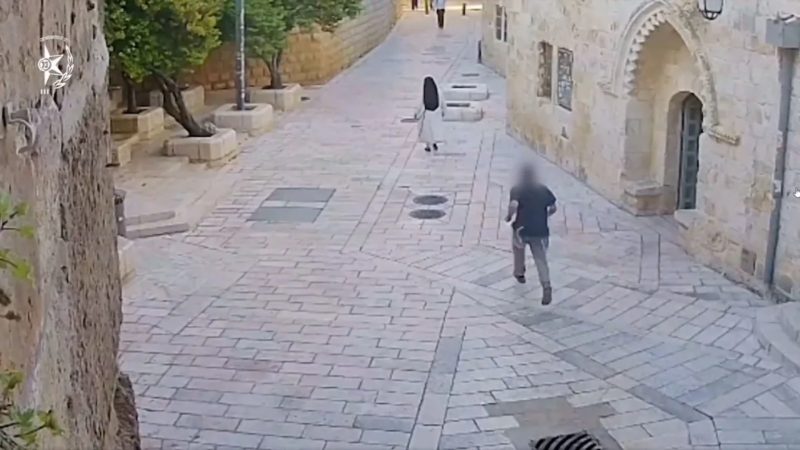
The incident itself was captured on security cameras, making it unusually difficult to dismiss as an allegation or isolated account.
On April 28, near the Tomb of David on Mount Zion, the nun, a French national and researcher at the French Biblical and Archaeological School of Jerusalem, was walking through the area when Schreiber approached her from behind. Wearing a religious habit, she was pushed violently to the ground and struck her head against a stone surface. The assailant initially walked away, then returned and kicked her before a passerby intervened.
The nun suffered bleeding injuries to her head and required medical treatment.
BREAKING: A Christian nun was attacked in the old city of Jerusalem by a Jewish extremist.
As a Jew living in Israel, I strongly condemn this disgusting crime. I commend the police that arrested the criminal and I hope he will pay the highest price.
Most people in Israel are… pic.twitter.com/zaMVBc5omQ
— Hananya Naftali (@HananyaNaftali) May 1, 2026
The location made the assault particularly sensitive. Mount Zion stands immediately beside the Old City and contains sites sacred to Jews and Christians. The French Biblical and Archaeological School, where the nun works, is one of Jerusalem’s longstanding centers for biblical and archaeological research. The attack therefore occurred not simply in an anonymous urban setting, but in a part of the city where religious identity is unusually visible and where Jewish and Christian sacred history overlap.
France condemned the assault. The French consulate in Jerusalem called for justice, while Israel’s Foreign Ministry described the incident as shameful and reaffirmed its commitment to freedom of religion and worship.
That official response is important, particularly because the case comes against a broader backdrop of concern about anti-Christian harassment in Israel.
According to a report published this year by two Israeli organizations working to promote Jewish-Christian coexistence, incidents targeting Christians increased by 63 percent in 2025. The recorded incidents ranged from verbal abuse and spitting to physical violence and damage to Christian religious symbols.
Spitting accounted for 60 percent of the reported incidents. Insults, shouting and threats represented another 18 percent, while damage to Christian religious symbols accounted for 12 percent. Physical violence made up 5 percent, desecration of Christian holy sites 3 percent, and online harassment 2 percent.
Those figures do not establish that every incident is driven by the same ideology, nor do they suggest that the psychiatric case against Schreiber can automatically be classified as religious persecution. The court’s finding of psychosis is a central fact and should not be displaced by a broader political narrative.
But that caution should not obscure the legitimate concern about the cumulative effect of apparently disparate acts.
Religious freedom is not measured only by whether governments formally permit people to attend Mass, maintain churches or conduct religious research. It also depends on whether believers can walk through the streets without being attacked because they are visibly identifiable as Christians, and whether religious minorities can maintain their presence without intimidation.
Jerusalem presents an especially demanding test because religious communities do not live alongside one another in an ordinary multicultural environment. Sacred places, historical claims and religious identities frequently intersect within a few streets. Protecting freedom of religion therefore requires more than declarations of principle; it requires consistent protection of people who are exercising that freedom.
Israel’s condemnation of the attack and its stated commitment to safeguarding religious practice are therefore significant. So is the court’s willingness to recognize a serious psychiatric disorder when determining criminal responsibility. Both principles can stand together: mental illness may explain why an individual is not criminally punishable, while the state remains responsible for ensuring that vulnerable victims and religious communities are protected.
The case also illustrates why the condition of Christians in the Holy Land cannot be assessed solely through the language of geopolitics. Christians in Jerusalem are not merely observers of a conflict between larger political forces. They are a historic community whose freedom to live, worship, work and move safely is itself part of the region’s religious landscape.
The attack on the French nun was carried out by one man. The court has determined that his mental state played a decisive role. Yet the growing statistics on anti-Christian harassment raise a broader question that no psychiatric ruling can answer: whether the social environment in which Christians live is becoming more hostile.
Thank you for reading our content. If you would like to receive ZENIT’s daily e-mail news, you can subscribe for free through this link.

Publicaciones relacionadas:
 Israel continues to attack Christians and seize land from Palestinians now in the West Bank
 Lebanon, Gaza and the Holy Land: Christians Caught Between War, Humanitarian Collapse and a Struggle for Religious Freedom
 Jews Denounce the Persecution of Christians by Radical Jews in the Holy Land: Facts, Figures, and Other Concerns
 Israel Declares the Only Entirely Christian City in the Holy Land a “Closed Military Zone”
